Introduction
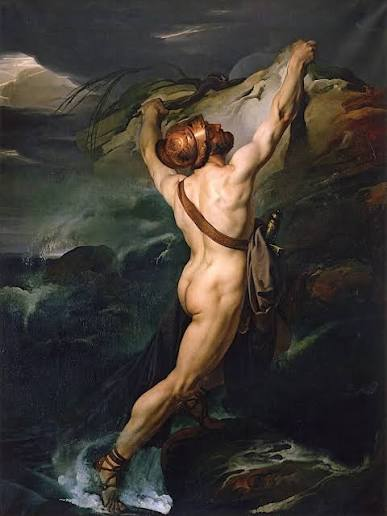
In the Homeric epics, Ajax the Lesser, king of Lokris, was celebrated as a lightning-fast warrior and peerless spearman, second in speed only to Achilles. However, his heroic legacy was permanently stained during the sack of Troy, when he dragged the prophetic princess Cassandra away from the sacred statue of Athena and violated her within the goddess's own temple. This supreme act of hubris brought a terrible, multi-generational curse upon his homeland. According to classical tradition, Ajax was struck down by Poseidon during a violent storm on his return journey, and the Lokrians were commanded by the Oracle of Delphi to send a biannual tribute of noble virgins to Troy for a thousand years to appease the wrath of Athena.
To counteract this national curse and secure the protection of their deceased, angry king, the Lokrians established a unique, highly secretive hero cult centered around a remote sanctuary known as the Temple of Lokrian Ajax. For centuries, the exact location of this cursed hero sanctuary eluded explorers, until targeted archaeological surveys identified the ruins of a specialized archaic temple complex near the ancient coastal boundaries of Lokris.
The Archaeology of Apotropaic Rituals and the Empty Throne
The excavation of the Lokrian Ajax Temple revealed an architectural and material footprint that diverged sharply from standard Greek sanctuaries. Built during the early 6th century BCE, the temple lacked a traditional central cult statue representing an Olympian god. Instead, the focus of the cella (the inner chamber) was a monumental, elaborately carved stone platform that functioned as an aniconic monument—an empty throne or couch left permanently vacant for the invisible, wandering spirit of the dead hero. This design perfectly aligns with the specific nature of a hero cult, where the deceased warrior's ghost is believed to physically inhabit the sanctuary to defend his territory.
The artifacts recovered from the temple's votive pits provide a vivid look at the apotropaic (evil-averting) rituals practiced by the Lokrians to manage their national curse. Archaeologists unearhed thousands of unique bronze miniature shields, iron spear points, and lead plaques inscribed with defensive curses and prayers for protection.
Chemical analysis of organic residues extracted from specialized sacrificial vessels (escharae) revealed heavy concentrations of wine, honey, and unrefined animal blood that had been poured directly into subterranean conduits leading beneath the temple floor. This liquid offering was designed to nourish the subterranean spirit of Ajax.
Furthermore, bioarchaeological studies of animal remains around the temple revealed a high proportion of black rams sacrificed at night, with their heads turned downward toward the earth—a classic chthonic (underworld) ritual profile that highlights the deep anxiety of the Lokrian population, who sought to keep the volatile, cursed spirit of their legendary king placated and bound to the defense of his native soil.
Conclusion
The unearthing of the Lokrian Ajax Temple provides an invaluable, tangible link between epic poetry, religious taboo, and the physical architecture of ancient Greece. It demonstrates that for the ancient Greeks, the figures of the Trojan War were not distant myths, but terrifyingly real historical ancestors whose actions could permanently alter the spiritual safety of an entire state.
By constructing a specialized sanctuary focused on an empty throne and underground blood offerings, the Lokrians successfully created a physical mechanism to contain a generational curse and transform a disgraced, sacrilegious king into a protective guardian of their frontier. Ultimately, the Lokrian Ajax Temple stands as a powerful testament to the complexity of hero worship, revealing how ancient communities utilized material culture and ritual space to navigate the dangerous boundaries between guilt, memory, and divine wrath.