Introduction
The remains of former settlements can reveal how communities built homes, organized households, managed livestock, and adapted to changes in their social and political environment. In Lesotho, the archaeological study of village ruins is particularly valuable because the country's mountainous landscape contains a wide range of settlement locations, from sheltered valleys to elevated slopes and open plateaus.
The title Mapoteng: Lesotho's Basotho Village Ruins invites an investigation into the material traces of Basotho settlement. The exact date and character of any particular ruins at Mapoteng would need to be verified through archaeological and historical research. Nevertheless, the wider study of Basotho villages offers an important way to understand the development of domestic life, community organization, and rural landscapes.
The Development of Basotho Communities
The formation of the Basotho nation took place within a period of significant regional change during the late eighteenth and early nineteenth centuries. Under Moshoeshoe I, communities facing conflict and displacement increasingly gathered under a political leadership that helped establish a durable Basotho polity.
This process did not mean that all communities immediately adopted identical ways of living. Families brought different histories, practices, and relationships into the emerging political community. Settlement patterns were shaped by local conditions, livestock ownership, agricultural opportunities, political circumstances, and access to protection.
The growth of Basotho communities also took place within a wider Southern African environment of migration, conflict, trade, and interaction. These regional developments influenced where people settled and how they organized their households.
Village ruins can potentially preserve traces of these processes, but their interpretation requires careful dating. A building associated with the nineteenth century should not automatically be described as an early Basotho structure without supporting evidence.
The Organization of a Village
A village is more than a collection of houses. Its layout can reflect relationships between households, livestock, fields, water sources, paths, and communal spaces.
Domestic buildings may be grouped closely together or distributed across a wider area. Livestock enclosures can occupy positions that provide access to grazing while keeping animals near enough for supervision. Paths may connect houses to cultivated land, water sources, meeting places, and routes leading to neighboring settlements.
These arrangements often develop gradually. A settlement may begin with a small number of households and expand as families grow, new relatives arrive, or land-use patterns change. Structures may be rebuilt in the same locations or moved as practical needs evolve.
Researchers examining Mapoteng would therefore need to establish whether visible ruins belong to a single settlement phase or represent several periods of occupation. Differences in construction methods, building orientation, and associated artefacts may help distinguish these phases.
Building Materials and Domestic Architecture
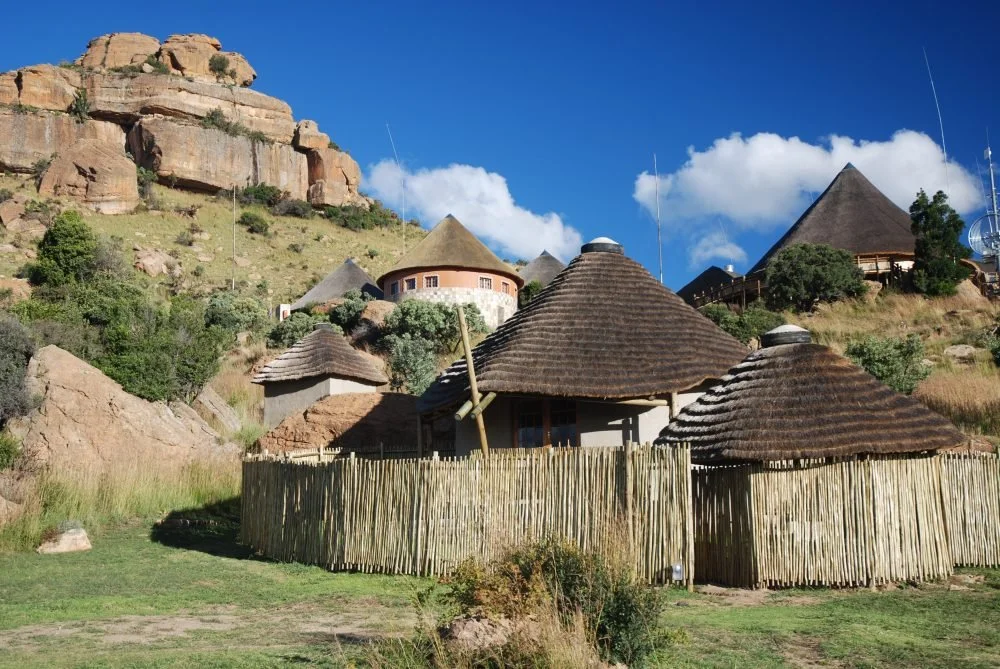
Traditional architecture in Lesotho reflects the use of locally available materials and the demands of the climate. Depending on the period and household resources, buildings may incorporate stone, earth, timber, thatch, and other materials.
Stone walls can survive after roofs and other perishable components disappear. As a result, the remains visible today may represent only part of the original building. A low stone foundation does not reveal the full height of the structure or the materials once used for its roof and upper walls.
The design of a dwelling must also be understood in relation to its use. A house may contain spaces for sleeping, cooking, storage, or other domestic activities, but these functions cannot always be identified from surviving foundations alone.
Ethnographic comparisons can help researchers develop possible interpretations, provided they recognize that architecture changes over time. A building technique used in a recent village cannot automatically be projected unchanged into a much earlier period.
Household Economies and Livestock
Livestock and cultivation have played important roles in many Basotho households. Cattle and other animals can provide food and materials, while also contributing to social relationships, wealth, and ceremonial life. Cultivated fields support household subsistence, and stored food can help families manage seasonal shortages.
A village's layout may reflect the practical demands of these activities. Enclosures, storage spaces, paths, and nearby fields can indicate how households organized their work. The proximity of a dwelling to an enclosure may suggest a connection between domestic life and livestock management, although the precise relationship requires evidence.
Not all households would have possessed the same resources. Access to land, animals, labor, and political connections could differ, affecting the size and arrangement of domestic spaces.
Archaeologists may investigate these differences through building dimensions, storage capacity, artefact assemblages, and evidence of food production. Such findings must be interpreted cautiously because the survival of archaeological materials is uneven.
Political Change and Settlement Movement
Basotho settlement history has been shaped by conflict, changing political relationships, colonial pressure, economic transformation, and environmental challenges. These factors could encourage households to move, rebuild, consolidate, or abandon particular locations.
A village may have been occupied for a relatively short period because conditions changed, or it may have developed through several generations of rebuilding. Abandonment does not necessarily mean that a settlement was destroyed in a single dramatic event.
Researchers should distinguish between evidence of deliberate destruction, gradual decline, relocation, and the ordinary deterioration of buildings. Burned material, collapsed walls, and scattered artefacts can have different explanations depending on the wider context.
Historical records may help establish the circumstances of settlement changes, while oral histories can preserve accounts of family movements and local traditions. These sources should be considered alongside archaeological evidence rather than treated as interchangeable forms of proof.
Investigating the Ruins at Mapoteng
A systematic study would map surviving structures and document their construction methods, dimensions, and relationships to the surrounding landscape. Surface artefacts could provide preliminary information about activities and possible occupation periods.
Where appropriate, controlled excavation might reveal floors, hearths, storage features, and layers of domestic refuse. Suitable charcoal or other organic materials could help establish dates. Researchers would also examine whether the ruins correspond with historical maps, written records, or local accounts.
Community participation is essential. The ruins may be connected to family histories, land rights, ancestral memories, or places that retain cultural significance. Archaeological work should respect those relationships and avoid presenting inhabited or remembered landscapes as if they were disconnected from contemporary communities.
Heritage Preservation
Village ruins can be damaged by construction, farming, erosion, vegetation, and the reuse of stone for new buildings. Their protection requires recording their location and condition, assessing development risks, and consulting local residents.
Interpretation should explain how the settlement fits into the broader history of Lesotho without claiming more certainty than the evidence permits.
Conclusion
Mapoteng's village ruins offer a valuable subject for examining Basotho domestic architecture, household economies, and settlement history. Their significance depends on understanding how buildings relate to one another, how residents used the surrounding land, and how historical events influenced patterns of occupation.
By combining archaeology, historical documentation, landscape analysis, and community knowledge, researchers can move beyond the appearance of abandoned walls to reconstruct the lives and decisions of the people who once lived there. These ruins can help preserve a more detailed understanding of Lesotho's past and the changing organization of Basotho communities.