Introduction
Salt was one of the most important resources in medieval societies. It was essential for preserving meat and fish, seasoning food, supporting livestock, and facilitating long-distance trade. Coastal communities developed a variety of salt-production techniques, including solar evaporation, seawater boiling, and the use of shallow evaporation ponds.
Although saltworks contributed to economic growth, they also transformed coastal environments. Their construction required land, water management, fuel, and labor. Examining the archaeological remains of medieval saltworks can therefore reveal not only how people produced a valuable commodity but also how industrial activity influenced coastal ecology.
The Importance of Medieval Salt Production
Before modern refrigeration, salt played a central role in food preservation. Fishing communities used it to preserve catches for transport and storage, while agricultural communities relied on salted meat and other provisions during periods when fresh food was scarce.
Salt production could become an important source of local revenue. Rulers and landowners sometimes taxed production, controlled access to salt deposits, or regulated its trade. Saltworks consequently connected coastal laborers with merchants, governments, and distant consumers.
Methods of Coastal Salt Production
Medieval salt producers used methods suited to their local environments.
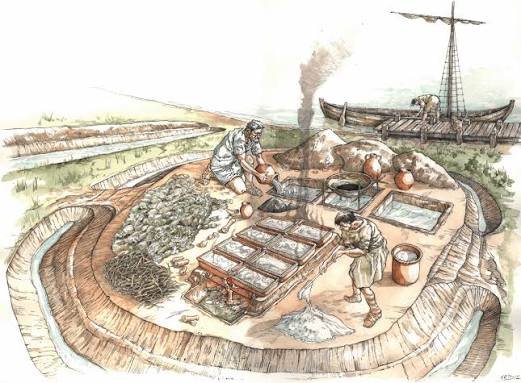
Solar evaporation relied on sunlight and wind to remove water from seawater. This method was especially effective in warm, relatively dry coastal regions. Producers directed seawater into shallow ponds, allowing evaporation to concentrate the salt until crystals could be collected.
In cooler or wetter climates, salt could be obtained by boiling brine. This required substantial fuel and specialized heating structures. Where natural salt springs existed, communities could collect concentrated brine and process it near the source.
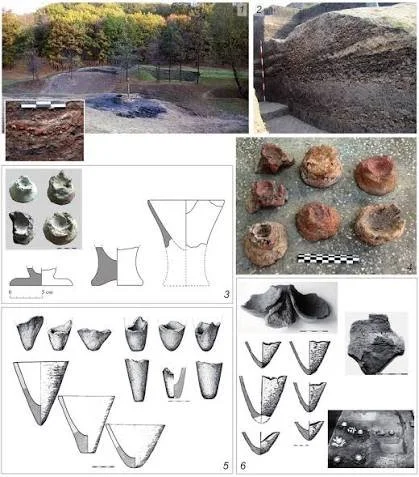
Each technique produced a different archaeological signature, including pond embankments, drainage channels, heating installations, fuel deposits, and salt-encrusted surfaces.
Changes to Coastal Landscapes
Constructing saltworks often required modifying wetlands, lagoons, tidal flats, and coastal marshes. Producers could build dikes, dig channels, redirect water, and divide broad areas into shallow ponds.
These interventions changed how water moved through the landscape. Altered drainage could influence sediment accumulation, vegetation, and the movement of nutrients. In some places, saltworks may have replaced natural marsh habitat with managed evaporation ponds.
However, environmental effects varied. Some saltworks occupied naturally saline areas where vegetation was already limited, while others required extensive alterations to productive wetlands.
Fuel Consumption and Woodland Pressure
Boiling seawater or brine required large quantities of fuel. Depending on the scale and duration of production, nearby woodlands could experience increased pressure.
Archaeologists investigate this possibility through charcoal deposits, pollen records, wood identification, and changes in local vegetation. A decline in tree pollen near a salt-production site may indicate woodland clearance, but it does not prove that salt-making was the sole cause. Agriculture, construction, grazing, and other industries could produce similar changes.
Where fuel supplies became scarce, producers might have shifted to alternative materials or obtained wood from more distant locations.
Effects on Plants and Animals
Saltworks could affect habitats by changing salinity, water depth, and the availability of food and shelter. Freshwater and brackish-water organisms might decline where water became more saline, while salt-tolerant species could become more common.
At the same time, managed ponds sometimes created habitats for particular birds and aquatic organisms. The ecological consequences were therefore not necessarily uniform or entirely destructive.
Archaeological findings must be combined with environmental evidence to determine how local ecosystems changed over time.
Archaeological Methods
Researchers can reconstruct medieval salt production through several methods:
Landscape survey: Identifies pond boundaries, embankments, channels, and former shorelines.
Sediment analysis: Reveals changes in salinity, flooding, and sediment movement.
Pollen analysis: Helps reconstruct vegetation before, during, and after production.
Charcoal analysis: Identifies fuel types and possible changes in woodland use.
Radiocarbon dating: Dates suitable organic remains associated with production.
Ceramic and structural analysis: Helps identify heating vessels, furnaces, and related installations.
No single method provides a complete picture. Strong interpretations depend on combining several independent lines of evidence.
Conclusion
Medieval saltworks were more than industrial facilities. They were managed landscapes that connected food preservation, commerce, political authority, and environmental change.
Their effects on coastal ecology depended on production methods, local climate, fuel availability, and the habitats they occupied. Some saltworks altered wetlands and increased pressure on woodlands, while others made use of naturally saline environments.
Studying these sites allows archaeologists to explore an enduring question: how did communities balance the economic benefits of resource extraction against the environmental costs of transforming the landscapes around them?