Introduction
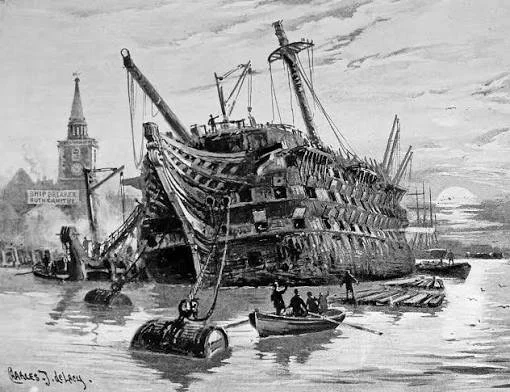
Wooden ships required enormous quantities of timber. When vessels became damaged, obsolete, or uneconomical to repair, their timbers could be reused in buildings, bridges, warehouses, and other structures.
This practice, often called timber reuse or ship-timber recycling, created a complex archaeological record. A beam in an early modern building might have originated from a ship built decades earlier, or it could have been cut from ordinary construction timber that merely resembles ship material.
Identifying reused ship timbers requires a combination of architectural investigation, wood science, historical research, and scientific dating.
Why Ship Timbers Were Reused
Shipbuilding consumed valuable resources. Large vessels contained substantial structural members, including frames, keel timbers, planks, and beams. When a ship was dismantled, many pieces remained useful.
Reusing these materials reduced the need to obtain new timber. Large curved pieces could be especially valuable because they were difficult to reproduce from straight trunks.
Timber reuse also occurred because of material shortages, local building traditions, and the availability of dismantled vessels near ports and shipyards.
Recognizing Shipbuilding Features
One of the first tasks is examining the timber's shape and construction marks.
Ship frames often contain pronounced curves that follow the hull's shape. Planks may preserve patterns of fastening holes, treenails, or corrosion stains from metal fasteners. Some timbers may also display cut marks, joints, or recesses associated with ship construction.
These features can suggest a maritime origin, but none is conclusive on its own. Curved timber was also used in roofs and other structures, while reused building materials could contain holes from earlier fasteners.
Tool Marks and Fasteners
Close examination can reveal traces of earlier construction.
Researchers may document:
Mortises and tenons.
Nail and bolt holes.
Treenail openings.
Saw marks and adze marks.
Metal corrosion staining.
Cut surfaces that interrupt earlier joints.
The sequence of these features matters. A timber may have been modified several times, first during shipbuilding, then during dismantling, and finally during architectural reuse.
Recording these relationships can help reconstruct the timber's working history.
Identifying the Wood Species
Wood anatomy can help identify the species or group of species used in a timber. Microscopic examination of the cellular structure may distinguish oak from pine, fir, or other woods, although closely related species can be difficult to separate.
Species identification provides useful information about resource selection and possible trade networks. It does not necessarily identify the location where a tree grew, because timber could be transported over long distances.
A building containing several wood species may reflect multiple construction phases or the reuse of materials from different sources.
Dendrochronology
Dendrochronology, or tree-ring dating, is one of the most useful tools for investigating historic timbers.
Trees growing in the same region often develop similar annual growth patterns in response to weather. By matching a timber's ring sequence with a regional chronology, researchers may estimate when the tree was felled.
If the outermost rings and bark edge survive, the felling date can sometimes be estimated closely. If the outer rings are missing, the date may only establish that the tree was cut after a particular year.
Even a precise felling date does not directly date a building's construction. A timber could have been stored, reused, or salvaged long after the tree was cut.
Historical and Archival Evidence
Ship registers, dockyard accounts, demolition records, property inventories, and building contracts can provide crucial context.
A record describing the dismantling of a vessel near a building site could support a reuse hypothesis. Conversely, a building account might identify a timber shipment from a forest, suggesting that the material was newly harvested rather than salvaged.
Researchers should compare documents with physical evidence rather than assuming that a historical reference describes the exact timber under investigation.
Scientific Dating and Provenance
Radiocarbon dating can help establish the age of suitable wood, especially when tree-ring dating is unavailable. However, radiocarbon results usually provide a date range rather than an exact year.
Chemical and isotopic analyses may sometimes contribute to provenance studies, but identifying the precise forest where a timber grew can be difficult. Trees from similar environments may have overlapping signatures, and historical trade complicates simple geographic assumptions.
Challenges in Interpretation
The central challenge is distinguishing ship timber from other reused wood. A curved beam with fastening holes may be suggestive, but convincing identification requires a coherent combination of features.
Researchers must also consider whether the timber was reused directly from a ship or was salvaged from a shipyard, warehouse, or earlier building. Each possibility implies a different chain of reuse.
Conclusion
Reused ship timbers offer a valuable record of early modern material economies. They reveal how communities extended the life of expensive resources and how maritime industries supplied materials to inland and coastal construction.
The strongest identifications combine visible shipbuilding features, wood anatomy, dendrochronology, archaeological context, and historical documentation. Together, these methods can turn an ordinary-looking beam into evidence of a much longer journey—from forest, to shipyard, to vessel, and finally to architecture.