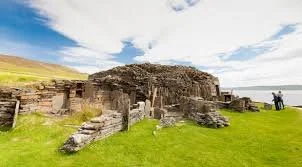
Midhowe Broch is one of Rousay's most impressive Iron Age monuments and an important example of the distinctive architectural traditions that developed in Orkney. The structure belongs to the broader family of monumental circular stone buildings that characterize Iron Age northern Scotland.
Its combination of massive stone construction, internal divisions, and relationship with the surrounding landscape provides valuable evidence for understanding architecture, settlement, social organization, and daily life during the Iron Age.
The Wheelhouse Tradition
Wheelhouses are distinctive Iron Age buildings found especially in northern Scotland.
Their defining characteristic is an interior organized around a central space with stone piers supporting or dividing the roof structure.
The term “wheelhouse” comes from the radial arrangement of these piers, which can resemble the spokes of a wheel when viewed from above.
This architecture demonstrates a sophisticated understanding of structural engineering.
Midhowe and Broch Architecture
Midhowe is associated with the broader broch tradition.
Brochs were characterized by thick circular walls and complex internal spaces.
The combination of monumental outer architecture and carefully organized internal areas demonstrates that Iron Age builders were not simply constructing defensive shelters.
They were designing buildings with multiple functional requirements.
Engineering Achievement
Constructing Midhowe required considerable planning.
Builders had to quarry or collect stone, transport it, and arrange it into stable walls.
The circular design distributed structural forces efficiently.
The radial internal supports helped create substantial enclosed spaces while maintaining structural stability.
The engineering achievement is especially impressive given the absence of modern machinery.
Domestic Life
The structure was part of a lived environment.
Cooking, food preparation, craft production, storage, and social interaction could all occur within or around the building.
The central hearth would have been important for warmth and cooking.
Stone shelves, benches, cells, and other architectural features provided practical spaces.
Agriculture
The inhabitants depended heavily on farming.
Livestock included cattle and sheep, while cereal cultivation provided grain.
Agricultural production required substantial labor and seasonal organization.
The community would have needed to store food for winter and maintain animals throughout the year.
Marine Resources
Rousay's coastline provided access to marine resources.
Fishing, shellfish collection, and seabird exploitation could supplement farming.
The sea also allowed travel to neighboring islands.
This combination of agricultural and maritime resources was a characteristic feature of Orkney's island economy.
Social Status
The size and complexity of Midhowe raises questions about social hierarchy.
Monumental architecture can function as a statement of collective identity or individual authority.
The building may have been associated with a prominent family or community group.
Its construction demonstrates that people could mobilize labor beyond the scale required for ordinary houses.
Changing Interpretations
Archaeological interpretation of brochs has changed considerably.
Earlier scholars often emphasized military functions.
More recent interpretations recognize a wider range of possibilities.
Brochs could have been residences, community centers, storage facilities, defensive structures, symbols of authority, or combinations of these.
The archaeological evidence does not support a single universal explanation for every broch.
Preservation
Coastal and island archaeological sites face significant threats.
Weathering, erosion, vegetation growth, and human activity can damage exposed stone structures.
Preserving Midhowe therefore requires continued archaeological monitoring.
Digital recording can create detailed records that remain valuable even if parts of the monument deteriorate.
Conclusion
Midhowe Broch demonstrates the architectural sophistication of Iron Age Rousay.
Its circular construction, complex internal organization, and relationship with the surrounding agricultural and maritime landscape reveal a society capable of advanced engineering and substantial social coordination.
The monument is important not only because of its impressive stonework but because it provides evidence for the people who designed, constructed, inhabited, and maintained it.
Through Midhowe, the Iron Age of Rousay becomes a tangible world of farmers, craftspeople, sailors, households, communities, and leaders whose architecture still dominates the landscape.