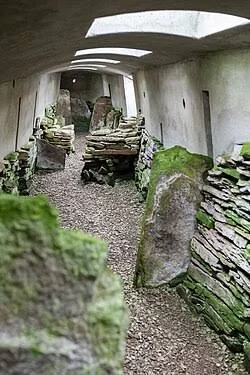
The cairn at Blackhammar belongs to Rousay's extensive prehistoric funerary landscape. Cairns are among the most enduring archaeological monuments in Scotland, and their presence on Rousay demonstrates the long-term importance of burial, ancestry, and ceremonial activity within the island's communities.
Although cairns may appear relatively modest compared with Rousay's larger chambered tombs and Iron Age monuments, they provide valuable evidence for how prehistoric people commemorated the dead and transformed natural landscapes into places of memory.
Cairns as Monuments
A cairn is broadly a mound or structure composed primarily of stones.
Prehistoric cairns could serve several functions, including burial, commemoration, ceremonial activity, territorial marking, or combinations of these.
Their interpretation depends upon archaeological evidence and architectural context.
The Meaning of Burial Monuments
Death was not simply a biological event.
For prehistoric communities, funerary practices could reinforce relationships between individuals, families, ancestors, and the wider community.
A monument provided a permanent physical location where the dead could remain part of the social landscape.
Future generations could visit or recognize the monument.
Construction
Building a cairn required collective labor.
Stones had to be gathered and transported.
The monument then had to be carefully constructed so that it remained stable.
The labor itself may have had social importance.
Communal construction could bring together people from different households and reinforce shared identity.
Rousay's Prehistoric Landscape
Rousay contains an extraordinary concentration of prehistoric monuments.
This makes the island particularly valuable for understanding how different monuments interacted.
A cairn could be positioned in relation to settlements, agricultural fields, other burial monuments, hills, or coastal features.
The landscape was therefore an interconnected system rather than a collection of isolated sites.
Visibility and Memory
Many prehistoric monuments were deliberately placed where they could be seen.
A monument visible from a settlement or route could serve as a constant reminder of ancestors.
This may have helped establish a sense of belonging to a particular community or territory.
Archaeological Investigation
Archaeologists can investigate cairns through excavation and non-invasive survey.
Excavation may reveal burial chambers, human remains, pottery, stone tools, and construction phases.
Radiocarbon dating can establish chronology where organic material survives.
Osteological analysis of human remains can provide information about age, sex, health, diet, and sometimes mobility.
Environmental Context
Pollen, charcoal, animal bones, and soil layers can reveal the environment surrounding a monument.
Such evidence helps reconstruct how landscapes changed during and after monument construction.
Agriculture, grazing, climate change, and later land use all contributed to the modern appearance of Rousay.
Later Reuse
Prehistoric monuments were sometimes reopened or reused.
Later communities could also disturb them while farming or extracting stone.
This means that archaeological cairns often contain evidence of multiple episodes of human activity.
Conclusion
Blackhammar's cairn contributes to the understanding of Rousay's prehistoric funerary traditions.
Its importance lies in the relationship between monument construction, collective memory, ancestry, and landscape.
The cairn represents a deliberate attempt to create permanence within a changing world.
For the people who built it, the monument may have served as a physical bridge between the living and the dead. For modern archaeology, it provides evidence for how prehistoric communities understood place, identity, and remembrance.