High atop a vast, artificially leveled mountain ridge rising four hundred meters above the fertile Valley of Oaxaca stands Monte Albán, the ancient, cloud-swept capital of the Zapotec civilization. Founded around 500 BCE during the Middle Preclassic period, Monte Albán represents one of the earliest true state-level societies in Mesoamerica. Near the southwestern edge of the city’s monumental Main Plaza lies Building L, a structure that houses one of the most enigmatic, controversial, and raw artistic displays of the ancient world: the Danzantes (The Dancers). This collection of over five hundred carved stone slabs (stelae) represents the oldest and largest corpus of monumental public art in the Zapotec region, offering a chilling visual testimony to the raw political power and psychological warfare that birthed the Zapotec state.
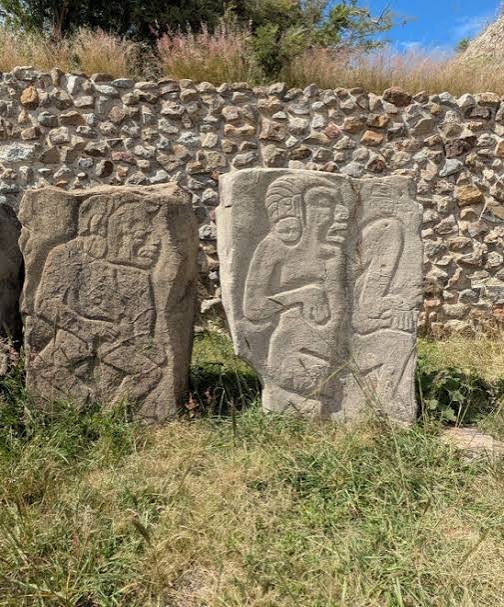
The Danzantes receive their popular modern name from early Spanish colonial and nineteenth-century explorers who viewed the figures' strange, distorted bodily postures and assumed they represented ecstatic ritual dancers, acrobatics, or individuals suffering from congenital physical deformities. However, modern archaeological science and iconographic analysis have completely dismantled this romantic interpretation. Today, historians universally recognize that these five hundred figures are not dancing at all; rather, they are a massive, public gallery of captured, tortured, and mutilated enemy leaders, chiefs, and warriors from rival towns across the Oaxaca Valley.
The artistic style of the Danzantes is remarkably fluid, low-relief carving executed directly onto large slabs of local gray limestone. The figures are uniformly depicted entirely naked, a state that in ancient Mesoamerica represented the absolute zenith of public humiliation, social degradation, and the complete stripping away of political status. Their limbs are contorted into unnatural, agonizing positions; knees are bent, arms hang limply, and heads are thrown back in expressions of intense physical suffering. Many of the figures feature closed eyes, open mouths, and limp tongues, indicating that they have already succumbed to their violent execution.
A closer look at the stone carvings reveals the brutal details of Zapotec state terror. Many of the Danzantes display deep, stylized incisions across their torsos, representing the ritual extraction of internal organs or cardiotomy. Most shockingly, several figures are depicted with elaborate scroll-like patterns flowing directly from their groins, which iconographers have identified as graphic representations of ritual emasculation and castration, a practice designed to completely eradicate the lineage and dynastic power of rival kingdoms. The blood flowing from these wounds is often stylized as flowing water or speech scrolls, turning the physical destruction of the human body into a permanent religious offering to the Zapotec gods of rain and earth.
Beyond the visceral imagery, the Danzantes hold immense linguistic importance. Several of the stone slabs feature early Zapotec hieroglyphic signs and calendar dates carved directly between the thighs or next to the heads of the victims. These glyphs represent the specific personal names of the captured lords—often named after their birthdates in the 260-day sacred calendar—serving as a permanent historical register of exactly who Monte Albán had conquered. This public naming ensured that visiting ambassadors and subjugated populations walking through the Main Plaza could visually read the concrete proofs of the city’s military dominance.
Building L was effectively an architectural wall of intimidation. By displaying five hundred mutilated bodies at the very entrance of the civic-religious core, the founding lords of Monte Albán sent an unmistakable political message to all who entered: resistance to the Zapotec state would result in total physical and spiritual obliteration. The Danzantesstand today not as a monument to aesthetic grace, but as a monument to the complex, often violent origins of primary civilization in the Americas, where stone art was weaponized as a permanent tool of psychological warfare to forge an empire among the clouds.