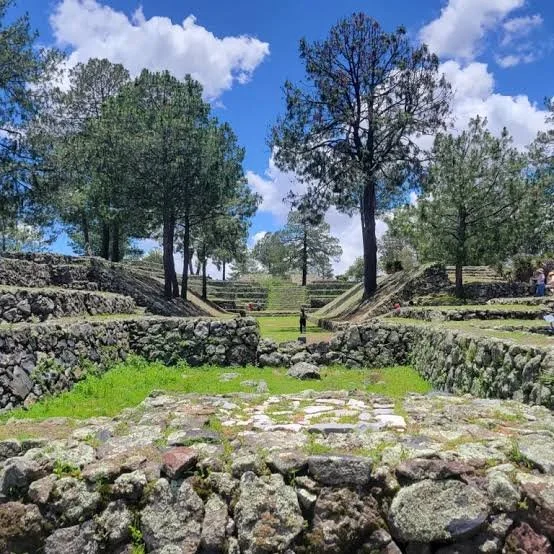
Sprawling across a vast, barren volcanic plateau in the remote, semi-arid high basin of northeast Puebla, the ancient fortress city of Cantona stands as an imposing, enigmatic marvel of Mesoamerican urban planning. Flourishing primarily during the Epiclassic period between 600 and 900 CE—a turbulent era marked by the catastrophic collapse of Teotihuacán—Cantona grew to become one of the largest and most populated cities in the Mexican highlands, covering over twenty-five square kilometers. Despite its immense size and architectural sophistication, Cantona was completely constructed without the use of any mortar or lime plaster, relying instead on a brilliant technique of dry-stone masonry (piedra sobre piedra) that gives the city a rugged, monochromatic, and heavily fortified appearance.
The defining characteristic of Cantona’s urban design is its highly complex, labyrinthine network of sunken streets and fortified walls. The city was built directly over a jagged, inhospitable volcanic lava flow known as a malpaís(badlands). Rather than leveling this uneven terrain, Cantona’s engineers integrated the black volcanic rock into their defensive strategy. They constructed over four thousand individual residential patios, each enclosed by high, thick stone walls, and connected them via a spiderweb network of narrow, deep stone alleyways. This design was highly deliberate: it allowed the city's rulers to control internal traffic perfectly, isolate different social classes, and turn the entire metropolis into a giant military maze where any invading army would be instantly trapped and ambushed in the narrow corridors.
Cantona is also globally celebrated in the field of archaeology for its unparalleled obsession with the Mesoamerican ball game. To date, excavations have revealed a staggering total of twenty-four independent ball courts scattered across the volcanic landscape, far more than any other site in Mesoamerica. Twelve of these ball courts are arranged in highly specialized, monumental architectural complexes that directly connect the sports courts to elevated civic plazas and pyramid temples. This intense concentration indicates that at Cantona, the ball game (ullamaliztli) was not merely an occasional religious ritual or athletic event, but the primary institutional mechanism for political governance, resource distribution, and ideological control.
The standard Cantona ball court features an elongated, I-shaped playing alley framed by sloping stone lateral walls and raised end zones. Unlike the smooth, plastered ball courts of Chichen Itza or El Tajín, Cantona's courts are made entirely of precisely fitted, unmortared black basalt stones. The games played here were high-stakes affairs, heavily tied to the agricultural cycle and the worship of fertility deities. The captain of the losing team—and sometimes the winning team—was often ritually decapitated at the edge of the court, their blood offered to the parched volcanic earth to ensure the coming of seasonal rains, a grim reality confirmed by the discovery of numerous human skeletal remains buried beneath the stone floors of the playing fields.
The economic engine that funded the construction of this massive, dry-stone labyrinth was the control of obsidian. Cantona was strategically positioned near the Oyameles-Zaragoza obsidian quarry, one of the largest and highest-quality sources of volcanic glass in Central Mexico. The city’s artisans weaponized this resource, manufacturing millions of razor-sharp projectile points, knives, scrapers, and ritual bloodletting blades, which were exported across Mesoamerica via complex trade routes stretching to the Gulf Coast and the Maya area. This lucrative monopoly allowed Cantona to maintain a fiercely independent, militaristic culture that successfully resisted the imperial expansion of nearby Teotihuacán.
Cantona stands today as a stark monument to human adaptation within an environmental wasteland. Stripped of the bright stucco paints and lush jungles that define other classic Mexican sites, its raw, black volcanic stone architecture offers a powerful look at an Epiclassic military state. The endless rows of unmortared stone walls and the silent, numerous ball courts remain a testament to a society that engineered safety, commerce, and profound religious ritual directly out of the jagged, frozen fire of a volcanic landscape.