Critical information about this unknown boy was destroyed during World War II.
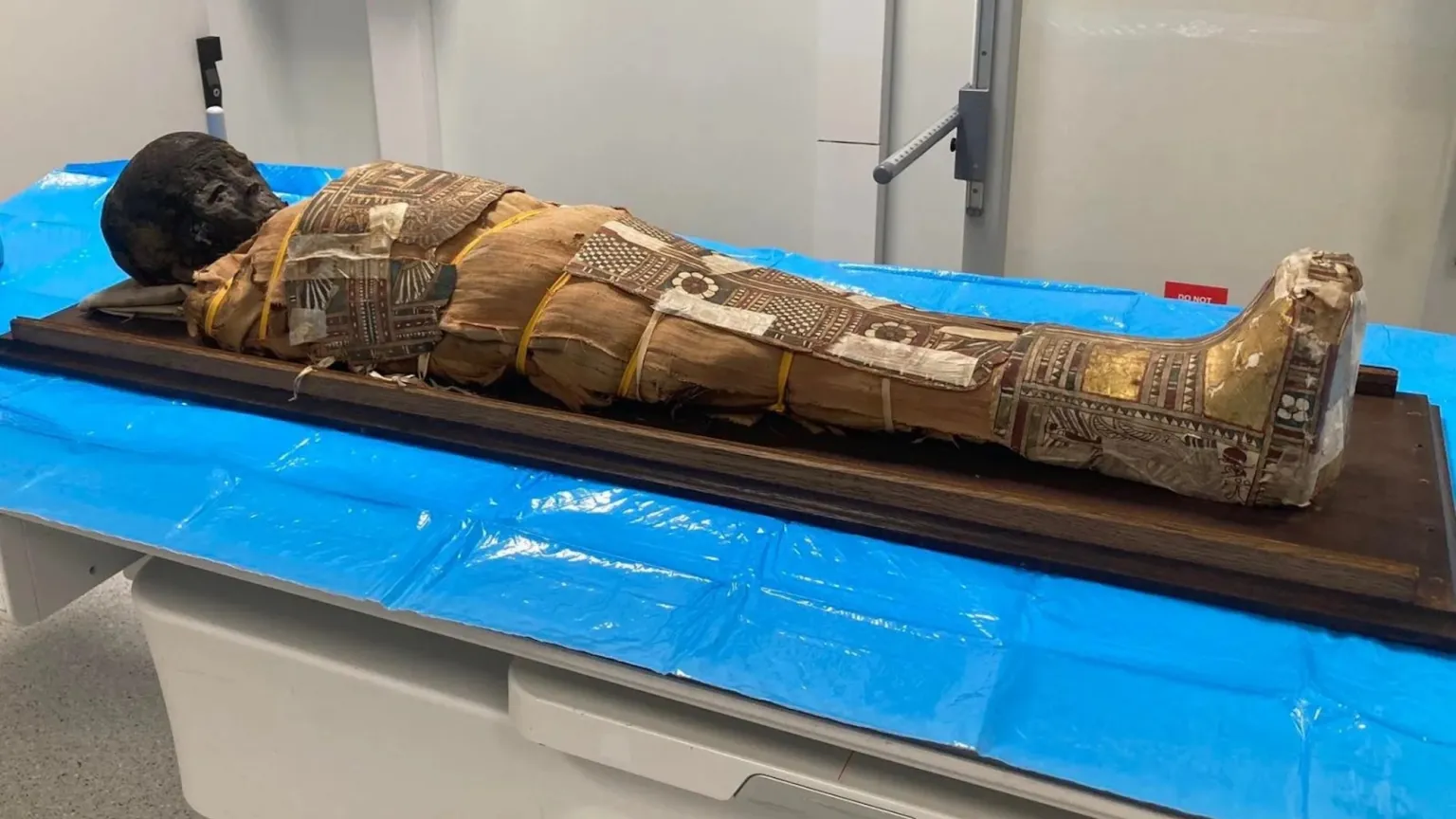
Archaeologists in Poland are gradually reconstructing the story of an ancient Egyptian child mummy whose identity was nearly lost to history. Housed in the Archdiocesan Museum in Wrocław since 1914, the mummy’s documentation disappeared during World War II, leaving researchers with little context—until now.
Modern technology meets ancient remains
A team led by Agata Kubala at the University of Wrocław began a full investigation in 2023 using:
CT scans
X-ray imaging
3D digital reconstruction
These non-invasive methods allowed researchers to study both the body and its outer casing (cartonnage) without unwrapping or damaging the mummy—a major advancement compared to older excavation techniques.
Who was the child?
From dental analysis, the team determined:
The mummy belonged to a boy around 8 years old
No clear signs of disease or trauma were found
The cause of death remains unknown
Despite this uncertainty, the burial itself reveals important social clues.
Unusual mummification methods
The boy’s body shows a mix of traditional and unusual embalming practices:
The brain was removed through the nasal cavity (standard Egyptian method)
Internal organs were extracted—but likely through the rectum, rather than the usual abdominal incision
The body was partially filled with textiles instead of heavy resin use
These variations suggest:
a non-elite but still careful burial
likely a middle-class family during the Ptolemaic Period (332–30 BCE)
This is important because it shows that mummification techniques were not uniform, but varied depending on resources and local practices.
Clues from the decorated casing (cartonnage)
The cartonnage—made of layered linen and plaster—contains rich symbolic imagery pointing to the boy’s origins.
Key motifs include:
rosettes
lotus flowers
a winged scarab
a hybrid deity figure
These elements suggest a connection to Upper Egypt, particularly regions near Kom Ombo or Aswan.
One especially intriguing figure may represent Nehebkau, a serpent god associated with protection and the afterlife.
The most mysterious discovery: an object on the chest
The most surprising find came not from the body itself, but from inside the wrappings.
Using 3D imaging, researchers identified:
a previously unknown object placed on the child’s chest
Because the mummy is too fragile to unwrap, the object remains untouched. However, researchers believe it could be:
a papyrus scroll
possibly containing the boy’s name or personal information
If confirmed, this would be extremely rare and valuable—offering a direct link to the child’s identity, something usually lost in anonymous mummies.
Why this discovery matters
This case highlights several important developments in archaeology:
1. Technology is transforming research
Non-invasive imaging allows scientists to study fragile remains without destroying them.
2. Mummification was more diverse than expected
Not all Egyptians followed the same embalming methods—social class and region mattered.
3. Identity can still be recovered
Even without historical records, objects like amulets or scrolls may preserve personal details.
4. War still impacts archaeology
The loss of records during World War II shows how modern events can permanently affect our understanding of the ancient past.