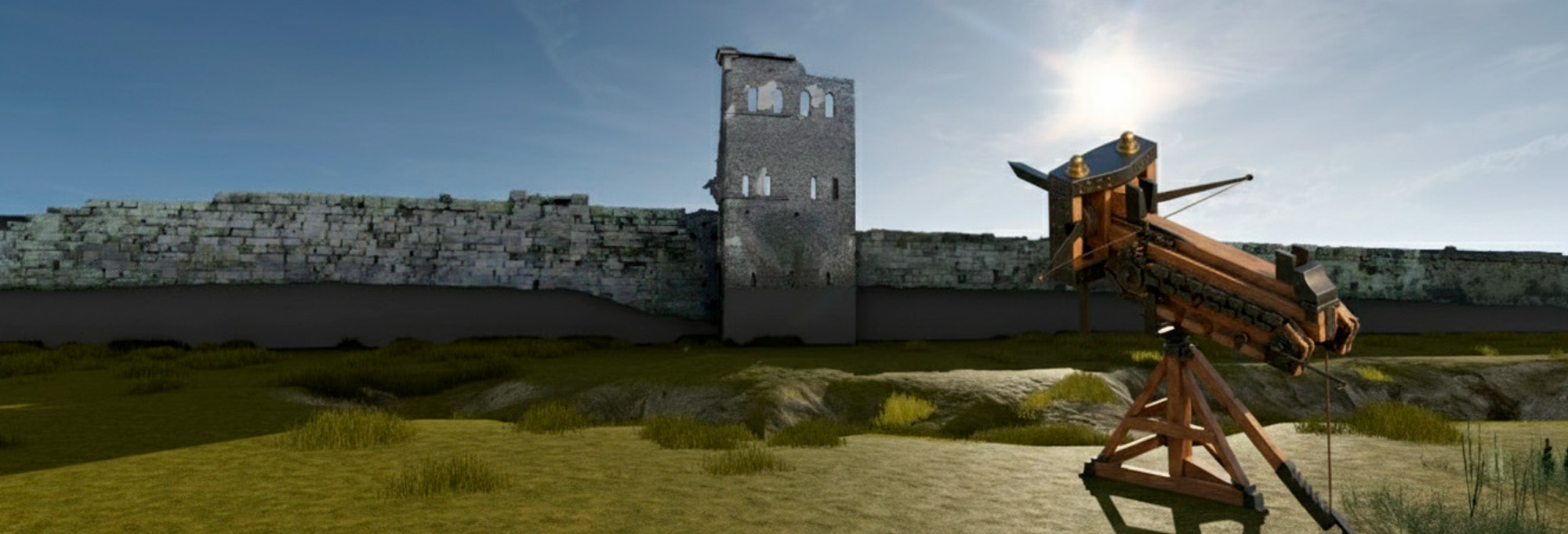
Archaeologists and engineers in Italy may have finally uncovered real evidence for one of antiquity’s most debated weapons: the polybolos, a rapid-fire mechanical catapult described over 2,000 years ago.
The polybolos—meaning “multiple thrower”—was first detailed by the ancient Greek engineer Philo of Byzantium in the 3rd century BCE. According to his account, the weapon used a chain-driven mechanism to automatically load and fire bolts in succession, making it far more advanced than typical catapults of the time. He attributed its invention to Dionysius of Alexandria. However, for centuries, the polybolos remained largely theoretical, as no clear archaeological evidence had confirmed its existence.
That may now be changing. Researchers from the University of Campania Luigi Vanvitelli and the University of Bologna have identified unusual patterns of damage in the ancient walls of Pompeii. Specifically, they found square-shaped impact holes arranged in curved, repeating sequences—a pattern that suggests controlled, rapid, and continuous firing rather than isolated projectile strikes.
These marks are concentrated near key defensive points such as the city gates, and are believed to date back to the siege of Pompeii in 89 BCE by the Roman general Lucius Cornelius Sulla. This was long before the city’s destruction by Mount Vesuvius in 79 CE, during a time when Pompeii attempted to break away from Roman rule.
To better understand the damage, researchers used digital reconstruction techniques to model the projectiles, their trajectories, and the type of weapon that could have produced them. Their findings suggest that no known conventional Roman artillery matches the observed impact patterns. Instead, the evidence aligns closely with the mechanics described for the polybolos—particularly its ability to fire bolts in rapid succession along a controlled path.
If this interpretation is correct, it would mark the first physical evidence of the polybolos, transforming it from a largely theoretical device into a confirmed piece of ancient military technology. It also suggests that Roman-era armies may have had access to more sophisticated and efficient weapons than previously believed.
While further research is still needed to confirm the findings, this discovery offers a compelling new perspective on ancient warfare—one where innovation and mechanical ingenuity played a far greater role than traditionally assumed.