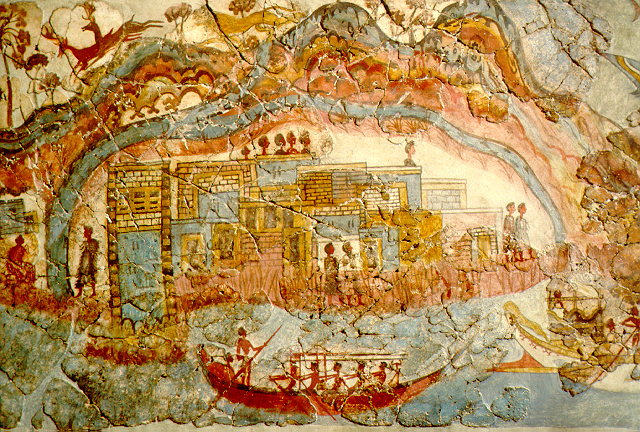
The wall paintings of Akrotiri, preserved by the volcanic eruption of Thera (modern Santorini) around the 17th century BCE, provide the most vivid evidence of the Minoan thalassocracy (maritime empire). These frescoes, specifically the "Flotilla Fresco," offer a rare, high-definition look at Bronze Age naval technology, maritime trade, and the cultural centrality of the sea to Minoan life.
The Flotilla Fresco: A Maritime Snapshot
Found in the "West House" of Akrotiri, this long, detailed mural depicts a fleet of ships traveling between coastal towns. It is a vital source for reconstructing the appearance and function of Minoan vessels.
Vessel Design: The painting depicts several types of ships, ranging from small passenger vessels to large, ceremonial galleys. The ships feature high, decorated sterns and prominent prows, often adorned with floral or avian motifs.
Propulsion: The imagery shows both rowing and sailing. While the oars are prominent, the presence of masts indicates the use of sails for longer voyages across the Aegean. The ships appear to be constructed with a clear distinction between the hull and the decorative superstructure, reflecting advanced carpentry skills.
Logistics of the Expedition: The scene is widely interpreted as a ritualized voyage or a diplomatic mission. It depicts sailors, passengers, and military-style guards, suggesting that the Minoan navy served multiple purposes: commerce, exploration, and the projection of state power across island colonies.
Landscape and Urbanism: The fresco depicts vibrant, multi-storied buildings and bustling harbors. This provides crucial archaeological data on the coastal architecture of the era, confirming that Minoan maritime hubs were sophisticated urban centers with specialized facilities for docking, loading, and public assembly.
Engineering and Nautical Nuance
The "Flying" Prow: A distinct feature of the ships in the Akrotiri paintings is the upward-curving prow. Nautical archaeologists believe this was not merely aesthetic; it served a functional role in stabilizing the ship in the choppy, unpredictable waters of the Aegean, acting similarly to a breakwater.
Hull Construction: The attention to detail in the paintings, such as the depiction of hull planks and lashings, correlates with evidence found in shipwreck sites. It suggests that the Minoans utilized shell-first construction methods, relying on meticulous joinery and tensioned lashings to create flexible, seaworthy hulls.
Ceremonial Adornment: Many ships are adorned with garlands, colorful pavilions, and figures of deities or symbols of the state. This underscores that maritime travel was deeply entwined with religious practice; the Minoan navy was effectively a vessel for both economic exchange and the transport of sacred traditions.
The Minoan Thalassocracy
Maritime Connectivity: The frescoes prove that the Minoans were not isolated on Crete. The navy connected the Aegean, Cyprus, and Egypt, facilitating a "Bronze Age Globalism" that saw the exchange of pottery, metals, and artistic styles.
Control of the Sea: The navy was the backbone of Minoan hegemony. By controlling the Aegean shipping lanes, the Minoans effectively monopolized the flow of tin and copper—essential materials for Bronze Age weaponry and tool manufacture—thereby maintaining a dominant geopolitical position.
A Vulnerable Power: Ironically, the same maritime dominance that propelled Minoan culture to its heights was also its potential weakness. The reliance on centralized naval trade hubs made the civilization particularly sensitive to natural disasters—such as the massive tsunamis triggered by the Thera eruption, which likely decimated the fleet and destroyed the harbor infrastructure depicted in the paintings.
The wall paintings of Akrotiri remain our most reliable "visual manual" for understanding the Minoan maritime world. They elevate our perception of the Minoans from a purely terrestrial agrarian society to a sophisticated, sea-faring civilization that defined the Mediterranean during the 2nd millennium BCE.