Carbon isotope ratios suggest that pre-aqueduct, the water was often contaminated with human waste
Archaeology isn’t always about glamorous discoveries like gold, jewels, or perfectly preserved swords—the kind that capture headlines. More often, researchers work with subtle clues, teasing out history from the most ordinary or overlooked materials. A striking example comes from Germany, where scientists have used Roman limescale to trace Pompeii’s ancient water supply.
Pompeii is one of archaeology’s most iconic sites. The eruption of Mount Vesuvius in 79 CE buried the city almost instantly, preserving everything—from human bodies frozen in ash to buildings adorned with vibrant murals. The ruins provide a unique snapshot of Roman life in the first century CE, capturing both its grandeur and its human tragedies.
Supplying the Roman baths
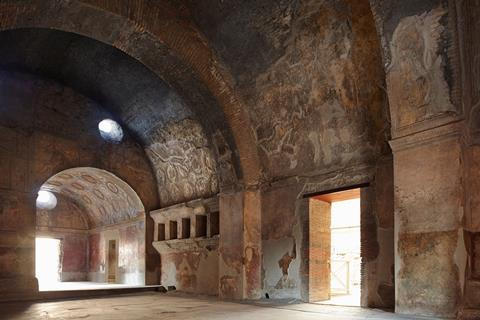
Among the city’s remains are remarkably intact bath complexes, which reveal how sophisticated public bathing was in Roman society. Pompeii had three main public baths: the Republican, Stabian, and Forum Baths. Yet water was never abundant. Before the first century CE, residents relied on deep wells—up to 40 meters—and rainwater cisterns. Even when lifted by hand-powered devices, this water was not suitable for drinking.
Around 1 CE, the Aqua Augusta aqueduct was constructed, channeling water from springs 30–40 km away. This reliable supply could provide potable water and freed the city from dependence on deep wells, causing the Republican Baths to fall out of use.
As with all natural water sources, minerals dissolved in the water formed calcium carbonate deposits—limescale—on the walls of wells, cisterns, baths, and bronze heating devices. Preserved for centuries, these deposits provide a detailed record of Pompeii’s water sources and quality over nearly 300 years, with some crusts reaching 3 cm in thickness.
Reading the chemical record
The secret lies in the water’s chemistry. By comparing modern groundwater near Pompeii with spring water from the aqueduct, researchers identified distinctive patterns. Trace metals like copper and zinc reflect the use of bronze heating equipment. More revealing, however, are the ratios of stable carbon (δ¹³C) and oxygen (δ¹⁸O) isotopes, which differ depending on the geology of the water source and microbial activity.
In the Republican Baths, δ¹³C levels drop between the well deposits and those in the baths themselves, suggesting contamination from human waste and microbes. This indicates that bath water was replaced infrequently—likely no more than once a day—making late-evening dips somewhat unpleasant.
The Stabian Baths show a similar pattern in their older sections, which were fed by wells. Later sections, however, display isotopic signatures matching the aqueduct water. This innovation allowed for more frequent water replacement, improving hygiene and overall cleanlinessall information gleaned from ancient limescale.