Introduction
The Oseberg Ship is among the most extraordinary archaeological discoveries of the Viking Age. Excavated from a large burial mound near Tønsberg in Norway, the ship contained the richly furnished burial of two women and an exceptional collection of objects.
Dating to the 9th century, the Oseberg burial provides evidence not only for Viking shipbuilding but also for elite identity, ritual, artistic production, textiles, transportation, and the social roles of women in Viking Age Scandinavia.
The term "queen's grave" is sometimes used to describe the burial, but the precise identities and political positions of the women remain uncertain. Archaeology can demonstrate their high status, but assigning a specific royal title requires caution.
The Oseberg Discovery
The burial mound was excavated in the early twentieth century.
Unlike many Viking graves that had suffered extensive looting, the Oseberg burial contained an extraordinary quantity of surviving material.
The discovery revealed a ship surrounded by grave goods and burial equipment.
The preservation was exceptional because the burial environment protected wooden and organic materials that normally decay.
The Oseberg Ship
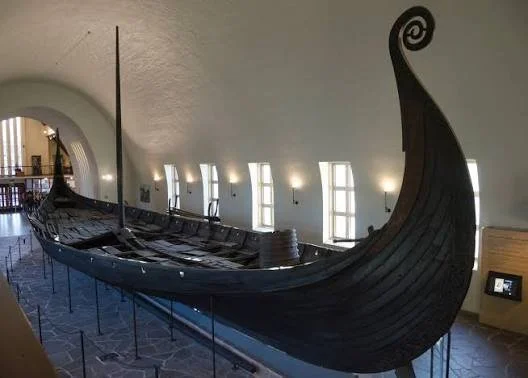
The ship itself is a masterpiece of Viking Age craftsmanship.
It was constructed using overlapping wooden planks in the clinker tradition.
The hull was relatively slender and elegant, and its construction demonstrates careful attention to both structural strength and appearance.
The vessel possessed a mast and sail as well as oar positions.
However, researchers have debated its suitability for long-distance open-water travel compared with vessels such as the Gokstad ship.
The Oseberg vessel appears particularly impressive as a ceremonial or elite ship, although it could certainly operate on water.
Elaborate Carving
One of the ship's most remarkable features is its carving.
The bow and stern are richly decorated with intricate animal ornamentation.
The carving demonstrates the sophistication of Viking Age artistic traditions.
Interwoven animals, serpentine bodies, gripping beasts, and complex geometric arrangements create a visual language that is characteristic of Scandinavian art.
The precision of the work indicates highly skilled specialist craftsmanship.
The Burial Chamber
A wooden burial chamber was constructed within the ship.
Two women were buried there.
The chamber contained textiles, furniture, equipment, and other objects.
Because organic materials usually disappear in archaeological contexts, their survival makes the Oseberg burial particularly important.
Researchers can therefore study not only metal and ceramics but also wood, textiles, leather, and other materials.
The Two Women
The identities of the women remain uncertain.
Scientific research indicates that they were adults, and their burial treatment indicates exceptionally high social status.
One of the women appears to have been older than the other.
Interpretations of their relationship and individual identities remain debated.
Some have proposed royal or aristocratic status, while others emphasize the possibility that one may have held a religious or ritual position.
The archaeological evidence does not allow every question to be answered conclusively.
Women and Viking Age Power
The Oseberg burial is particularly significant for understanding women in Viking society.
Elite women could possess wealth, receive elaborate burials, and participate in networks of political and social influence.
This does not mean that Viking society was egalitarian or that women possessed the same roles as men.
Rather, the evidence demonstrates that women could occupy positions of considerable status.
The Oseberg burial is therefore an important counterweight to interpretations of Viking history that focus exclusively on male warriors.
The Grave Goods
The burial contained an extraordinary collection of objects.
Among them were:
sledges;
carts;
wooden containers;
textiles;
agricultural and household equipment;
carved wooden objects;
animal remains;
personal and ceremonial items.
These objects provide insight into elite life.
The inclusion of sledges and carts suggests that transportation had symbolic and practical importance.
Textiles
The textiles are especially valuable.
Textile archaeology is difficult because fabric normally decays rapidly.
The Oseberg preservation environment allowed researchers to study weaving, embroidery, dyeing, and decorative techniques.
Textiles could communicate social identity.
Clothing and decorative fabrics required considerable labor, and elaborate textiles could therefore serve as visible indicators of wealth.
Ritual Interpretation
The exact purpose of the burial remains debated.
Some objects may have had practical functions, while others appear to have symbolic significance.
Animal remains and ritual objects have contributed to interpretations involving funerary ceremonies.
The burial demonstrates that Viking funerary practices could be complex and highly individualized.
The Oseberg Ship and Viking Art
The ship is also crucial for understanding Scandinavian art.
Its decoration belongs to a broader sequence of Viking artistic styles.
Researchers compare motifs from Oseberg with carvings and metalwork from other Scandinavian sites.
Such comparisons help archaeologists trace artistic developments and cultural connections.
Preservation
The survival of the Oseberg Ship required major conservation efforts.
Waterlogged archaeological wood can deteriorate rapidly once exposed to air.
Historically, preservation techniques sometimes introduced substances into the wood that later caused problems.
Modern conservation has therefore become increasingly cautious, emphasizing long-term stability and scientific monitoring.
Historical Importance
The Oseberg burial provides evidence for:
elite social organization;
women's status;
shipbuilding;
textile production;
transportation;
Viking art;
ritual practices;
woodworking;
religious culture.
Few archaeological discoveries combine so many categories of evidence.
Conclusion
The Oseberg Ship is one of the defining archaeological treasures of the Viking Age.
Its richly carved hull demonstrates exceptional craftsmanship, while its burial chamber and grave goods provide an unusually detailed picture of elite Scandinavian culture.
Although the popular description of the burial as a "queen's grave" captures its extraordinary status, the precise identities of the women remain uncertain.
That uncertainty is part of the site's importance.
The Oseberg burial reminds us that archaeology can reveal astonishingly detailed evidence while still leaving unanswered questions.
Its timber, textiles, carvings, and grave goods preserve a world that would otherwise have been largely lost—and make Oseberg one of the most powerful windows into Viking Age Scandinavia.