Introduction
The Tune Ship is one of Norway's earliest major Viking ship discoveries and an important source for understanding Scandinavian clinker-built vessels.
Discovered in a burial mound near Fredrikstad in southeastern Norway, the vessel dates to the 9th century and provides evidence for the technological development of Viking ships.
Although less complete than the famous Gokstad and Oseberg vessels, the Tune Ship remains historically significant because its surviving components reveal the construction principles that allowed Viking ships to become fast, flexible, and seaworthy.
The Viking Clinker Tradition
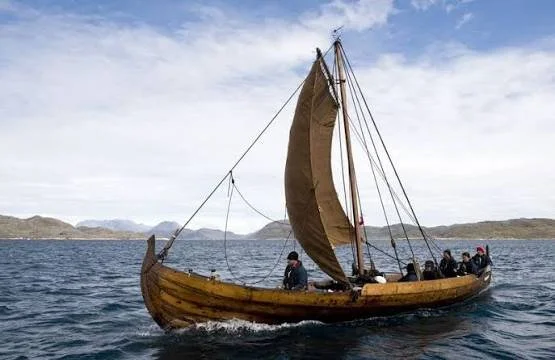
Clinker construction was a defining feature of Scandinavian shipbuilding.
Planks were arranged so that each plank overlapped the one below it.
These overlaps were secured using fasteners, producing a hull that was both strong and flexible.
The technique allowed shipbuilders to construct relatively light vessels without sacrificing structural integrity.
Why Flexibility Mattered
A completely rigid hull would be vulnerable in rough seas.
Viking ships needed to absorb waves and changing loads.
Clinker construction allowed the hull to flex slightly.
This flexibility contributed to the seaworthiness that became characteristic of Scandinavian vessels.
The Tune Burial
The ship was placed within a burial mound.
As with other Viking ship burials, this represented a significant investment.
A functioning ship was a valuable object.
Removing it from everyday use and placing it in a grave demonstrates the importance of the deceased and the symbolic value of the vessel.
The Vessel's Archaeological Importance
The Tune Ship is particularly valuable because it belongs to an early phase of Viking ship development.
Comparisons between Tune, Oseberg, and Gokstad help researchers understand how Scandinavian ship design evolved.
Differences in hull proportions, construction methods, and structural arrangements demonstrate that Viking ships were not all identical.
They were designed for different purposes.
Sail and Oar
Like other Viking vessels, the Tune Ship belonged to a technological system combining sail and oar propulsion.
Sailing provided efficient movement over longer distances when winds were favorable.
Oars provided control in narrow waterways and during periods of calm.
This dual system allowed ships to operate across varied environments.
Shipbuilding as Specialized Knowledge
Building a ship required more than simply knowing how to work wood.
Shipwrights had to understand:
hull proportions;
timber grain;
plank flexibility;
fastening systems;
weight distribution;
mast support;
steering;
hydrodynamics.
This knowledge was accumulated through experience.
A shipyard was therefore a center of specialized technological knowledge.
Ships and Social Organization
The construction of a large ship required organized labor.
Trees had to be felled and transported.
Iron fasteners had to be produced.
Wood had to be shaped.
Different components had to fit together precisely.
This required coordination and leadership.
Large ships consequently reveal something about the organizational capacity of Viking communities.
The Maritime Landscape
Southeastern Norway contained extensive waterways and access to the Skagerrak.
This made the region an important area for maritime activity.
Ships could connect inland settlements with coastal communities and wider Scandinavian networks.
The Tune Ship belongs to this interconnected maritime landscape.
The Legacy of the Tune Ship
The Tune vessel is sometimes overshadowed by its better-preserved counterparts.
Yet archaeological importance does not depend entirely on visual completeness.
Even incomplete remains can answer important technological questions.
The Tune Ship contributes to the comparative study of Viking shipbuilding and helps researchers reconstruct the development of Scandinavian maritime engineering.
Conclusion
The Tune Ship is a valuable survivor from the formative period of Viking Age maritime technology.
Its clinker-built hull reflects a construction tradition that combined flexibility, strength, and relatively low weight.
Its burial demonstrates the social and symbolic importance of ships in elite Scandinavian culture.
Although the vessel is less complete than the Oseberg or Gokstad ships, it remains essential to the archaeological record.
Together, these ships reveal that Viking maritime success was not the product of a single revolutionary invention. It was the result of generations of experimentation, craftsmanship, environmental knowledge, and cultural investment in the sea.