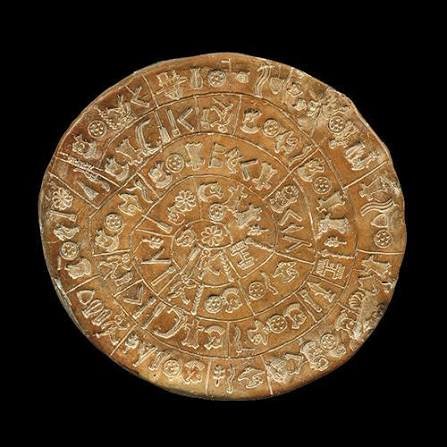
Since its excavation in 1908 from a baseline storage magazine within the Minoan palace of Phaistos, the Phaistos Disk has resisted every attempt at decipherment. The 15-centimeter-wide circle of fired clay, covered on both sides with 242 unique pictographic symbols stamped into a spiraling track, has long driven philologists to frustration. Because it represents a completely isolated linguistic sample—the world’s earliest known document created using movable type—scholars have lacked the comparative data necessary to break its code. However, a major development has emerged from a project applying advanced machine learning models to the undeciphered scripts of the Bronze Age Aegean.
The project uses a deep-learning transformer architecture specifically trained on the corpus of known Aegean scripts, particularly Linear A (the administrative script of the Minoan palaces) and Cretan Hieroglyphics. Rather than trying to directly guess the meaning of individual signs, the AI was programmed to execute a highly complex structural analysis. It treated the disk as a spatial and statistical map, analyzing the exact distribution frequencies of signs, the mathematical intervals at which specific symbols repeat, and the behavior of prefixes and suffixes across different segments of the spiral track.
The AI's processing power yielded its first major breakthrough by establishing that the syntax of the disk is not an isolated anomaly. When the model mapped the disk’s sign groups against the broader database of Linear A inscriptions found on clay administrative tablets and stone libation vessels across Crete, it identified striking structural overlaps. The algorithmic analysis showed that several recurring sign clusters on the disk match the exact prefix-root-suffix patterns found in Linear A formulas associated with sacred offerings and agricultural inventory listings.
Crucially, the AI has shed new light on the disk's internal mechanics. By analyzing the deep impressions left in the clay, the model verified the sequence of production: the scribe used pre-carved wooden or metal stamps to press the symbols into the wet clay, working from the outer rim inward toward the center. The AI also isolated several instances where the scribe made mistakes, smoothing over a sign to stamp a different one over it. These structural corrections align perfectly with the administrative corrections seen on standard Minoan palace tablets.
The computational data strongly suggests that the Phaistos Disk is not a foreign artifact imported from the Anatolian coast or a modern forgery, as some critics have argued. Instead, it appears to be a deeply indigenous product of the palatial administration, utilizing a specialized, high-status variant of the logosyllabic script system common to Bronze Age Crete. While a word-for-word translation remains a work in progress, the AI has established a firm linguistic bridge between the disk and Linear A, proving that this legendary artifact was a core component of the Minoan administrative and religious apparatus.