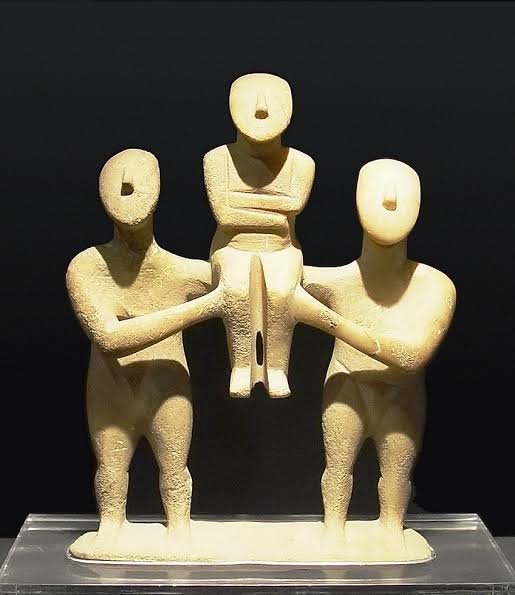
The minimalist, folded-arm marble figurines of the Early Cycladic period (c. 3200–2000 BCE) have long been celebrated as masterpieces of prehistoric art. Yet, because a vast majority of these sculptures were pulled from the ground by looters during the 19th and 20th centuries, their actual manufacturing contexts have remained an archaeological mystery. This gap has been filled by a major discovery on the island of Paros: a massive, highly organized Early Bronze Age workshop complex dedicated entirely to the industrial-scale production of Cycladic marble idols.
Located along a sloping valley just a short distance from the island’s famous underground veins of pure white, semi-translucent lychnites marble, the Paros site functions as a frozen 5,000-year-old factory floor. What makes the discovery so significant is that it preserves the entire chaîne opératoire—the complete sequence of human actions, choices, and techniques required to transform a raw stone block into a finished ritual object.
The excavation trenches have revealed thousands of stone artifacts left behind by ancient craftsmen. Among the most illuminating finds are the figurines abandoned at early or mid-stages of production. Prehistoric sculptors did not simply carve a figure out of a block; they used a highly conservative, grid-based system of geometric proportions. The unfinished pieces show how a craftsman first selected a flat, water-worn marble slab or rough quarry block, then used coarse stone chisels to block out the basic triangular silhouette of the head and the rectangular mass of the torso.
The site highlights the extreme physical difficulty and material cost of this ancient industry. Because the Cycladic islanders did not yet possess hard bronze tools capable of carving marble efficiently, the entire reduction process relied on abrasive technology. The workshop floor is dense with thousands of discarded tools made from imported materials. Master artisans used heavy percussion blocks of local basalt to knock off large fragments, followed by a meticulous scraping and grinding process using high-grade emery stone brought across the sea from Naxos.
The final, glassy smooth polish was achieved using flat rubbing stones coated with fine pumice slurry. The sheer volume of broken figurines abandoned at the workshop underscores the high failure rate of this technique. If an artisan hit a hidden fault line in the brittle Paros marble or applied too much pressure while incising the delicate groove between the folded arms, the figurine would snap, forcing them to abandon the project.
Furthermore, the workshop clarifies the role of color in Cycladic art. Soil chemistry and multi-spectral imaging of the workshop’s discard pits have turned up traces of cinnabar (a bright red mercuric sulfide) and azurite (a deep blue copper carbonate), along with tiny clay mixing palettes. These idols were never meant to be cold, white, minimalist silhouettes. Instead, the factory floor shows they were painted with bright, sometimes jarring facial features, body stripes, and complex hair patterns, presenting a vivid, multi-colored look to their original Bronze Age viewers.