The Roman Silk Trade represents the first era of true globalism. While Rome and the Han Dynasty of China were separated by over 4,000 miles and never officially met, they were linked by a complex, multi-layered network of middlemen that spanned the steppes of Central Asia and the monsoon winds of the Indian Ocean.
To the Romans, silk was more than a fabric; it was a controversial symbol of decadence, wealth, and the "moral decay" of the Republic.
1. The Seres: The Mysterious "Silk People"
The Romans called the Chinese the Seres (derived from the Greek serikos, meaning "silken"). However, Roman knowledge of China was purely speculative.
The Tree Myth: For centuries, Romans believed that silk grew on trees. The naturalist Pliny the Elder described it as a fine down "combed from the leaves of trees" in the far eastern forests.
Lack of Direct Contact: While a few Roman merchants reached the fringes of the East, and a Chinese envoy named Gan Ying attempted to reach Rome in 97 CE (he was turned back by the Parthians), the two empires remained "ghosts" to one another.
2. The Two Paths: Land and Sea
The trade operated through two primary arteries, each fraught with distinct dangers and controlled by different powers.
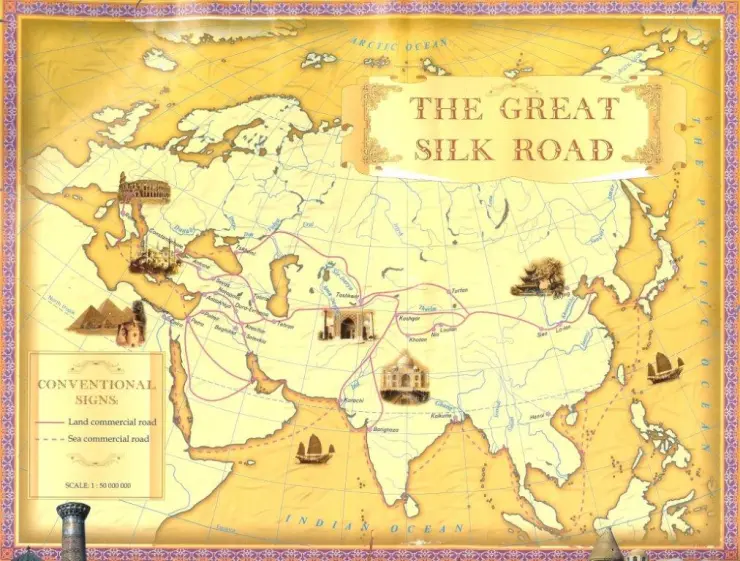
The Overland Silk Road: Goods traveled from the Chinese capital of Chang'an through the Gansu Corridor to the oasis cities of the Tarim Basin. From there, they crossed the Pamir Mountains into the hands of the Parthians and later the Sasanian Persians, who acted as the ultimate "gatekeepers," often marking up prices by 100% or more.
The Maritime Route: By the 1st century CE, Roman sailors mastered the monsoon winds. Ships would sail from Egypt across the Arabian Sea to the ports of southern India (like Muziris). There, they traded Mediterranean wine and gold for Chinese silk that had been brought south by Indian merchants.
3. The "Moral" Crisis: Silk and the Senate
When silk first arrived in Rome, it caused a sensation. Its weightless, translucent quality was unlike anything the Romans had ever seen.
The Scandal of Transparency: Moralists like Seneca the Younger complained that silk garments were so thin that they didn't actually hide a woman's body. He famously remarked that wearing silk was "hardly different from being naked."
Economic Hemorrhage: Rome was obsessed with silk but produced nothing the East wanted in return, except Gold and Silver. Pliny the Elder estimated that 100 million sesterces flowed out of the empire every year to pay for luxury goods from India and China—a massive trade deficit that contributed to Rome's long-term economic instability.
4. The "Silk War" with Persia
The Roman-Persian wars were often fueled by the silk trade. Because the Sasanians controlled the land routes, they could cut off Rome’s supply at will or tax it into oblivion.
The Byzantine Gambit: By the 6th century CE, the Eastern Roman (Byzantine) Emperor Justinian I grew tired of Persian monopolies. He attempted to bypass the Persians by making alliances with the Ethiopians to secure sea routes, but the Persians remained dominant.
5. The Great Heist: How the Secret Broke
The most famous story in the history of the silk trade is the Smuggling of the Silkworms (c. 552 CE).
The Monk Spies: According to the historian Procopius, two Nestorian monks who had lived in the East traveled to Justinian's court. They revealed that silk came from caterpillars, not trees.
The Bamboo Cane: The monks were sent back and successfully smuggled silkworm eggs and mulberry seeds out of the East hidden inside hollowed-out bamboo walking sticks.
The Monopoly Ends: This heist allowed the Byzantines to start their own silk industry in Greece and Constantinople, finally breaking the 1,000-year-old Chinese monopoly and ending the era of the "Silk Road" as the West's only source.
6. Archaeological Proof: Silk in the Graves
Archaeologists have found physical evidence of this trade at both ends of the world.
Palmyra: In the Syrian desert, tombs have revealed fragments of Chinese silk woven with local wool, showing how global materials were blended in the "middleman" cities.
Roman Glass in China: Conversely, high-quality Roman glassware has been found in Chinese tombs of the Han and Jin dynasties, proving that while Rome sent gold East, they also exported their own technical masterpieces.
The Roman silk trade proves that even in an age of horses and sailing ships, the demand for luxury was powerful enough to bridge continents.