Food preservation has played a major role in human subsistence throughout history. By extending the period during which meat and other foods could be stored safely, preservation methods allowed communities to manage seasonal shortages, transport resources, and support people who were not directly involved in food production. Salting is one such method, using salt to reduce the availability of water needed by many microorganisms and thereby slow certain forms of spoilage. The possibility of prehistoric trade in salted game raises important questions about how communities preserved animal products and exchanged food across coastal landscapes.
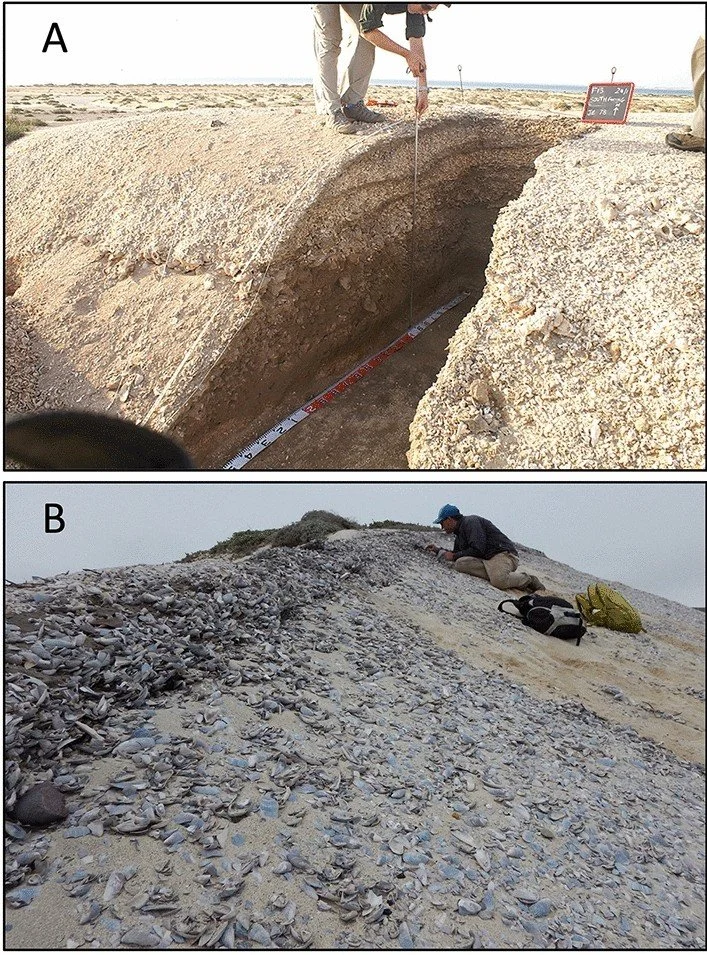
A midden is an archaeological deposit containing accumulated refuse, often including animal bones, shells, charcoal, pottery, and other discarded materials. Coastal middens are especially valuable because they can preserve evidence of fishing, shellfish gathering, terrestrial hunting, and domestic activity. Their contents may reveal which animals people consumed, how they processed food, and how their diets changed over time. However, a midden is not necessarily a simple record of meals. It may contain materials from different activities and occupation periods, and its composition can be affected by disposal practices, scavenging, erosion, and later disturbance.
Evidence of game processing can sometimes be identified through animal bones that show cut marks, deliberate breakage, burning, or other modifications associated with butchery. The species represented may indicate whether people hunted deer, wild boar, rabbits, or other locally available animals. Age profiles and anatomical patterns can provide clues about hunting strategies and carcass processing. Yet bones alone generally cannot establish whether the meat was salted, dried, smoked, consumed fresh, or transported elsewhere.
Salt preservation is particularly difficult to identify archaeologically because salt dissolves readily in water and may disappear from deposits over time. The presence of salt crystals or mineral residues in a vessel is not necessarily evidence of food preservation, as salts can accumulate naturally or enter through later contamination. Researchers therefore need to combine chemical analysis with the shape and function of containers, evidence of animal processing, and the broader environmental context.
Coastal environments could provide access to salt through seawater evaporation, salt-rich soils, or naturally occurring brine, depending on local geology and climate. Communities might collect seawater in shallow basins and allow evaporation to concentrate the dissolved salts. In other circumstances, they could heat brine, although this would require fuel and suitable containers. Archaeological evidence of salt production could help establish whether a settlement had the resources and technology necessary to preserve meat on a substantial scale.
If game was preserved and transported, the process would have involved several stages. Animals would need to be hunted and butchered, and the meat prepared using an appropriate method. Salting could help extend storage life, but its effectiveness would depend on the amount of salt used, the size and condition of the meat, temperature, humidity, and the handling conditions. Preserved meat could then be transported in containers, wrapped in organic materials, or carried using other forms of packaging that might not survive archaeologically.
Trade in salted game would have connected hunters, processors, and consumers. Communities with access to hunting grounds might have supplied meat to coastal settlements, while coastal producers could have exchanged preserved animal products for fish, shells, salt, tools, or other goods. Such exchanges might have taken place through direct barter, reciprocal relationships, seasonal gatherings, or more formal trading arrangements. However, evidence of animal remains at a coastal site does not automatically demonstrate long-distance trade.
Researchers can investigate the movement of animal products through several lines of evidence. Stable isotope analysis may sometimes help determine whether animals were raised or hunted in different environmental zones, although it does not directly identify the movement of preserved meat. Ancient DNA and other biological methods may help characterize animal populations. Differences in butchery patterns, the distribution of particular species, and the presence of transport containers can provide additional clues about how animal products circulated.
The archaeological context of coastal middens is particularly important when considering trade. If a settlement contains animal species that were not naturally available nearby, researchers may investigate whether the remains arrived through exchange, human migration, or the movement of live animals. If the bones occur alongside evidence of specialized processing and storage, a food-production interpretation may become more plausible. Nevertheless, the remains may represent fresh meat brought to the settlement rather than salted products intended for resale.
Chronology also matters. Prehistoric communities did not all possess the same food-preservation technologies, and practices varied across regions. The earliest evidence for the use of salt in food processing may be difficult to distinguish from evidence of salt collection for other purposes. Researchers must establish when the relevant activities occurred and avoid assuming that methods documented in later historical periods were already widespread in earlier societies.
Experimental studies can help test how preservation might have worked. Researchers can examine the effects of salt concentration, drying, temperature, and packaging on animal tissues under controlled conditions. They can then compare the resulting residues and changes with archaeological evidence. Such experiments demonstrate whether a proposed process is feasible, but they cannot independently prove that prehistoric communities used a specific recipe or trading system.
The study of prehistoric salted-game trade highlights the complexity of reconstructing food economies from archaeological remains. Coastal middens provide valuable evidence of hunting, processing, and consumption, while salt-production sites and transport-related artifacts may offer clues about preservation and exchange. A convincing case for trade in salted game requires several independent lines of evidence rather than the presence of animal bones alone. By combining zooarchaeology, chemical analysis, environmental reconstruction, and settlement studies, researchers can investigate how prehistoric communities preserved food and connected different landscapes through the movement of resources.