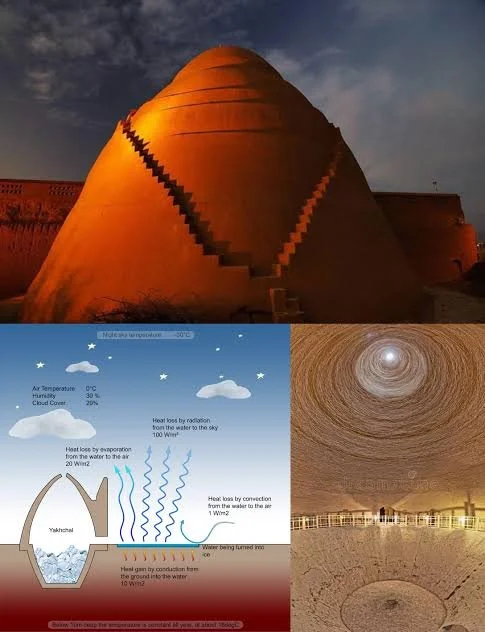
Before mechanical refrigeration became available, people developed ingenious ways to preserve ice and snow for use during warmer months. In regions where winter temperatures were low enough to produce natural ice, communities sometimes collected frozen water and stored it in specially designed structures. These facilities, commonly called icehouses or ice pits, could preserve ice for extended periods when their construction and insulation limited exposure to heat. Archaeological evidence of ancient icehouses in lowland environments can reveal how people managed temperature, organized seasonal labor, and developed technologies for food preservation and other practical needs.
The basic principle of an icehouse was to reduce the rate at which stored ice melted. Because heat naturally moves from warmer surroundings toward colder materials, an effective storage structure needed to limit heat transfer through its walls, roof, floor, and entrance. Some icehouses were built partly or entirely underground, where soil temperatures could remain relatively stable. Others used thick masonry, timber, thatch, straw, leaves, sawdust, or other insulating materials. Their effectiveness depended on local climate, the design of the structure, the amount of ice stored, and the frequency with which the storage chamber was opened.
Lowland locations presented particular challenges. Unlike high mountain environments, where snow and ice might remain available for longer periods, many lowland areas experience warmer temperatures during much of the year. Communities that wished to maintain ice stores therefore needed to collect ice during suitable cold periods, transport it to storage sites, and protect it from melting. The process could require substantial coordination, especially where ice was gathered from distant ponds, lakes, rivers, or artificial freezing basins.
Archaeologically identifying an icehouse can be difficult because many structures were designed to be simple and partly concealed. A circular or rectangular pit, a chamber with thick walls, a drainage feature, or a narrow entrance might be consistent with cold storage, but similar structures could have served as wells, cellars, grain stores, or refuse pits. Researchers must examine the dimensions, construction materials, ventilation, drainage, and relationship to nearby buildings before assigning a specific function.
Drainage was an important component of ice storage. As ice melted, water needed to escape without accumulating around the remaining ice or entering the chamber from the surrounding soil. A drainage channel or permeable floor could help remove meltwater, while a raised entrance or carefully designed roof might reduce the entry of rainwater. These features can sometimes survive archaeologically and provide clues about the intended operation of a storage structure.
Insulating materials are often more difficult to identify. Straw, leaves, wool, sawdust, and other organic materials decay under many burial conditions, leaving little direct evidence. However, researchers may find traces of plant fibers, organic residues, or distinctive layers of sediment within a storage chamber. The arrangement of surviving construction materials can also suggest where insulation was placed. Such interpretations require caution because organic deposits may have accumulated after the structure was abandoned.
The location of an icehouse can reveal its intended users. A structure near a large residence, public building, religious institution, or administrative complex might have supplied a household or institution with cold storage. Facilities associated with markets or food-processing areas could have supported the preservation of perishable goods. Yet the presence of an icehouse does not necessarily mean that ice was used for everyday food refrigeration by the wider population. Access may have been limited by cost, social status, or the availability of ice.
Ice could serve several purposes beyond keeping food cold. It might be used to cool drinks, preserve selected ingredients, prepare certain foods, or provide relief during hot weather. In some historical settings, cold storage was associated with medicine or the care of particular patients. The precise use of an icehouse must be established through the archaeological and historical context rather than assumed from its design alone.
Experimental archaeology and engineering analysis can help explain how ancient icehouses worked. Researchers can model heat transfer through different wall materials, estimate the influence of underground placement, and test the effects of ventilation and drainage. Comparisons with surviving historical icehouses can provide practical examples of how insulation systems were constructed and maintained. These investigations can show whether a proposed design could plausibly preserve ice under the climate conditions of a particular region.
Chronology is essential because ice storage technologies developed in different places and periods. A chamber that resembles a known icehouse may have been constructed for another purpose before being converted to cold storage. Archaeologists can use stratigraphic evidence, construction techniques, associated artifacts, and suitable dating methods to establish when the structure was built and how it changed during use.
Ancient icehouses demonstrate that effective temperature management did not require electricity or modern refrigeration equipment. Through careful construction, insulation, drainage, and seasonal planning, people could preserve naturally occurring ice in environments where it would otherwise melt quickly. By studying the remains of these structures, archaeologists can investigate how communities adapted to local climates and developed practical technologies for storing perishable resources.