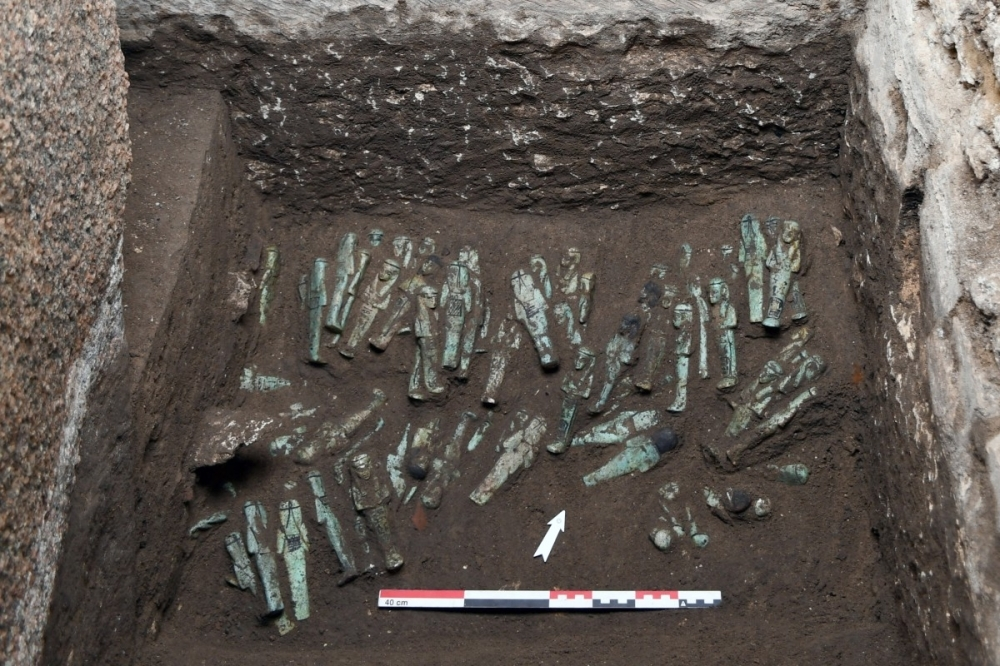
A remarkable collection of 225 funerary figurines has been uncovered inside a tomb in the ancient Egyptian capital of Tanis in the Nile Delt rare discovery that has also resolved a long-standing archaeological puzzle.
According to French Egyptologist Frederic Payraudeau, it has been nearly eight decades since figurines were last found in place within a royal tomb in the Tanis necropolis. Discoveries like this have also never occurred farther south in the Valley of the Kings near modern Luxor, except for the famous find in Tutankhamun’s tomb in 1922, largely because so many burial sites were looted over the centuries.
Payraudeau, who heads the French excavation mission at Tanis, said the discovery was made on the morning of October 9. By that time, the team had already explored three corners of a narrow burial chamber that contained a massive, unidentified sarcophagus.
The moment they noticed several figurines clustered together, they realized the significance of the find. The team immediately alerted others on site, and because the discovery occurred just before the weekend—when work normally ends early—they decided to continue and set up lighting to excavate through the night.
Over the next ten days, archaeologists carefully recovered all 225 figurines. The pieces, made of green material, had been intentionally arranged in a star-like pattern along the sides of a trapezoid-shaped pit, with horizontal rows lining the bottom.
These figurines, known as ushabti, were created to serve the deceased in the afterlife. More than half depict women, an unusually high proportion for such finds.
Tanis, founded around 1050 BC in the Nile Delta, became the capital during Egypt’s 21st dynasty. At that time, the Valley of the Kings—plundered heavily during the reigns of rulers such as Ramses—was abandoned, and the royal burial grounds were relocated to Tanis.
Solving an old mystery
Symbols on the newly uncovered figurines revealed the identity of the individual buried in the sarcophagus: Pharaoh Shoshenq III, who ruled from 830 to 791 BC. This came as a surprise because another tomb at the site including the largest sarcophagus bears his name.
This raised an old question: why was Shoshenq III not buried in the tomb he had prepared?
Experts explain that constructing a tomb in ancient Egypt was always a risk, as a king could never be certain that a successor would honor the original burial plan. Political turmoil during Shoshenq III’s reign—including a violent civil conflict between Upper and Lower Egypt—may have disrupted the intended succession. It is also possible that his remains were moved later to protect them from looting, though relocating a massive granite sarcophagus into such a confined space would have been extremely difficult.
Once fully analyzed, the figurines will be placed on display in an Egyptian museum.