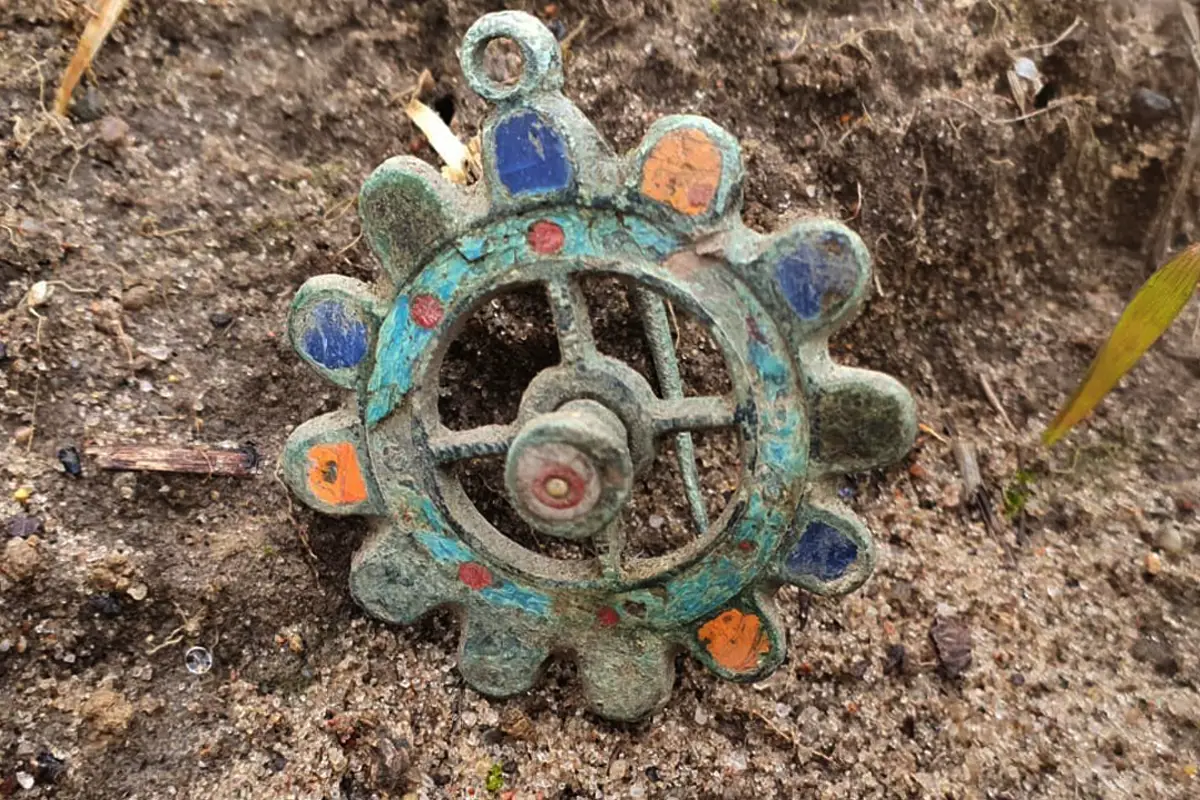
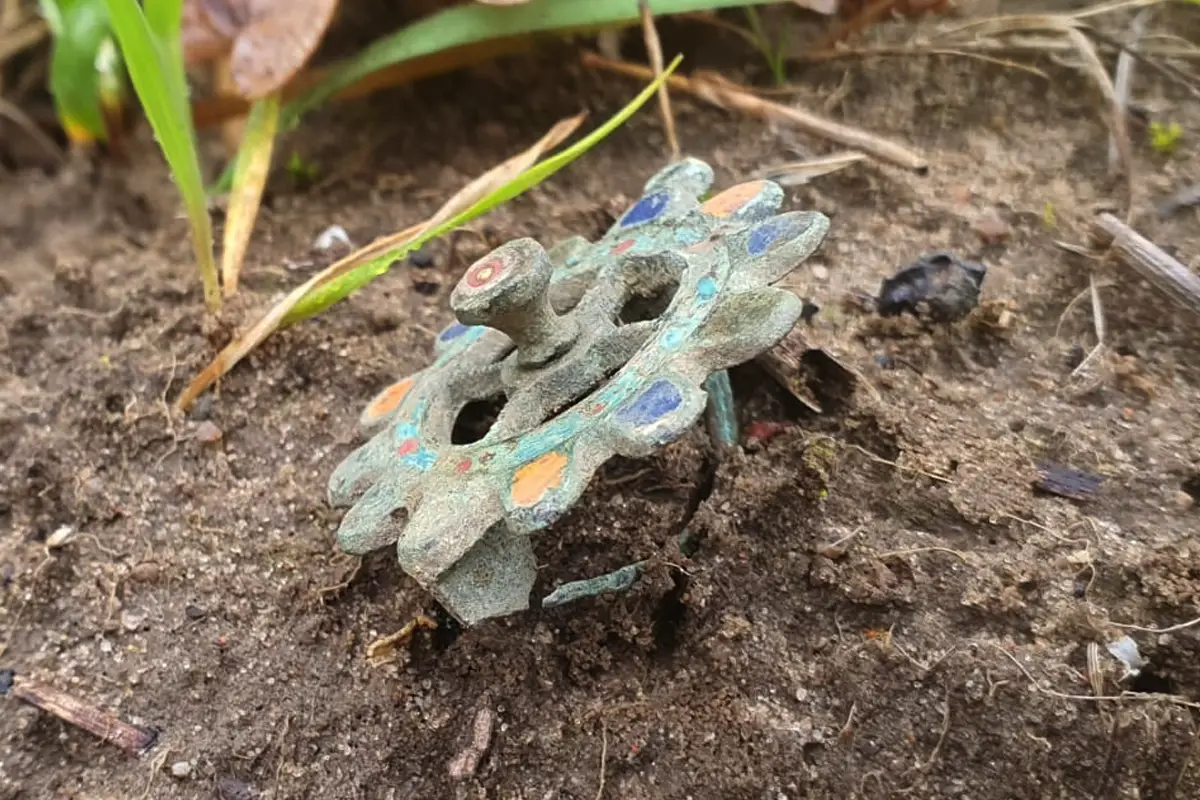
A rare enamelled fibula discovered near Grudziądz is being celebrated as only the second of its kind found in Poland.
The Grudziądz Fortress Association uncovered the artefact during a routine metal-detector survey. Association president Patryk Budziński recalled the moment the team realized they had found something extraordinary and promptly informed the Voivodeship Conservation Authority.
Earlier surveys in the area had revealed Roman ceramics, several fibulae, a cosmetic spoon, fragments of belt pendants, a spur, a hair ornament, a Teutonic coin, and a Scythian spearhead. This diverse collection indicates a multicultural settlement near the historic Amber Road, a major trade route linking the Baltic to the Roman world.
While the newly discovered brooch is still being studied, researchers are cautiously comparing it to a similar fibula found in a child’s grave at the barrow cemetery in Babi Dół-Borcz in the Somonino commune.
The site, studied from 1978 to 2015 by teams from Jagiellonian University and the University of Łódź, is linked to the Wielbark culture, associated with the arrival of Goths from Scandinavia in the early centuries AD.
The Babi Dół-Borcz fibula is a 3.3-centimetre circular disc with a central knob, decorated with alternating white and blue enamel and a red enamel ring at its centre. The Grudziądz fibula is very similar, though slightly larger and with 12 protrusions instead of eight.
Enamelled brooches like these were produced across the Roman provinces, especially in Gaul and Rhaetia, from the late first to mid-second century AD. Often worn by girls, they likely functioned as ornaments, toys, or protective amulets.
All artefacts have been secured, reported to the Provincial Conservation Office, and will eventually be displayed at the Museum in Bydgoszcz.