Roman Amphitheaters: The Structural Engineering of the Veronese Arena
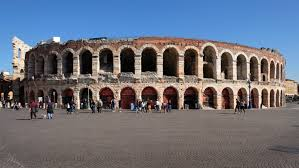
The Arena di Verona, completed around 30 CE, is one of the best-preserved ancient structures of its kind. While the Colosseum in Rome is more famous, the Veronese Arena offers a unique look at the transition of Roman engineering from late-Republic styles to the monumental Imperial standard. Built to hold nearly 30,000 spectators, it remains in use today, a testament to the durability of Roman concrete and elliptical design.
1. The Elliptical Geometry
Roman engineers favored the ellipse over the circle for amphitheaters. Unlike a circular stadium, which has a single focal point, the elliptical shape provides better sightlines for a larger number of spectators while keeping the action in the center relatively close to everyone.
The Four-Center Method: To layout the arena, surveyors likely used a "four-center" geometry, using four different circular arcs to approximate a perfect ellipse. This made it easier for masons to cut stones with consistent curvatures.
Dimensions: The arena measures 152 meters by 123 meters. The internal "performance" space remains perfectly proportioned for the gladiatorial munera (games) it once hosted.
2. The Concentric Ring System
The structural integrity of the Arena relies on a system of concentric elliptical rings and radial walls. This "honeycomb" structure distributed the massive weight of the stone seating (the cavea) and the thousands of spectators downward and outward.
The Internal Arcades: The building consists of three main concentric rings of arches. The outer "skin" was originally a massive ring of white and pink limestone from Valpolicella.
The "Ala" (The Wing): Much of the outermost ring was destroyed by a massive earthquake in 1117 CE. Today, only a small section—four arches known as the "Ala"—remains, giving us a cross-section view of the original exterior height (nearly 31 meters).
3. Advanced Materials: The "Verona Marble"
One reason for the Arena's survival is the specific material used. It is constructed primarily of Veronese Red Marble (actually a dense limestone).
Opus Reticulatum and Concrete: The internal core of the walls used opus caementicium (Roman concrete) faced with brick and small diamond-shaped stones (opus reticulatum). This created a flexible yet incredibly strong core that has resisted seismic activity for two millennia.
Pink Limestone Facade: The local limestone was not only aesthetically striking but also highly resistant to the erosion common in the humid climate of the Po Valley.
4. The Vomitoria: Crowd Control Engineering
The Romans were masters of "human traffic engineering." The Arena was designed so that 30,000 people could enter and exit the building in less than 20 minutes.
Vomitoria: These were the vaulted entryways and exits located under the seating tiers. The name comes from the Latin vomere (to spew forth), referring to the way the crowds were rapidly "discharged" into the corridors.
Segregated Access: The system of internal staircases ensured that different social classes—from the elite in the lower tiers to the commoners in the upper wooden galleries—never had to mingle in the hallways.
5. Underground Infrastructure: The Hypogeum
Beneath the arena floor was a complex world of tunnels and chambers known as the hypogeum.
Drainage: Because the Arena sits in a natural basin, the Romans engineered a sophisticated drainage system that still functions today, preventing the underground chambers from flooding during heavy rains.
Man and Beast: Unlike the later, more complex mechanical elevators of the Colosseum, the Veronese Arena relied on a system of ramps and service tunnels to bring gladiators and wild animals into the spotlight.
The Arena di Verona is one of the few ancient buildings that has never truly "died"; it transitioned from a site of bloodsport to a medieval court, a Renaissance theater, and finally a modern opera house.