The Hittite Empire: The Iron Age Superpower That Rivaled Egypt
For centuries, the Hittites were a "lost" civilization, known only through brief mentions in the Bible. However, archaeological excavations in the late 19th and early 20th centuries revealed a massive, sophisticated empire centered in the rugged highlands of modern-day Anatolia (Turkey). From their capital of Hattusa, the Hittites commanded a military and diplomatic machine that challenged the might of Pharaonic Egypt and the Middle Kingdom of Assyria.
1. Hattusa: The Mountain Fortress
The capital city, Hattusa, was a masterpiece of Bronze Age urban planning and defensive engineering. Built on a rocky outcrop, it was protected by massive double walls and innovative "postern" tunnels—secret underground passages that allowed soldiers to launch surprise counter-attacks during a siege.
The Lion Gate: One of the most iconic entrances to the city, guarded by two massive stone lions designed to magically protect the capital and project the "king’s ferocity."
The Great Temple: A sprawling complex dedicated to the Storm God Tarhunna and the Sun Goddess of Arinna. Unlike Egyptian temples, which were often hidden behind walls, Hittite temples featured large windows, reflecting a different approach to light and the divine.
The Royal Archives: Archaeologists discovered over 30,000 clay tablets written in cuneiform. These records revealed a highly organized state with laws, treaties, and even instructions for the "cleanliness of the royal kitchen."
2. The Chariot Revolution
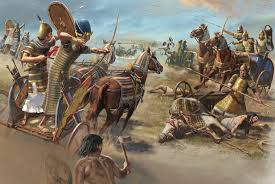
The Hittites were the undisputed masters of chariot warfare. While other civilizations used chariots primarily as mobile archery platforms, the Hittites redesigned them for maximum impact.
Three-Man Crews: Unlike the two-man Egyptian chariots, Hittite chariots carried three people: a driver, a shield-bearer, and a warrior armed with a long thrusting spear.
Centralized Axle: By moving the wheel axle to the middle of the chariot body (rather than the rear), they could support more weight, turning the chariot into a heavy "tank" capable of crashing directly into enemy infantry lines.
3. The Battle of Kadesh and the World’s First Peace Treaty
The rivalry between the Hittites and Egypt peaked in 1274 BCE at the Battle of Kadesh in modern-day Syria. It was the largest chariot battle ever fought, involving roughly 5,000 to 6,000 vehicles.
The Stalemate: Both King Muwatalli II and Pharaoh Ramesses II claimed victory, but the reality was a bloody draw.
The Eternal Treaty: Years later, in 1259 BCE, the two superpowers signed the Treaty of Kadesh. It is the oldest known written peace treaty in history. It established a "permanent" peace, a mutual defense pact against external threats, and even clauses for the extradition of political refugees. A clay copy of this treaty is currently on display at the United Nations Headquarters in New York.
4. The "Secret" of Iron
The Hittites are traditionally credited with ushering in the Iron Age. While they didn't mass-produce steel weapons in the modern sense, they were among the first to master the smelting of iron ore, which was abundant in the Anatolian mountains.
Prestige Metal: In the Late Bronze Age, iron was rarer and more valuable than gold. The Hittite kings used iron daggers as high-status gifts for other monarchs, signaling their technological edge.
Strategic Advantage: Their ability to work with iron, combined with their mastery of bronze, gave them a durable arsenal that lasted longer in the heat of sustained campaigns.
5. The Great Collapse
Around 1200 BCE, the Hittite Empire vanished almost overnight during the "Late Bronze Age Collapse."
Internal Strife: Evidence suggests the royal family was plagued by civil war and succession crises.
The Sea Peoples: Massive migrations and raids by the mysterious "Sea Peoples" disrupted trade routes and destroyed coastal cities.
Famine: Recent paleoclimate data (tree ring analysis) shows a severe, multi-year drought in Anatolia at the time of the collapse, likely causing the central government to fail as the food supply withered.