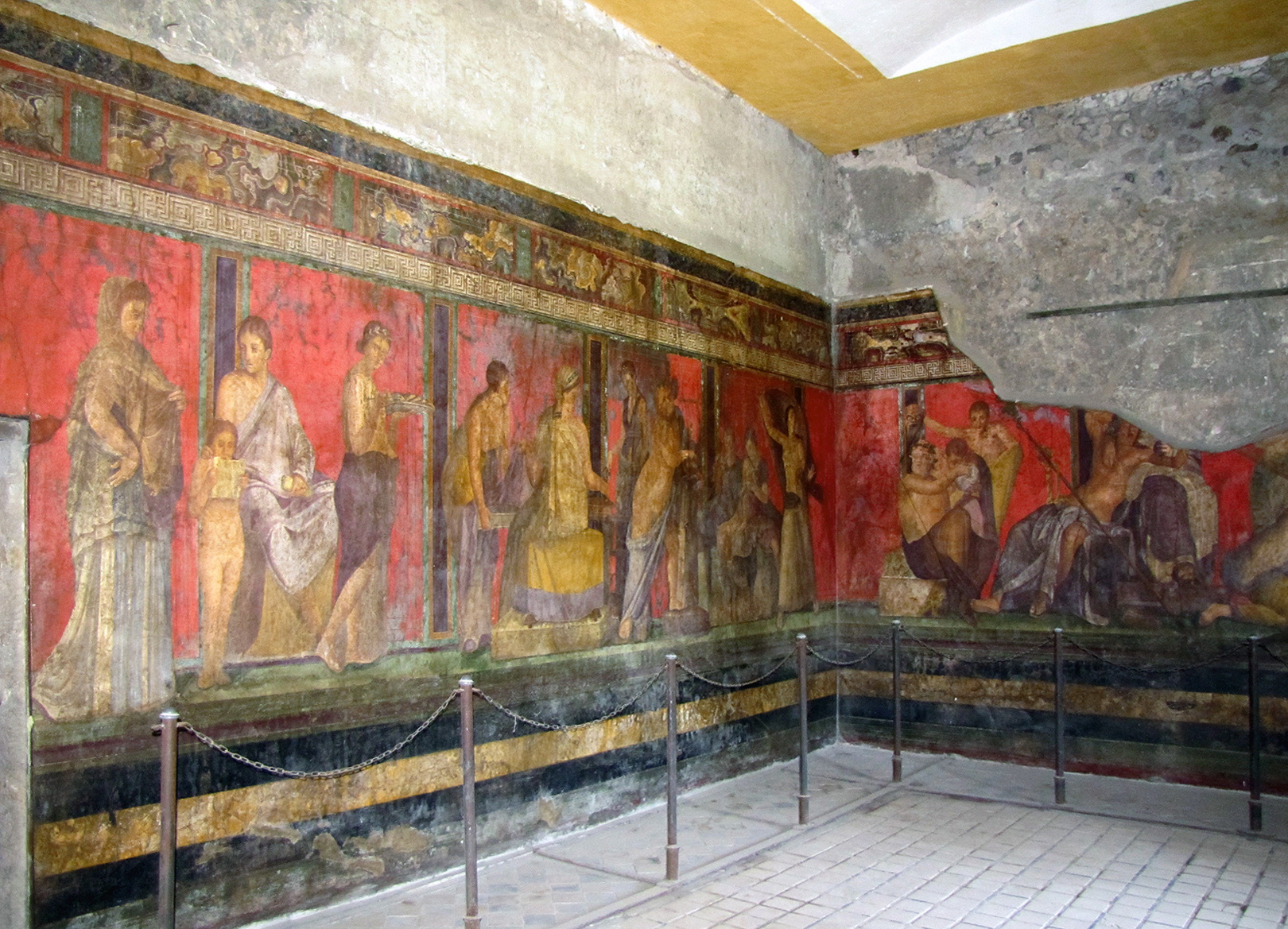
When the catastrophic eruption of Mount Vesuvius buried the cities of Pompeii and Herculaneum in 79 CE, it froze an entire civilization in time. While the disaster was an unspeakable tragedy, it inadvertently preserved the most extensive collection of ancient interior design ever discovered.
Before the rediscovery of these cities, historians knew very little about how the Romans decorated their private spaces. By examining the preserved villas, nineteenth-century art historian August Mau categorized the evolution of Roman interior design into The Four Pompeian Styles.
Far from simple wallpaper or repetitive murals, these styles reflect a shifting cultural obsession—moving from a desire to mimic expensive materials to a craving for mind-bending optical illusions, theatrical stagecraft, and delicate minimalism.
The Evolutionary Timeline
The four styles didn't exist in a vacuum; they evolved sequentially over two centuries, charting Rome's rise from a modest Republic to a lavish, decadent global Empire.
The First Style: Incrustation
c. 200 – 80 BCE
A Republican-era style focused on simulating rich, imported structural stones like marble using painted stucco relief.
The Second Style: Architectural Illusionism
c. 80 – 20 BCE
A radical shift to three-dimensional perspective, digitally "opening up" windowless Roman rooms into expansive cityscapes and landscapes.
The Third Style: Ornate Minimalism
c. 20 BCE – 40 CE
An Augustan-era rejection of perspective in favor of flat, monocromatic walls adorned with delicate, impossible architectural details and tiny vignettes.
The Fourth Style: Intricate Theatricality
c. 40 – 79 CE
A chaotic, hyper-detailed synthesis of the previous styles, featuring crowded walls, faux textile tapestries, and fantastical, stage-like perspective.
1. The First Style: Incrustation (c. 200–80 BCE)
The First Style is all about tactile imitation. During the Roman Republic, wealthy citizens wanted to show off their sophistication by lining their walls with expensive, colored marbles imported from Greece, Numidia, and Egypt. However, actually importing these stones was staggeringly expensive.
[ Plaster Layer ] ──► Molded into raised panels ──► Painted to mimic marble veining
Instead of buying real stone, Roman decorators used plaster to shape raised, three-dimensional blocks on the wall. Once the plaster dried, artists painted realistic faux-marble veining and vivid bands of yellow, deep red, and dark green over the panels.
The goal wasn't to trick the viewer into thinking the room was fake, but to celebrate a highly skilled, polished illusion of architectural wealth.
2. The Second Style: Architectural Illusionism (c. 80–20 BCE)
The Second Style represents perhaps the greatest revolution in ancient painting: the birth of trompe-l'œil (trick-of-the-eye) perspective.
Roman elite houses (domus) were notoriously claustrophobic, featuring tiny rooms with no exterior windows to block out street noise. Second Style artists solved this problem by using paint to completely dissolve the physical stone wall.
By employing a brilliant, intuitive understanding of single-point linear perspective, painters created the illusion that the viewer was looking through a series of grand columns out into a sprawling world. Walls were transformed into painted vistas of grand temples, bustling Hellenistic city streets, quiet country shrines, and lush, rolling gardens.
3. The Third Style: Ornate Minimalism (c. 20 BCE–40 CE)
During the reign of Emperor Augustus, taste shifted dramatically. The wide-open, dizzying illusions of the Second Style were abandoned in favor of elegant flat surfaces and strict symmetry.
The Third Style closed the wall back up. Rooms were painted in rich, heavy blocks of solid color—most famously a brilliant Egyptian black, stark white, or a deep cinnabar red known today as Pompeian Red.
[ Solid Color Wall ] ───► Ultra-thin, impossible columns ───► Tiny central painted vignette
Instead of realistic columns, artists drew impossibly thin, reed-like candelabras and delicate vines that couldn't possibly support a real roof. Floating in the absolute center of these large, monochromatic fields were tiny, meticulously detailed rectangular panels mimicking framed gallery paintings, usually depicting quiet mythological scenes or idyllic countryside landscapes.
4. The Fourth Style: Intricate Theatricality (c. 40–79 CE)
The Fourth Style is the grand finale of Roman wall painting—a hyper-decorated style that was popular when Vesuvius erupted. It can be described as a frantic, crowded mashup of all three previous styles.
In a Fourth Style room, the lower panels feature the faux-marble look of the First Style. The walls are divided into flat panels of color reminiscent of the Third Style, but these panels are flanked by open "windows" showing chaotic, impossible architectures that twist and turn like a theatrical stage set.
The imagery became crowded, surreal, and deeply dramatic, featuring large narrative mythological paintings, floating cupids, and faux textile borders that made the entire room look like it was draped in woven silk tapestries.
Summary
The evolution of Roman wall painting, known as the "Four Pompeian Styles," tracks the shift from simple Republican austerity to the theatrical decadence of the Imperial age. Each style fundamentally altered how the Romans perceived their domestic spaces.
The Evolution of Roman Wall Painting
First Style (Incrustation Style)
Visual Goal: Imitation of precious stone.
Identifying Features: Raised plaster panels painted to mimic slabs of expensive marble or stone; zero illusion of depth.
Cultural Vibe: Reflects the plain, structural values of the Roman Republic, prioritizing solid, grounded status.
Second Style (Architectural Style)
Visual Goal: Breaking through the wall to create space.
Identifying Features: Realistic perspective painting using painted columns, lintels, and windows that look out onto distant, vibrant vistas or landscapes.
Cultural Vibe: Bold, experimental, and worldly; it transformed cramped interior rooms into expansive, dramatic environments.
Third Style (Ornate Style)
Visual Goal: Refined, monochromatic order.
Identifying Features: A move away from realism toward flat, solid-colored walls adorned with ultra-thin, delicate candelabras and tiny, floating vignettes.
Cultural Vibe: Refined, minimalist, and elite; this style mirrored the sophisticated, restrained taste of the early Augustan era.
Fourth Style (Intricate Style)
Visual Goal: Eclectic, overwhelming luxury.
Identifying Features: A chaotic blend of the previous three styles, featuring busy, crowded designs and frame-like "stage sets" that give the wall an artificial, theatrical quality.
Cultural Vibe: Decadent, showy, and theatrical; it represents the late-Imperial shift toward dramatic displays of wealth and visual complexity.