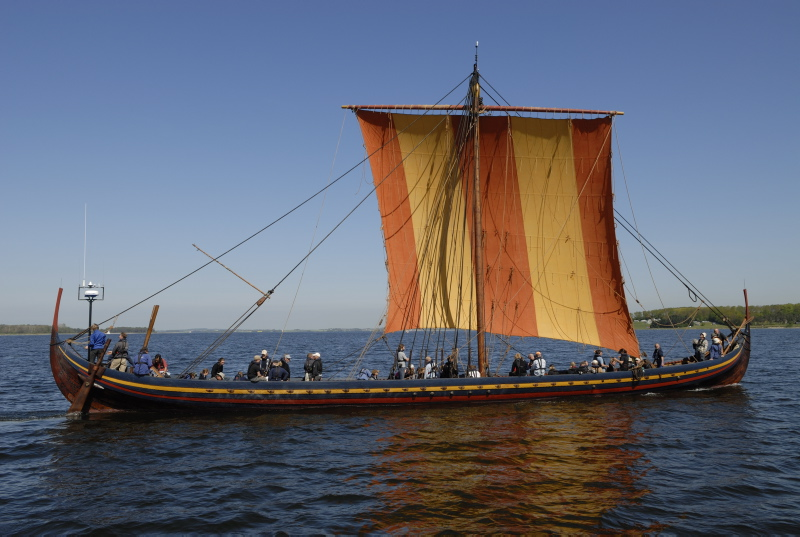
To the medieval world, the sight of a dragon-headed prow emerging from the morning mist was an omen of absolute terror. For centuries, the military expansion, trade monopolies, and far-reaching colonization of the Norse people were fueled by a single technological advantage: their unparalleled mastery of shipbuilding.
Yet, for a long time, historians only understood these vessels through stylized stone carvings, poetic sagas, and wealthy burial ships like the Oseberg or Gokstad. While beautiful, royal burial ships represent the luxury cars of the Viking world—they don't tell us what the everyday naval fleets actually looked like.
That changed entirely in 1962. Just outside the village of Skuldelev in Denmark’s Roskilde Fjord, underwater archaeologists uncovered a deliberate underwater blockade consisting of five distinct, uniquely specialized Viking ships. Sunk around 1070 CE to defend the royal capital of Roskilde from seafaring raiders, the Skuldelev shipwrecks provided a definitive, real-world catalog of Norse naval power.
1. The Secrets of Clinker Shipbuilding
The five Skuldelev ships varied wildly in purpose, but they all shared the foundational engineering DNA that made Norse vessels the kings of the northern seas: clinker (or lapstrake) construction.
Instead of carving thick logs or fastening planks edge-to-edge, Viking shipwrights used overlapping wooden boards.
Overlapping Planks: The hull was constructed by overlapping the edges of horizontal oak or pine planks and riveting them together with iron nails.
The Flex Dynamic: This design yielded an incredibly light, strong, and flexible hull. Rather than slamming rigidly into a wave, a clinker hull twisted and flexed with the energy of the sea, absorbing heavy impacts without fracturing the wood or popping seams.
Shallow Draft: This flexibility allowed the ships to sit exceptionally high in the water. Even a massive troop transport could sail in water less than three feet deep, letting the Vikings navigate shallow rivers far inland and pull directly onto sandy beaches without needing a formal harbor.
2. The Five Ships: A Specialized Fleet
The Skuldelev discovery shattered the myth that the Vikings used a single, all-purpose "longship." Instead, archaeologists discovered a highly specialized naval ecosystem split cleanly into two functional categories: Warships and Merchant Ships.
Ship DesignationArchetype NamePrimary PurposeKey Dimensions & SpecsSkuldelev 1KnarrOcean-going heavy cargo vessel; built for deep-sea trade to Iceland and Greenland.
Length: 52 ft
Capacity: ~24 tons of cargo
Crew: 6–8 men
Skuldelev 2SkeidLong-range ocean warship; a massive troop transport built for royal raiding fleets.
Length: 98 ft
Capacity: 70–80 warriors
Crew: 60 oarsmen
Skuldelev 3ByrdingCoastal merchant ship; small, nimble freighter used for local Baltic trade networks.
Length: 46 ft
Capacity: ~4.5 tons of cargo
Crew: 5–8 men
Skuldelev 5SnekkjaStandard warship; agile, sleek raiding vessel optimized for coastal warfare and shallow rivers.
Length: 57 ft
Capacity: ~30 warriors
Crew: 26 oarsmen
Skuldelev 6FergeFishing and utility vessel; later modified into a transport ferry for tools and livestock.
Length: 36 ft
Capacity: Utility/Transport
Crew: 4–5 men
(Note: Skuldelev 4 was initially thought to be a separate wreck, but was later proven to be a fragmented portion of the massive Skuldelev 2 warship.)
3. The Giants of War: Skuldelev 2 and 5
The military muscle of the Skuldelev fleet is anchored by Skuldelev 2, a true sea monster of the late Viking Age. Measuring nearly 100 feet long but just 12 feet wide, this ship was built for lightning-fast troop deployment.
[ SKEID WARSHIP ] ──► Long, ultra-narrow hull ──► Max speed of 15+ knots under sail or oar.
Tree-ring dating (dendrochronology) revealed a fascinating geopolitical story: Skuldelev 2 wasn't built in Denmark. Its timber was harvested in the vicinity of Dublin, Ireland, around 1042 CE. This confirms that the sprawling sea empire of the Norsemen maintained interconnected, sophisticated shipyards operating across the British Isles to supply Dublin's Viking kings with elite warships.
In contrast, Skuldelev 5 represents the smaller, local defensive draft. Built using a mix of new timbers and salvaged planks from older vessels, it was a practical, cost-effective coastal defender—the militia boat of its era.
4. The Workhorses of Empire: Skuldelev 1 and 3
While warships captured the imagination of chroniclers, it was the merchant freighters—the knarrs—that structurally sustained the Norse world.
   [ LONGSHIP (War) ] ───► Narrow, low hull; packed with oarsmen for speed.
                                  VS.
   [ KNARR (Merchant) ] ──► Deep, wide hull; open cargo hold; relies entirely on sail power.
Skuldelev 1 is a heavy ocean cruiser. Unlike the longships, which were crammed with rowers, the knarr relied almost exclusively on a single massive wool square sail. Oar ports were reserved only for maneuvering in harbors. By maximizing interior hull volume, these broad, deep-bellied freighters could haul tons of walrus ivory, furs, timber, and enslaved people across treacherous North Atlantic trade routes, cementing the economic foundations of the Viking Age.
5. The Strategy of the Blockade
The ultimate irony of the Skuldelev ships is that their survival was secured by their destruction. Around 1070 CE, the political stability of Denmark was fracturing. Fearing an imminent naval assault on the royal treasury at Roskilde, the local population engineered a defensive shield at the narrowest point of the fjord channel.
1.Gathering the Fleet:Phase 1.
Aging, battle-worn warships and obsolete merchant vessels were rounded up from the harbor. They were stripped of valuable rigging, sails, and metal equipment.
2.Strategic Loading:Phase 2.
The hulls were towed out into the Peberrenden navigation channel and meticulously packed to the brim with large glacial stones and gravel boulders.
3.The Controlled Sinking:Phase 3.
Scuttling holes were deliberately cut into the hulls, dropping the heavily weighted ships into the silt channel floor to create an artificial reef.
4.Reinforcing the Reef:Phase 4.
Years later, a second layer of ships (including Skuldelev 2) was scuttled directly on top of the original pile, completely sealing the deep-water gate against invading fleets.
By sacrificing these five vessels, the people of Roskilde preserved an unbroken cross-section of Viking naval technology, allowing modern historians to study the exact vessels that transformed the Norsemen from isolated Scandinavian tribes into global pioneers of the medieval world.