Introduction
Located in the fertile Casma Valley along the north-central coast of Peru, Sechín Alto is one of the oldest and largest monumental ceremonial centers in the Americas. Dating to approximately 3500 BCE, the site is around 5,500 years old, making it contemporary with the earliest civilizations of Ancient Egypt, Mesopotamia, and the Indus Valley. Sechín Alto forms part of the larger Sechín Archaeological Complex, which also includes nearby sites such as Sechín Bajo, Cerro Sechín, and Taukachi-Konkan. Together, these settlements demonstrate that complex societies capable of organizing large populations, constructing monumental architecture, and developing sophisticated religious traditions existed in the Andean region thousands of years before the rise of later civilizations such as the Moche, Wari, and Inca.
Situated near the Sechín River, a tributary of the Casma River, the site occupied a strategic agricultural zone sustained by seasonal irrigation and fertile floodplains. The availability of reliable water sources allowed early communities to cultivate crops such as cotton, squash, beans, gourds, and chili peppers, supporting a growing population capable of undertaking enormous public construction projects. Rather than serving as a military fortress or residential city alone, Sechín Alto functioned primarily as a ceremonial, political, and administrative center, where religious rituals, public gatherings, and communal labor reinforced the authority of emerging leaders and strengthened social cohesion among surrounding communities.
Monumental Architecture
Sechín Alto is best known for its enormous adobe ceremonial platform, one of the largest prehistoric structures in Peru. The principal mound measures approximately 300 meters (984 feet) in length, 250 meters (820 feet) in width, and rises more than 35 meters (115 feet) above the surrounding valley floor. Covering nearly 50 hectares, the complex ranks among the largest monumental constructions built anywhere in the ancient Americas during the fourth millennium BCE.
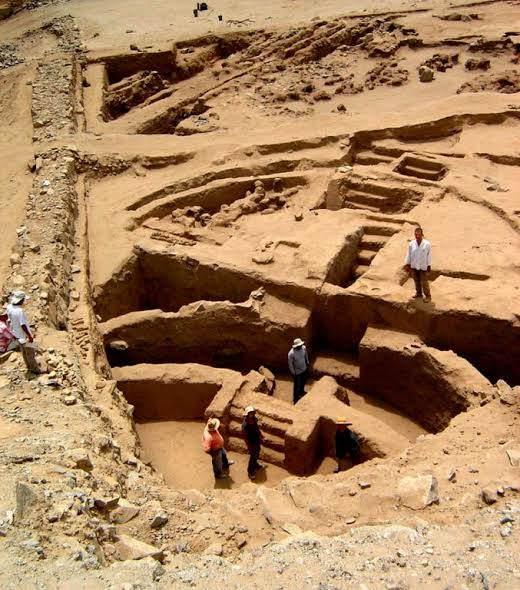
The ceremonial center was carefully planned around a central architectural axis, consisting of massive stepped platforms, broad plazas, elevated terraces, ceremonial courtyards, processional stairways, and enclosed ritual spaces. These structures were constructed primarily from sun-dried adobe bricks, compacted earth, and stone foundations, materials well suited to Peru's dry coastal climate. Thick retaining walls stabilized the enormous platforms, while wide staircases guided participants toward elevated ceremonial areas where important religious and political events were likely conducted.
The scale of construction demonstrates remarkable organizational abilities. Thousands of workers would have been required to manufacture adobe bricks, transport construction materials, level terraces, and erect the massive platforms. Such coordinated labor indicates the presence of effective leadership capable of mobilizing surrounding communities for large-scale public works, suggesting that Sechín Alto represented one of the earliest examples of organized state-level planning in the Americas.
Religious and Ceremonial Functions
Although much of Sechín Alto's architecture is monumental rather than decorative, the surrounding Sechín complex provides valuable insight into its ceremonial significance. Archaeologists believe the massive plazas and elevated platforms served as gathering places where religious rituals, seasonal festivals, agricultural ceremonies, and political assemblies brought together populations from neighboring settlements.
The elevated terraces likely supported temples or sacred buildings where priests performed ceremonies honoring supernatural forces believed to govern rainfall, fertility, agricultural productivity, and cosmic order. Processional pathways leading toward the summit suggest that ritual participants followed carefully organized ceremonial routes before reaching sacred spaces reserved for religious elites. The combination of monumental architecture and open public plazas indicates that religion played a central role in maintaining political authority and social unity within early Andean society.
The Stone Reliefs of the Sechín Complex
Although the famous carved stone reliefs are located primarily at nearby Cerro Sechín, they are closely associated with the broader Sechín ceremonial tradition. These remarkable carvings depict warriors, priests, dismembered human bodies, severed heads, skeletal figures, exposed internal organs, and ceremonial weapons. Executed in high-relief stone carving, the sculptures represent some of the earliest monumental narrative artworks in the Americas.
Archaeologists continue to debate their exact meaning. Some scholars interpret the reliefs as evidence of ritual sacrifice intended to ensure agricultural fertility and maintain cosmic balance, while others believe they commemorate military victories or symbolize the power of religious leaders over life and death. Regardless of interpretation, the carvings demonstrate an advanced artistic tradition and reveal that symbolism, ritual, and public display formed an essential part of early Andean civilization.
Engineering and Social Organization
The construction of Sechín Alto required an extraordinary understanding of engineering, planning, and resource management. Builders carefully selected elevated locations to reduce flooding, constructed extensive terraces to stabilize the landscape, and used thick adobe walls capable of supporting enormous platform structures. The site's orientation and architectural symmetry suggest careful planning rather than gradual expansion, reflecting a centralized vision for the ceremonial complex.
Equally impressive was the social organization required to sustain such construction. Agricultural surpluses produced through irrigation farming allowed specialized workers, craftsmen, priests, and administrators to emerge alongside farmers. Communities likely participated in organized labor projects, contributing manpower for the construction and maintenance of ceremonial buildings. These cooperative efforts strengthened political authority while reinforcing shared religious beliefs and regional identity.
Archaeological Importance
Excavations at Sechín Alto have produced valuable evidence of early Andean civilization, including adobe architecture, stone tools, pottery fragments from later occupations, woven textiles, food remains, and irrigation features. Radiocarbon dating has confirmed that the site's earliest monumental construction dates back approximately 3500 BCE, making it one of the oldest large ceremonial centers in the Western Hemisphere.
The discoveries have significantly reshaped scholarly understanding of civilization in the Americas. Rather than emerging suddenly, complex societies developed gradually through advances in agriculture, religious organization, engineering, and communal labor. Sechín Alto demonstrates that large-scale monument building, centralized planning, and organized ceremonial life existed in Peru thousands of years before many other famous American civilizations.
Conclusion
Sechín Alto stands as one of the earliest and most impressive monumental ceremonial complexes in the Americas, illustrating the remarkable achievements of Peru's prehistoric societies more than 5,500 years ago. Its enormous adobe platforms, carefully planned plazas, ceremonial terraces, and sophisticated construction techniques reveal a civilization capable of coordinating massive labor forces and creating monumental architecture on an unprecedented scale. Together with the symbolic stone reliefs of the surrounding Sechín complex, the site provides invaluable insight into the religious beliefs, engineering knowledge, artistic traditions, and political organization of early Andean peoples. Today, Sechín Alto remains one of the most important archaeological sites in South America, demonstrating that the foundations of complex civilization in the Andes were established millennia before the rise of the Inca Empire and continue to expand our understanding of humanity's earliest urban and ceremonial societies.