Introduction
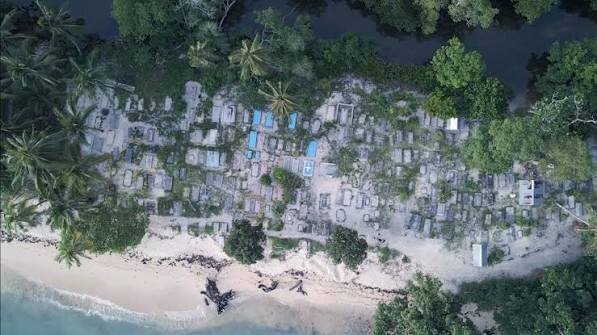
Archaeological remains beneath the water of enclosed and semi-enclosed seas offer an unusual opportunity to investigate ancient religious practices and coastal settlement patterns. Structures that once stood on dry land or near the shoreline may now be submerged because of sea-level change, tectonic movement, erosion, or other environmental processes.
Among these remains are platforms that may have supported religious or ceremonial activities. Such structures could have been associated with temples, shrines, offerings, processions, or public rituals.
The term "inner seas" can refer to several semi-enclosed bodies of water, including the Mediterranean, Black Sea, Baltic Sea, and other inland or partially enclosed marine environments. Their archaeological landscapes differ considerably, making regional context essential when interpreting submerged structures.
Understanding Submerged Platforms
A submerged platform is a constructed or modified surface that lies beneath the present water level.
It may consist of stone blocks, masonry foundations, paved surfaces, artificial terraces, or other structural remains.
Some platforms may originally have stood above the waterline. Others could have been built at the edge of a harbor, on a coastal promontory, or within a shallow-water environment.
Their original purpose cannot be determined from their shape alone. A platform might have supported a religious structure, but it could also have served as a landing area, fishery installation, industrial workspace, or defensive feature.
Coastal Religious Landscapes
Religious activity in ancient societies was often connected to prominent natural features.
Coastal temples and shrines could be located near harbors, cliffs, springs, islands, or important maritime routes.
Water itself held symbolic importance in many cultural traditions. It could be associated with purification, fertility, danger, travel, divine power, and the boundary between different worlds.
A platform positioned near the sea might therefore have had ceremonial significance. However, this interpretation requires supporting evidence from its archaeological context.
Why Religious Structures Become Submerged
Several environmental processes can cause archaeological structures to disappear beneath the water.
Long-term sea-level rise is one major factor. After the end of the last Ice Age, global sea levels rose substantially, flooding many former coastal landscapes.
Local geological processes can also change relative sea levels. Tectonic subsidence may lower the land, while earthquakes can alter coastlines and harbor environments.
Erosion, sediment movement, and coastal instability may further modify the original landscape.
In some locations, human activity has also contributed to submergence through changes in drainage, dam construction, or other alterations to water systems.
Inner Seas and Regional Variation
The Mediterranean contains numerous submerged archaeological sites because of its long history of coastal settlement, maritime trade, and changing sea levels.
The Black Sea has a distinctive geological history involving changes in water levels and connections with surrounding marine systems.
The Baltic Sea has experienced complex postglacial changes, including land uplift in some regions and changing shorelines.
These differences mean that submerged structures cannot be interpreted through a single universal model. Each site requires geological reconstruction specific to its location.
Archaeological Evidence for Religious Use
Identifying a submerged platform as religious requires more than observing a raised stone surface.
Researchers look for associated evidence such as inscriptions, religious imagery, altars, votive objects, ritual deposits, or architectural features consistent with known sacred structures.
The platform's orientation and relationship to nearby buildings may also be informative.
Objects recovered from the surrounding seabed can provide additional clues, although their original locations may have been altered by currents, storms, fishing activity, or later human disturbance.
A religious interpretation becomes stronger when several independent types of evidence support the same explanation.
Underwater Archaeological Methods
Underwater archaeology uses specialized equipment and recording techniques to document submerged structures.
Divers may conduct detailed surveys in shallow and accessible locations. In deeper or more difficult environments, remotely operated vehicles and autonomous underwater vehicles can assist investigation.
Multibeam sonar and side-scan sonar help map the seabed and identify possible structural features.
Photogrammetry allows researchers to create three-dimensional models from overlapping photographs. These models can preserve the appearance and dimensions of a site for further study.
Sediment sampling and underwater excavation may reveal construction layers, buried surfaces, and associated artifacts.
Dating Submerged Structures
Establishing the age of a submerged platform can be challenging.
Researchers may date associated pottery, organic remains, construction materials, or sediment layers.
Radiocarbon dating can be useful when suitable organic materials are present. However, samples must be carefully selected because they may have been redeposited or may not relate directly to the construction event.
Architectural comparisons and inscriptions can provide additional chronological information.
The date when a structure became submerged is not necessarily the same as the date when it was built. A platform could have remained in use for centuries before environmental changes covered it with water.
Alternative Explanations
One of the most important responsibilities in underwater archaeology is avoiding premature religious interpretations.
A stone platform near an ancient harbor may have supported loading activities rather than worship. A series of foundations could represent warehouses, fish-processing installations, or defensive works.
The presence of unusual objects does not automatically establish a sacred function.
Researchers must compare the structure with known examples and examine its relationship to the surrounding archaeological landscape.
Preservation and Heritage Protection
Submerged sites can sometimes preserve materials that would have deteriorated on land.
Low-oxygen sediment environments may protect wood, textiles, and other organic remains. However, marine organisms, saltwater corrosion, currents, and human disturbance can also damage archaeological materials.
Underwater heritage is vulnerable to looting, unregulated diving, construction, and fishing activity.
Documentation and protection are therefore essential, especially when sites may contain culturally significant religious remains.
Conclusion
Submerged religious platforms in inner seas offer a valuable opportunity to investigate how ancient communities connected sacred architecture with coastal and maritime landscapes. Their present underwater location may reflect long-term environmental change rather than their original intended setting.
Nevertheless, a platform cannot be identified as religious based on its appearance alone. Archaeological context, inscriptions, associated objects, architectural features, and geological reconstruction are necessary to establish its function.
By combining underwater survey, environmental science, and careful archaeological interpretation, researchers can reconstruct lost coastal landscapes and better understand the relationship between religion, settlement, and the changing sea.