Introduction
Human teeth preserve valuable information about the environments in which people lived during childhood and adolescence. Because dental tissues form during specific stages of development and can preserve chemical signals from the body, they offer researchers an opportunity to investigate past diet, geographic mobility, and environmental exposure.
Bioarchaeologists increasingly use stable isotope analysis to study how individuals moved between different regions during their lives. These methods can contribute to research on seasonal labour, particularly in societies where people traveled to agricultural fields, pastoral landscapes, mines, or other workplaces at particular times of the year.
However, teeth do not directly record occupation or employment. Isotope patterns must be interpreted alongside archaeological, skeletal, environmental, and historical evidence before they can be connected to seasonal work.
Why Teeth Preserve Isotope Evidence
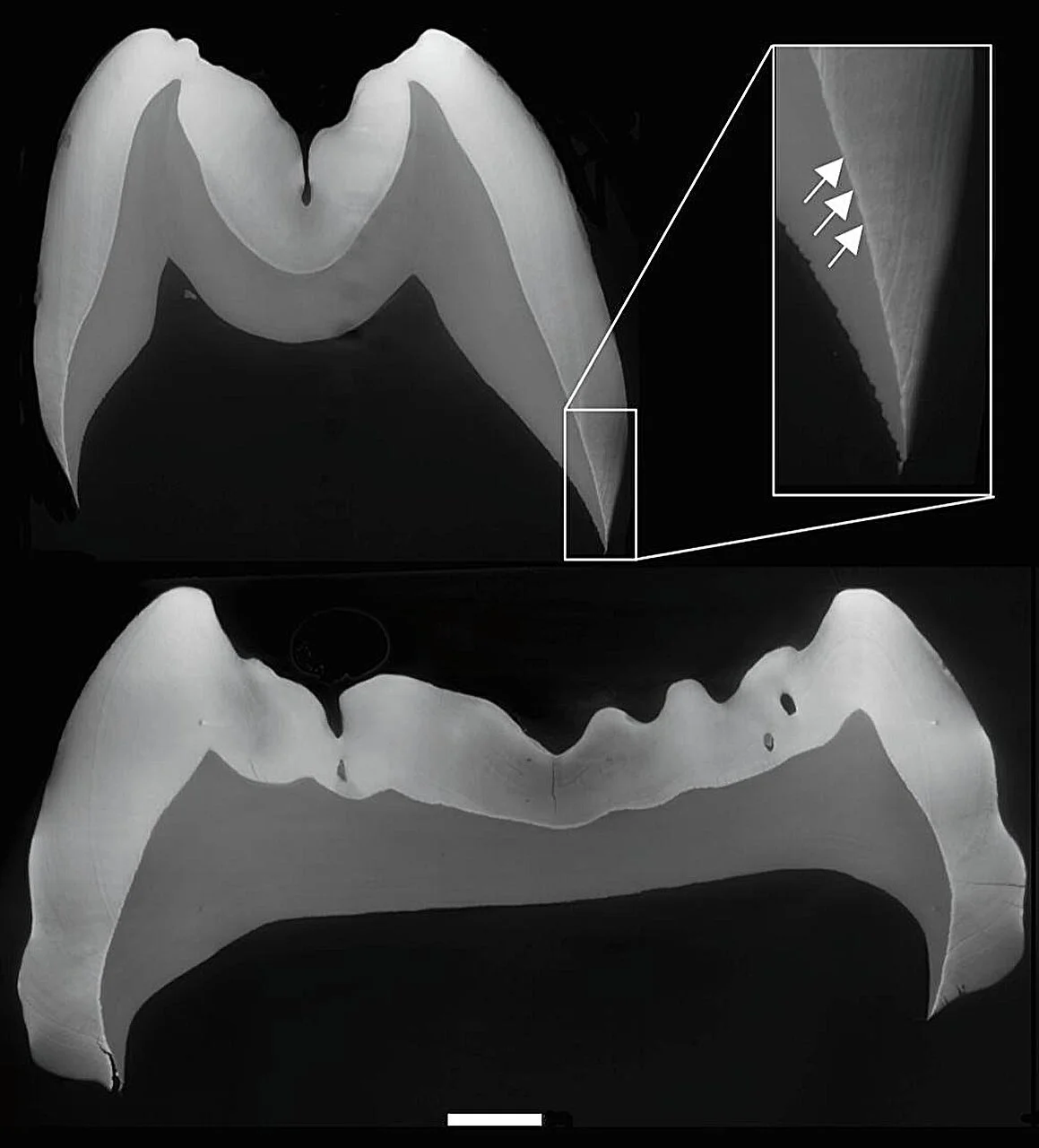
Teeth develop through a process in which mineralized tissues form over time.
Enamel is especially valuable because it is highly mineralized and generally preserves chemical information better than many other tissues.
Dentine also preserves biological information, although it is more vulnerable to chemical alteration after burial.
Unlike some skeletal tissues that continually remodel during life, tooth enamel does not remodel once it has formed. Its chemical composition can therefore preserve evidence of the period when that portion of the tooth developed.
This makes teeth useful for reconstructing aspects of childhood environments and early-life mobility.
Understanding Stable Isotopes
Isotopes are different forms of the same chemical element that contain different numbers of neutrons.
Some isotopes are stable and do not undergo radioactive decay. Their relative abundance can vary according to environmental conditions, diet, geology, and biological processes.
Bioarchaeologists examine isotope ratios in dental tissues to investigate past life histories.
Different isotope systems provide different types of information. No single isotope measurement can independently reconstruct every aspect of a person's movement or diet.
Strontium Isotopes and Geographic Mobility
Strontium isotope analysis is particularly important for investigating geographic mobility.
Strontium enters the food chain through rocks, soil, water, and plants. Its isotope composition varies across geological environments.
People absorb strontium through food and water. During tooth development, some of this chemical signal becomes incorporated into dental tissues.
Researchers compare the isotope values of human teeth with environmental baselines from local plants, water, soil, and small animals.
If a person's tooth enamel has a strontium signature inconsistent with the local environment, this may indicate that they spent part of childhood in another geological region.
However, similar geological environments can produce similar isotope values. A geographic origin cannot always be identified precisely.
Oxygen Isotopes and Environmental Conditions
Oxygen isotopes can provide additional information about the environments in which people lived.
The isotope composition of drinking water varies according to factors such as rainfall, temperature, altitude, distance from the sea, and evaporation.
These environmental differences can influence the oxygen isotope values preserved in dental tissues.
When strontium and oxygen isotope results are considered together, researchers may be able to distinguish between different possible geographic origins or movement patterns.
Nevertheless, oxygen isotope values can also be influenced by food preparation, water sources, and physiological factors. Interpretation requires local environmental reference data.
Seasonal Labour and Repeated Mobility
Seasonal labour involves working in a particular location during a specific period of the year.
Examples include harvesting crops, tending livestock, collecting natural resources, fishing, mining, or participating in construction projects.
People engaged in seasonal work may travel repeatedly between a permanent home and a temporary workplace.
Such movement can be difficult to reconstruct archaeologically because the individual may return to the same settlement after each working season.
If a person moved between environments with distinct isotope signatures, sequential samples from developing teeth might preserve changes associated with that movement.
However, detecting repeated seasonal travel is technically challenging. The timing of tooth formation, the resolution of sampling, and the similarity of environmental isotope values all influence what can be identified.
Incremental Sampling of Dental Tissues
Some teeth preserve chemical variation along their growth structures.
Researchers can collect small samples at different points along enamel or dentine to investigate changes during development.
Incremental sampling may reveal shifts in isotope values over time.
For example, a sequence of measurements might indicate that an individual experienced movement between two different environmental zones during the period when the sampled tissue formed.
But the resolution of the evidence depends on the tooth and the tissue being studied. It is not always possible to identify exact months or seasons.
Researchers must also consider that tooth development differs between tooth types and individuals.
Diet and Carbon Isotopes
Carbon isotope analysis can contribute to understanding diet.
Different plants use different photosynthetic pathways, producing distinct carbon isotope patterns. These differences can pass through food chains and become reflected in human tissues.
Carbon isotope values may therefore help distinguish between diets relying more heavily on certain plant groups or animals that consumed those plants.
In some cases, dietary differences may also reflect movement between ecological zones.
However, carbon isotopes primarily provide information about dietary resources rather than directly identifying a workplace or seasonal occupation.
Nitrogen Isotopes and Protein Consumption
Nitrogen isotope analysis is commonly used to investigate dietary protein sources.
Differences in nitrogen isotope values can reflect the consumption of terrestrial animals, freshwater resources, marine foods, and other dietary patterns.
Researchers may use carbon and nitrogen isotope results together to reconstruct changes in food consumption.
If individuals moved between regions with different food systems, dietary isotope values might change during their lives.
Yet diet can also change because of age, social status, food availability, or cultural practices. A dietary shift does not necessarily indicate geographic mobility.
Connecting Isotope Evidence with Labour
The most difficult part of investigating seasonal labour is linking evidence of movement to actual work.
A person who traveled between two regions may have moved for marriage, family visits, education, religious activities, trade, or other reasons.
To identify seasonal employment, researchers need additional evidence.
This might include skeletal changes associated with repeated physical activity, occupational tools, settlement patterns, workshop remains, agricultural installations, or historical records describing labor arrangements.
For example, isotope evidence of movement between a permanent settlement and a distant agricultural region could become more meaningful if the archaeological landscape contains seasonal farming installations and historical documents describe temporary harvest workers.
Even then, researchers should distinguish between a well-supported interpretation and a definitive identification of occupation.
Skeletal Evidence and Physical Activity
Bones can sometimes preserve evidence of repeated physical stress.
Changes in joints, muscle attachment areas, and patterns of skeletal injury may contribute to research on physical activity.
However, these features are not simple occupational markers. Similar skeletal changes can result from different activities, aging, illness, and individual variation.
Bioarchaeologists therefore avoid assigning a specific occupation based on one skeletal feature.
Combining skeletal evidence with isotopic mobility data and archaeological context can produce a more complete interpretation of past working lives.
Limitations and Ethical Considerations
Isotope analysis has several limitations.
Environmental isotope baselines may be incomplete. Different locations may produce overlapping values. Burial conditions can alter some chemical signals, particularly in dentine and bone.
Tooth development also limits the period of life that can be investigated. A tooth records the conditions under which it formed, not necessarily the individual's entire adult life.
Ethical considerations are equally important. Human remains should be studied with respect for descendant communities, local laws, and cultural traditions.
Sampling should be scientifically justified and as minimally destructive as possible.
Conclusion
Dental isotope analysis offers a powerful method for investigating childhood environments, geographic mobility, and dietary change in past populations. When combined with other archaeological evidence, it may help researchers explore whether individuals moved between regions in ways consistent with seasonal labour.
However, isotope signals do not directly reveal employment, occupation, or the exact timing of work. Seasonal labour must be reconstructed through the combined study of teeth, skeletal remains, environmental baselines, archaeological landscapes, and historical evidence.
This approach helps bring ordinary working people into archaeological narratives. Rather than focusing exclusively on rulers, soldiers, and wealthy individuals, bioarchaeology can investigate the movements and experiences of people whose labor supported the everyday economies of ancient societies.