Introduction
Games have been part of human social life for thousands of years. They provided entertainment, encouraged competition, taught strategic thinking, and created opportunities for interaction between individuals and communities.
Archaeological evidence for ancient games can include carved boards, marked stones, small pieces, counters, dice, and portable objects used during play. Some game boards were permanent features of buildings or public spaces, while others could be carried from one location to another.
Portable game boards are particularly interesting because they reveal how recreational activities could travel with merchants, soldiers, travelers, and ordinary households. Their archaeological study provides insight into leisure, social relationships, and the movement of cultural practices.
What Is a Portable Game Board?
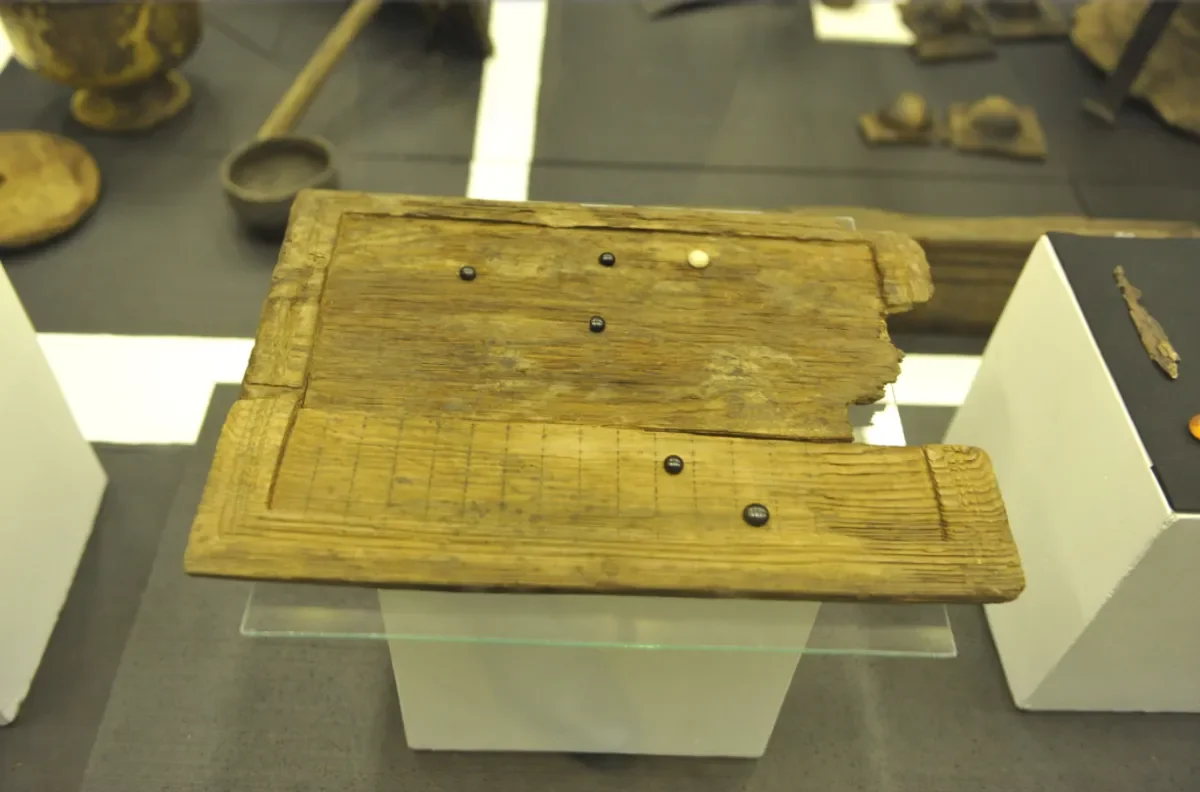
A portable game board is a surface designed or adapted for playing a structured game that can be moved between locations.
It might consist of a wooden board, a carved stone slab, a pottery fragment, a folded material, or a small object marked with lines and patterns.
Some boards were likely manufactured specifically for gaming. Others may have been improvised by drawing or carving patterns onto surfaces already used for different purposes.
The portable nature of these objects made them useful for travelers and people whose activities required frequent movement.
Archaeological Examples and Their Identification
Game boards have been identified in different historical periods and cultural settings. They can appear as grids, intersecting lines, circular arrangements, rows of holes, or other patterned surfaces.
However, not every marked surface represents a game.
A grid carved into stone could have served as a measurement guide, an architectural planning tool, a writing surface, or a decorative pattern.
Researchers therefore examine the shape of the board, repeated examples, associated pieces, wear patterns, and comparisons with historically documented games.
The presence of recognizable counters or playing pieces can strengthen an interpretation, although these objects may also have served other purposes.
Playing Pieces and Counters
Ancient games often required small objects that could be moved across a board.
These pieces might include stones, ceramic fragments, carved bone, shells, glass objects, or specially manufactured tokens.
Their size and shape can reveal how they were handled.
If a group of similar objects is discovered near a board, researchers may investigate whether they formed a set of playing pieces.
However, small stones and counters are common archaeological finds. Their identification as game pieces depends on context rather than appearance alone.
Games and Social Interaction
Games create structured opportunities for social interaction.
They can bring together people from different ages, occupations, and social backgrounds. A game may be played between family members, friends, soldiers, merchants, or strangers sharing a temporary space.
Public gaming areas could become places where people gathered and interacted.
Private games could provide entertainment within households or during travel.
The archaeological presence of gaming equipment may therefore reveal aspects of social life that are rarely described in official historical documents.
Portable Games and Mobility
Portable games were particularly useful in societies where people traveled frequently.
Merchants might carry games during long journeys. Soldiers could use them during periods of rest. Sailors might play while waiting in ports or during periods when ships were not moving.
Such objects could also spread cultural practices between regions.
A game board discovered far from its presumed place of origin might indicate the movement of people or ideas. However, it does not necessarily prove that the game itself originated in the location where the object was found.
Games can be borrowed, adapted, and modified through cultural contact.
Learning and Strategic Thinking
Many games involve memory, planning, probability, and decision-making.
Children may have used simple games to develop counting skills and understand rules. Adults could engage in more complex forms of strategic competition.
Games might therefore have served educational purposes as well as entertainment.
Some activities could also have helped players practice skills relevant to warfare, trade, or resource management. Yet such functions should not be assumed without evidence.
A game involving strategic movement does not automatically mean it was designed to train military commanders.
Social Status, Competition, and Gambling
Games can reflect differences in social status.
Some gaming objects may have been made from expensive materials or decorated with elaborate designs. These objects could indicate access to wealth or specialized craftsmanship.
Games might also have involved wagering or the exchange of valuables.
However, the presence of dice or counters does not prove that gambling occurred. The rules and social meaning of ancient games are often unknown.
Researchers must distinguish between evidence of play and assumptions about how people experienced that play.
Archaeological Methods
The study of portable game boards combines several archaeological approaches.
Wear analysis can identify repeated contact between pieces and board surfaces. Microscopic examination may reveal polishing, scratching, or other patterns associated with movement.
Experimental archaeology can help researchers test how pieces fit into grooves or how a board may have been used.
Comparative analysis is also important. Similar boards from different regions may indicate shared gaming traditions, although resemblance alone cannot establish direct cultural transmission.
Reconstructing Ancient Rules
One of the greatest challenges is determining how ancient games were played.
A board may survive while its rules disappear.
Written descriptions, illustrations, surviving pieces, and comparisons with later traditional games can help researchers develop possible reconstructions.
However, reconstructed rules should be treated as hypotheses unless supported by direct historical evidence.
Different communities may also have used similar boards for different games.
Conclusion
Portable game boards provide a valuable glimpse into the recreational lives of ancient communities. They reveal how people entertained themselves, interacted socially, developed strategic skills, and carried cultural practices across different environments.
Their interpretation requires caution because marked surfaces and small objects can serve many purposes. Through contextual excavation, wear analysis, comparative research, and historical documentation, archaeologists can better distinguish gaming equipment from other artifacts.
The study of ancient games reminds us that human history was shaped not only by warfare, trade, and political power, but also by ordinary moments of competition, amusement, and shared play.