Coastal landscapes have changed dramatically throughout human history. Rising sea levels, tectonic movement, coastal erosion, and the construction of reservoirs have submerged areas that were once accessible on foot. In some locations, these lost landscapes may contain pathways, steps, causeways, or other structures that once connected settlements with ceremonial spaces. The possibility of submerged ritual pathways offers an opportunity to investigate how people organized movement through sacred landscapes and how environmental change transformed places of cultural importance.
A ritual pathway is a route used as part of a religious or ceremonial activity. It may connect a settlement with a shrine, burial ground, sacred spring, temple, or other significant location. Some pathways could have been formally constructed, using stone paving, steps, walls, or raised causeways. Others may have followed natural ridges, shorelines, or established footpaths that acquired ceremonial meaning through repeated use. The archaeological challenge is to determine whether a route served a ritual purpose or was primarily intended for ordinary transportation.
Submergence can occur through several processes. Global sea-level rise can flood low-lying coastal terrain, while local subsidence may lower land relative to the sea. Earthquakes can alter the elevation of shorelines, and erosion can remove sections of a route before or after inundation. Inland, the creation of reservoirs may cover older settlements and paths beneath artificial lakes. Each process creates different archaeological conditions, influencing how structures survive and how researchers can investigate them.
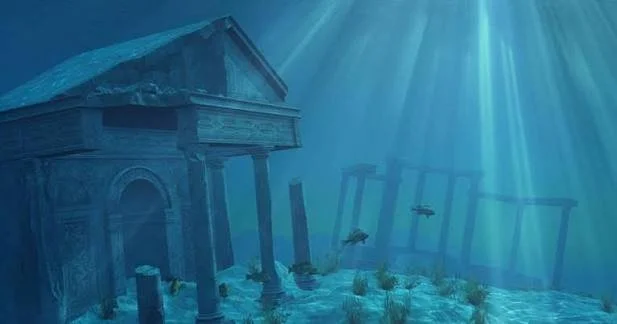
A submerged pathway might be recognized through a linear arrangement of stones, a series of steps descending beneath the water, or a constructed surface extending between two identifiable locations. Walls or embankments may indicate that the route was deliberately stabilized. Associated structures, such as platforms or designated gathering areas, could suggest that the pathway formed part of a larger architectural complex. Yet underwater linear features can also represent natural rock formations, geological fractures, ordinary roads, fish traps, or modern infrastructure.
Establishing the function of a pathway requires evidence from its surrounding landscape. A route connecting a settlement with a burial area or a known ceremonial site might support a ritual interpretation, particularly if the route contains features associated with repeated gatherings or offerings. However, proximity alone is not conclusive. A path could have served several purposes, and a route used for ordinary travel might later have acquired religious significance.
Underwater archaeological survey begins with mapping the submerged terrain. Multibeam sonar can record the shape of the seafloor, while side-scan sonar can help identify objects and surface features. Remotely operated vehicles and carefully planned diving surveys may allow researchers to examine suspected structures more closely. Photogrammetry can combine overlapping images into detailed three-dimensional models, making it possible to document features without removing them from their original context.
Sediment analysis can help reconstruct the environmental history of the site. Layers of sand, mud, shells, and other deposits may reveal whether the area was once a beach, marsh, riverbank, or terrestrial surface. Changes in sediment composition can sometimes indicate when water began to cover a location. Dating organic remains or suitable materials associated with the pathway may help establish its age, although researchers must ensure that the samples are directly related to the construction or use of the route.
The interpretation of ceremonial movement can also draw on the architecture of the pathway. Steps may have controlled the pace of movement, while changes in width or direction could have guided participants toward a particular destination. A route might have passed through visually prominent locations or followed a natural feature regarded as significant by the community. Nevertheless, these interpretations require caution because the same architectural characteristics can occur in ordinary access routes.
Offerings and associated objects may provide additional evidence of ritual activity. Objects deliberately placed near a pathway, repeated deposits in a specific location, or unusual concentrations of material may indicate ceremonial use. Underwater currents can move artifacts away from their original positions, however, and objects may also have entered the water accidentally. Their distribution must be evaluated alongside sediment movement, preservation conditions, and the possibility of later disturbance.
The cultural significance of submerged sites extends beyond their physical remains. Some underwater landscapes may retain meaning for descendant communities, particularly where local traditions remember former coastlines, sacred places, or ancestral activities. Archaeological research should therefore involve appropriate consultation and respect for cultural knowledge. The fact that a site is underwater does not make it an abandoned or culturally insignificant place.
Submerged ritual pathways also demonstrate how changing environments can transform the accessibility of sacred landscapes. A route once walked during ceremonies may now lie beneath the sea, while a former coastal shrine may have become isolated from the land that connected it to a community. Reconstructing these changes can help researchers understand how people adapted their ceremonial practices to shifting shorelines and how cultural landscapes developed over time.
The study of submerged ritual pathways combines underwater archaeology, geology, environmental reconstruction, and the study of religious landscapes. By establishing the construction, chronology, and context of underwater routes, researchers can investigate whether they were associated with ceremonial movement and how they functioned within wider settlement systems. Careful interpretation is essential, because the presence of a submerged structure alone cannot establish its ritual purpose. When several forms of evidence support the same explanation, however, these lost pathways can reveal important connections between human belief, movement, and environmental change.