Island communities have often depended on the sea for transportation, trade, fishing, and communication. These connections brought economic opportunities, but they could also expose islands to piracy, rival powers, military expeditions, and other maritime threats. In different historical periods, small cannons became part of the defensive equipment used to protect harbors, settlements, fortifications, and important coastal approaches. Their archaeological remains can reveal how island communities organized defense, acquired military technology, and adapted their strategies to the challenges of maritime security.
Small cannons varied widely in design, material, and purpose. Some were mounted on ships, where they could be used against other vessels or coastal positions. Others were installed on land to defend harbor entrances, walls, towers, and fortified settlements. Their effectiveness depended on their size, construction, ammunition, mounting arrangements, and the training of the people operating them. A cannon's physical dimensions can help researchers understand its capabilities, but its intended role must also be considered in relation to the setting in which it was found.
Archaeological evidence may include cannon barrels, cannonballs, fragments of gun carriages, metal fittings, ammunition storage areas, and structural remains associated with artillery positions. Some guns were cast from bronze, while others were manufactured from iron using different production techniques. Casting marks, inscriptions, bore dimensions, and manufacturing characteristics can sometimes help identify the period and origin of a weapon. Corrosion, marine encrustation, and damage caused by impact or burial may make such identification difficult.
The discovery of a cannon on an island does not automatically indicate that it was used for local defense. It may have belonged to a ship that sank offshore, been transported as cargo, or been moved to the location long after its original use. A cannon recovered from a harbor could have been part of a defensive battery, a merchant vessel, a military ship, or a later salvage operation. Researchers must therefore examine the object's archaeological context, its condition, associated artifacts, and the history of the surrounding site.
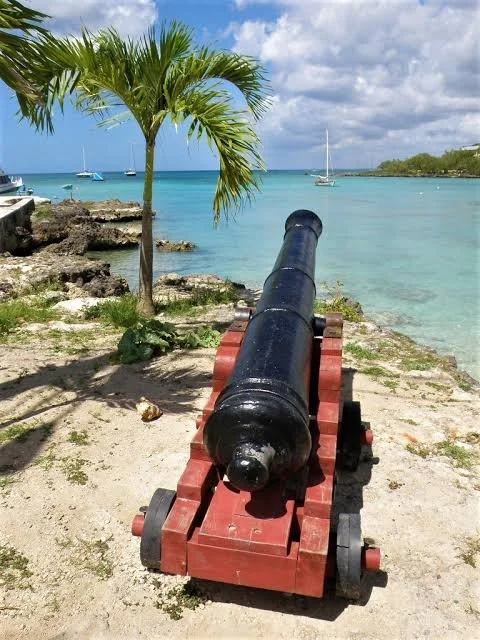
The placement of artillery can reveal how island communities assessed potential threats. Cannons positioned near narrow harbor entrances might have been intended to control access by hostile vessels. Guns installed on elevated ground could provide a wider field of view over the sea, while those placed along fortified walls might protect the approaches to a settlement. The relationship between gun positions, sightlines, harbor geometry, and nearby defensive structures can help researchers reconstruct the intended coverage of a defensive system.
However, the range and effectiveness of historical artillery varied considerably. A small cannon could be useful against lightly armed vessels or in close-range defense, but it might have limited effectiveness against larger, heavily armed ships. The positioning of several guns could create overlapping fields of fire, although this arrangement depended on the available terrain and the technology of the period. Archaeologists can investigate these possibilities through architectural surveys and digital models of historical coastlines.
The logistics of artillery defense were as important as the weapons themselves. Cannons required suitable ammunition, maintenance, mounting structures, and trained operators. Gunpowder had to be stored and protected from moisture, while ammunition needed to be transported and kept ready for use. Evidence of storage rooms, defensive platforms, workshops, and access routes can therefore reveal how a community supported its artillery rather than simply possessing it.
The availability of weapons also reflects economic and political relationships. Island communities might acquire cannons through trade, military supply systems, local manufacture, gifts, or the capture of enemy equipment. Imported weapons could connect an island to a distant state or commercial network. Differences in cannon design and composition may help identify these connections, although the movement of weapons between owners can complicate attempts to determine their original source.
Small cannons also had uses beyond direct combat. Some were fired to signal arrivals, communicate warnings, mark ceremonies, or participate in public celebrations. A cannon recovered near a harbor or public building might therefore have served a ceremonial or administrative role rather than a purely defensive one. Researchers should consider historical documentation, wear patterns, mounting arrangements, and the surrounding architecture before assigning a military function.
The archaeological record can sometimes help reconstruct episodes of conflict. Cannonballs, damaged fortifications, ammunition deposits, and weapons found in secure destruction layers may indicate violent events. Yet linking such evidence to a particular battle or attack requires reliable dating and historical comparison. A cannonball could have been stored for years before use, and damage to a fortification might result from later rebuilding, natural deterioration, or a different conflict.
Island environments create special conservation challenges. Cannons recovered from the sea may contain extensive corrosion, while the removal of marine deposits can expose unstable metal surfaces. Conservation specialists must assess the material, stabilize the object, and control the drying process where necessary. Some underwater military remains may also present hazards if unexploded ammunition or other dangerous materials are present. Such sites should be investigated only by qualified professionals following appropriate safety procedures.
The archaeology of small cannons provides insight into how island communities responded to maritime threats and organized the resources required for defense. By studying weapons, fortifications, ammunition, and harbor layouts together, researchers can reconstruct the relationship between military technology and local geography. The evidence also reveals that artillery was part of a broader system involving supply, training, communication, and political authority. Understanding that system helps explain how island communities protected their settlements and maintained connections with the wider maritime world.