Ancient Egyptians and Etruscans are often credited with inventing early orthodontics, supposedly using fine gold wires and catgut to straighten teeth. This idea has appeared in dentistry books for many years, suggesting that ancient societies were already concerned with perfect smiles. However, closer examination by archaeologists and dental historians has shown that this belief is largely incorrect.
A well-known example is the El-Quatta dental bridge from Egypt, dated to around 2500 BC. The gold wire found with the remains was once thought to function like braces, but evidence shows it was actually used to stabilise loose teeth or secure replacement teeth. Rather than aligning teeth, it served as a dental prosthesis.
The same applies to gold bands found in Etruscan tombs. These were likely dental splints meant to support teeth weakened by injury or gum disease, not tools designed to move teeth into proper alignment.
There are also practical reasons why these objects could not have worked as braces. Tests on Etruscan dental appliances revealed that the gold used was about 97% pure. Pure gold is extremely soft and bends easily, making it unsuitable for orthodontics. Braces require firm, elastic materials that can apply steady pressure over time. Gold of this purity would simply deform or break under such stress.
Another telling detail is who wore these gold bands. Many were found with female skeletons, which suggests they may have been symbols of status or decorative items rather than medical devices. Notably, none were found on children or teenagers—those most likely to need orthodontic treatment if such practices existed.
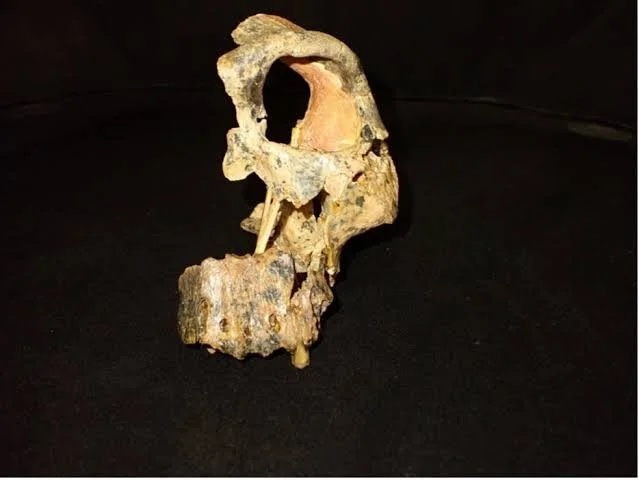
Perhaps the most interesting point is that ancient populations rarely suffered from the dental issues common today. Crooked or crowded teeth were extremely uncommon in the past. Studies of Stone Age skulls show little to no malocclusion, largely due to diet.
Ancient diets consisted of tough, fibrous foods that required extensive chewing. This constant jaw use led to larger, stronger jaws that easily accommodated all teeth. Modern diets, which are softer and more processed, do not provide the same stimulation, resulting in smaller jaws and crowded teeth.
Because misaligned teeth were so rare in ancient times, there was little need to develop techniques to straighten them.

Jaws were larger, due to food being tougher to chew on.
Ancient Egyptians and Etruscans are often credited with inventing early orthodontics, supposedly using fine gold wires and catgut to straighten teeth. This idea has appeared in dentistry textbooks for decades, suggesting that ancient societies were surprisingly advanced in their concern for straight smiles. However, closer examination by archaeologists and dental historians has shown that this belief is largely a misconception.
One commonly cited example is the El-Quatta dental bridge from Egypt, dated to around 2500 BC. While gold wire was indeed found with ancient remains, it was not used to realign teeth. Instead, the wire helped stabilize loose teeth or secure replacement teeth. In short, it functioned as a dental prosthesis rather than orthodontic braces.
Finds from Etruscan tombs tell a similar story. The gold bands discovered there were most likely dental splints, intended to support teeth damaged by disease or injury, not to shift them into better positions.
There are also strong practical reasons why these devices could not have worked as braces. Tests on Etruscan gold appliances show the metal was about 97 percent pure. Pure gold is very soft, bending and stretching easily. Orthodontic treatment requires steady, long-term pressure from metal that is resilient and springy. Gold of this purity would simply deform or break if tightened enough to move teeth.
Another intriguing detail is who wore these gold bands. Many were found in the graves of women, suggesting they may have symbolized status or served as decorative objects rather than medical tools. Notably, none have been found on children or adolescents—precisely the age group where orthodontic devices would be expected if they were truly used for tooth straightening.
Perhaps most interesting of all is that ancient people rarely suffered from the dental issues common today. Crooked or crowded teeth, known as malocclusion, were extremely uncommon in the past. Studies of Stone Age skulls show little to no crowding. This difference is largely due to diet.
Ancient diets consisted of tough, fibrous foods that required heavy chewing. This constant use encouraged the development of large, strong jaws capable of accommodating all the teeth. Modern diets, which are softer and more processed, require far less chewing. As a result, jaws often develop smaller, while teeth remain the same size, leading to crowding.
Because misaligned teeth were rare in ancient times, there was little need to develop methods to correct them.
That said, some early attempts to address dental irregularities did exist. One of the earliest reliable references comes from Roman times. In the first century AD, Roman medical writer Aulus Cornelius Celsus advised that if a child’s tooth erupted crooked, it should be gently pushed into place daily with a finger until it aligned properly. Though simple, this method relied on the same basic principle used today: sustained gentle pressure can move a tooth.
After the fall of Rome, progress in orthodontics stalled for centuries. Interest resurfaced in the 18th century, though early methods were often painful. People without access to proper dental tools used wooden “swelling wedges” to separate crowded teeth. These wedges absorbed saliva, expanded, and forced teeth apart—an extremely uncomfortable approach, but one that demonstrated an understanding of tooth movement through pressure.
True scientific orthodontics began in 1728 with French dentist Pierre Fauchard, often regarded as the father of modern dentistry. In his influential work The Surgeon Dentist, he provided the first detailed descriptions of treating malocclusion.
Fauchard developed the “bandeau,” a curved metal strip placed around teeth to widen the dental arch. This was the first appliance specifically designed to move teeth using controlled force. He also described methods for stabilizing teeth after repositioning. His work marked a turning point, shifting orthodontics from myth and crude experimentation to a scientific discipline.
During the 19th and 20th centuries, orthodontics advanced rapidly. The introduction of metal brackets, archwires, elastics, and later stainless steel made treatments more effective and predictable. Subsequent innovations—such as ceramic brackets, lingual braces, and clear aligners—made orthodontic care more discreet.
Today, orthodontics relies on digital imaging, computer modeling, and 3D printing, allowing for highly precise treatment planning.
While the image of ancient people wearing gold braces is appealing, it does not reflect historical reality. Ancient societies recognized dental issues and occasionally attempted simple solutions, but they lacked both the need and the technology for true orthodontic treatment.
The real development of orthodontics began not in antiquity, but with the scientific advances of the 18th century and later—a history that remains compelling even without the myths.