The Ancient Silk Road: How Buddhism Traveled from India to China
Buddhism originated in the eastern Indian subcontinent in the 6th century BCE. Over the next several centuries, it spread beyond its birthplace, primarily eastward to China. The transmission of Buddhism to China is one of the most transformative cultural exchanges in human history, facilitated heavily by the network of trade routes known as the Silk Road.
Rather than a single event, the journey of Buddhism was a gradual process of translation, adaptation, and cultural exchange along the desert oases of Central Asia.
1. The Routes of Transmission
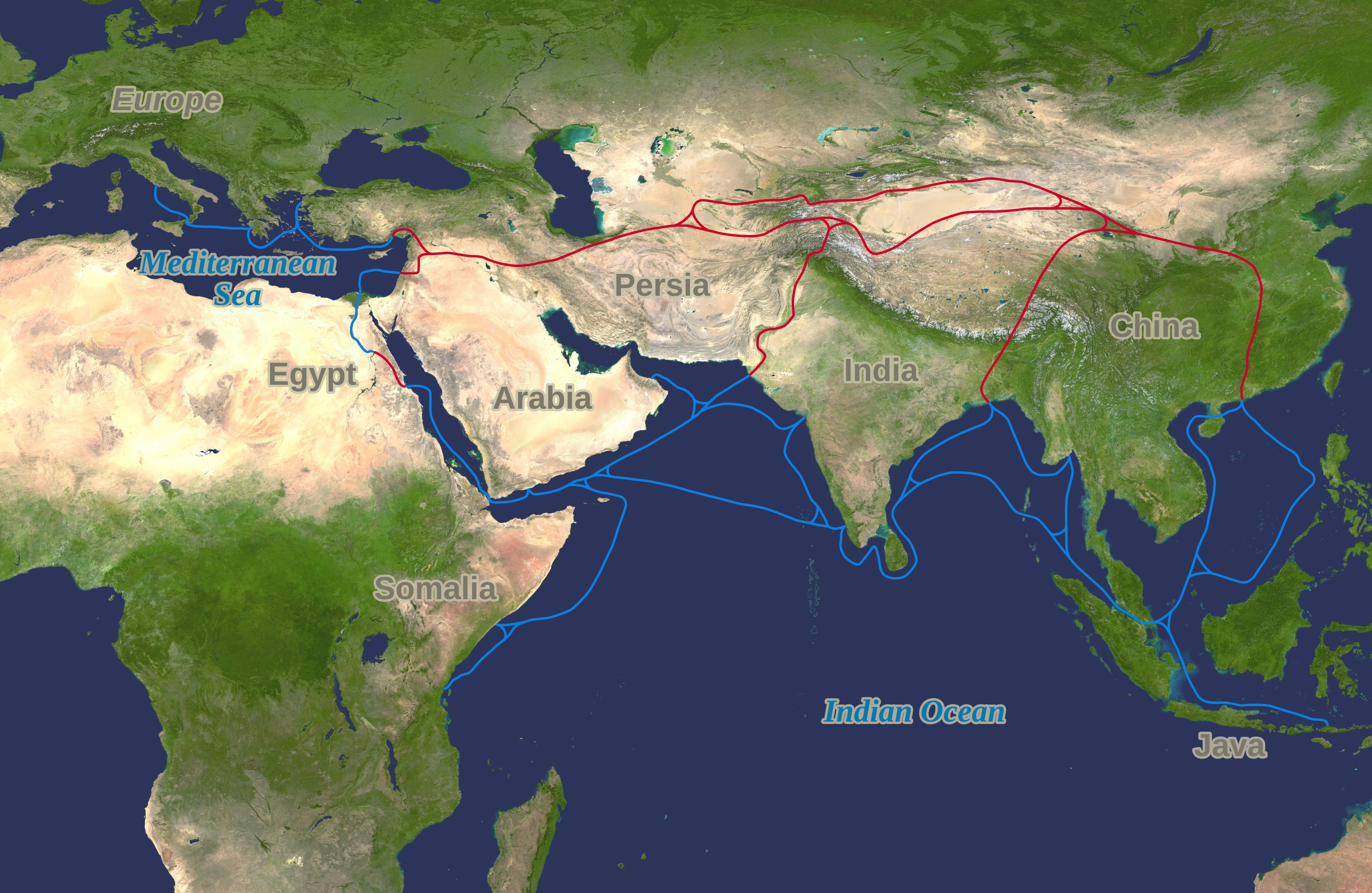
The Silk Road split into two main branches around the Taklamakan Desert, flanking the Tarim Basin, before connecting to the Chinese imperial capitals of Chang'an and Luoyang.
The Northern Route: Passed through kingdoms like Kashgar, Aksu, Kucha, and Turpan before reaching the Dunhuang oasis. This route was heavily influenced by the translation work of early Central Asian monks.
The Southern Route: Traversed through Yarkand, Khotan, and Miran, eventually meeting the Northern Route at Dunhuang. Khotan was an early, powerful center of Mahayana Buddhism.
2. The Role of Monks and Merchants
The initial transmission was driven by a symbiotic relationship between traveling merchants and Buddhist monks.
The Merchants: Caravans traversed the dangerous desert terrain looking to trade silk, spices, and precious metals. To seek protection during difficult journeys, merchants patronized Buddhist monks, building cave shrines and monasteries along the way.
The Monks: Buddhist ascetics traveled alongside the caravans or established outposts at oasis trade stops. They brought texts, scrolls, and relics, transforming desert monasteries into vital rest stops and hospitals for travelers.
3. The Oasis Kingdoms and Dunhuang
As Buddhism moved along the trade routes, it passed through distinct cultural centers that acted as melting pots.
Kucha: An important kingdom in the Tarim Basin that became a thriving center of Buddhist culture, famed for its Sanskrit translations and monastic complexes.
The Mogao Caves (Dunhuang): Situated at the convergence point of the Silk Road branches in western China, Dunhuang became the premier treasury of Buddhist art. Beginning in the 4th century CE, monks, merchants, and local rulers began carving hundreds of cave temples into the cliffs, filling them with statues and murals that document the evolution of Buddhist iconography.
4. Linguistic and Philosophical Translation
The intellectual transition of Buddhism into China required translating concepts from Sanskrit and Prakrit into a Chinese language and philosophy rooted in Confucianism and Daoism.
Equivalence Strategy: Early translators used Daoist terminology to explain Buddhist concepts (e.g., using Dao "the Way" to translate Dharma "the teaching," and wuwei "non-action" for Nirvana).
The Translators: Master translators like Kumarajiva (who arrived in Chang'an in 401 CE) and the pilgrim-monk Xuanzang (who traveled to India in the 7th century CE) established highly precise translation bureaus. They standardized scriptures so that complex Indian philosophies could be understood in the Chinese imperial courts.