The Olmec Influence: How the "Mother Culture" Shaped Mesoamerica
Flourishing from roughly 1200 to 400 BCE in the tropical lowlands of south-central Mexico, the Olmec civilization is widely regarded as the foundational "mother culture" of Mesoamerica. While contemporary anthropologists often debate whether "mother culture" or "sister culture" better describes their relationship to later societies, the Olmec established a baseline of social, religious, and artistic practices that rippled through time.
Civilizations like the Maya, Zapotec, Teotihuacan, and Aztec all built upon the intellectual and cultural blueprint created by the Olmec.
1. Monumental Architecture and Urban Planning
The Olmec were the first in Mesoamerica to construct massive ceremonial centers and earthen pyramids, establishing an architectural tradition that defined regional city-states for millennia.
Ceremonial Centers: Sites like San Lorenzo and La Venta were oriented along specific axes, typically aligning with astronomical points. These complexes served as both religious centers and seats of elite power.
Earthen Mounds and Pyramids: The Olmec constructed massive clay platforms and the region's first known pyramid at La Venta, setting a precedent for the towering stone pyramids later built by the Maya and Teotihuacan.
2. Religious Iconography and Deities
Olmec art is deeply symbolic, and their pantheon of deities and supernatural beings was absorbed and adapted by subsequent cultures.
The Jaguar Motif: The Olmec frequently depicted a fusion of human and jaguar features, often called the "were-jaguar." This creature is linked to rain, fertility, and the earth, and it evolved into the powerful rain and lightning gods of later cultures (such as Tlaloc among the Aztecs and Chaac among the Maya).
The Feathered Serpent: Early Olmec art contains the foundational imagery of a feathered or plumed serpent, a deity that would eventually become one of the most prominent gods across Mesoamerica (Quetzalcoatl or Kukulcán).
3. Intellectual and Ritual Foundations
Beyond architecture and art, the Olmec pioneered systems of communication, timekeeping, and ritual that structured Mesoamerican life.
The Mesoamerican Ballgame: The Olmec are credited with developing the rubber ball and the earliest ball courts. The game held deep religious and political significance and was played in every major Mesoamerican civilization.
Writing and Calendrics: Recent discoveries, such as the Cascajal Block, indicate that the Olmec developed one of the earliest writing systems in the Americas. Furthermore, they utilized the 260-day ritual calendar, which became a core component of both Maya and Aztec timekeeping.
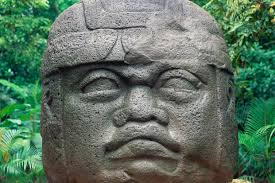
Monolithic Carving: The most famous Olmec artifacts are the massive basalt Colossal Heads, weighing up to 20 tons. These represent individual rulers and established the tradition of carving massive, individualized portraits of leaders in stone.
4. Trade and Exchange Networks
The spread of Olmec influence was not just ideological; it was actively maintained through vast trade networks that stretched from the Valley of Mexico to Central America.
Exotic Materials: The Olmec imported non-local materials such as jadeite, serpentine, obsidian, and iron ore (magnetite), processing them into exquisite ritual objects.
Diffusion of Style: "Olmecoid" pottery, figurines, and jade celts have been found far from the Gulf Coast, indicating that neighboring groups highly prized Olmec craftsmanship and sought to emulate their symbols of status.