Introduction
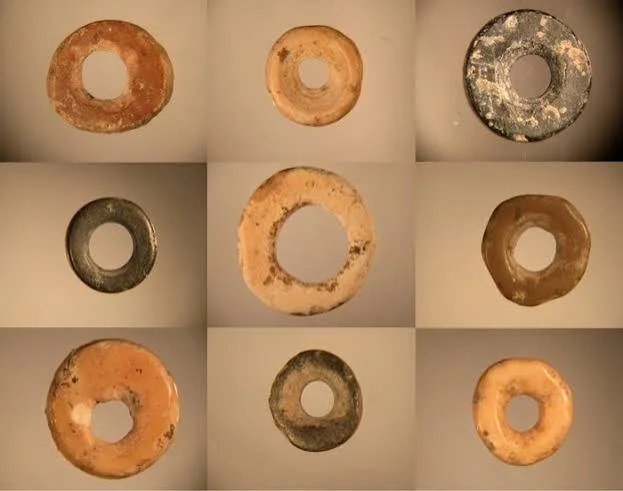
Beads are among the most widely distributed forms of personal ornament in the archaeological record. They can be made from stone, shell, bone, teeth, ceramic, glass, metal, and other materials. Their small size makes them portable, while their decorative and symbolic possibilities allow them to communicate identity, relationships, status, and cultural affiliation.
Because beads often travel far from the places where their raw materials were obtained, they can provide valuable evidence of exchange networks. A bead discovered at an archaeological site may reveal connections between communities separated by considerable distances.
However, the movement of a bead does not automatically prove direct trade between its place of manufacture and its final location. Objects can pass through many hands, be reused across generations, or acquire new meanings as they move between societies.
Why Beads Matter
Beads can serve several purposes.
They may be worn as necklaces, bracelets, clothing decorations, hair ornaments, or components of other objects. They can also be deposited in graves, used in ceremonies, or kept as treasured possessions.
Their significance varies by culture and context.
A bead made from an uncommon material might communicate access to distant resources. A particular shape or arrangement could identify membership in a social group, although such meanings must be established through evidence.
Researchers should not assume that all beads functioned primarily as status symbols. Some may have been ordinary ornaments, while others carried personal, protective, or ritual meanings.
Raw Materials and Geographic Origins
The first step in investigating bead exchange is identifying the material.
Shell beads may derive from marine or freshwater species. Stone beads can be made from minerals with distinct geological distributions. Bone and teeth can sometimes be linked to particular animal species.
Scientific methods can help establish the composition and possible origin of materials.
For example, mineralogical and elemental analysis may compare a stone bead with geological sources. Biological identification may help determine the species from which a shell or tooth originated.
However, identifying a material source does not automatically reveal the route it followed. A bead may have been transported as a finished object, manufactured elsewhere from imported raw material, or repeatedly exchanged between communities.
Manufacturing Techniques
Bead production involves several stages, including selecting the raw material, shaping it, perforating it, polishing it, and sometimes decorating it.
Manufacturing traces can reveal how these tasks were performed.
Researchers may identify drilling marks, grinding surfaces, unfinished blanks, broken pieces, and production debris. A concentration of such materials may indicate that beads were manufactured at the site.
If finished beads occur without production waste, they may have arrived through exchange, although portable craftspeople could also have made objects using equipment that left few traces.
Technological comparison can reveal similarities between bead-making traditions across different regions.
Exchange Networks and Distance
The geographic distribution of beads can help researchers investigate movement and exchange.
If a material originates far from the site where a bead was found, some form of transport must have occurred. This may involve trade, migration, gift exchange, marriage connections, pilgrimage, or other forms of social interaction.
The network need not have been centralized. An object could move through a sequence of small exchanges between neighboring communities.
Archaeologists use distribution maps, material sourcing, chronology, and manufacturing analysis to investigate these possibilities.
A wide distribution does not necessarily mean that a single large trading organization existed. Several overlapping networks may have moved similar objects.
Beads and Social Identity
Personal ornaments can help people express identity and relationships.
Differences in bead material, color, shape, or arrangement may correspond with age, gender, social role, community affiliation, or personal preference.
Burial contexts are particularly useful because researchers can examine how beads were arranged around the body and whether their distribution differed among individuals.
Yet social categories cannot be inferred from ornament alone. Burial customs vary, and the placement of an object may reflect ritual decisions made by surviving relatives rather than the deceased person's everyday clothing.
Interpretations should therefore be based on repeated patterns and comparison with other evidence.
Beads in Burials
Beads are frequently found in graves because personal ornaments may be buried with their owners or included as offerings.
Their arrangement can reveal whether they were worn as part of a necklace, attached to clothing, or placed separately.
Some graves contain large numbers of beads, while others contain very few or none. These differences may reflect social distinctions, personal choices, funerary customs, or preservation.
The absence of beads does not necessarily mean that a person lacked ornaments during life. Organic strings and other components may decay, leaving only part of the original object.
Beads and Gender Interpretation
Researchers sometimes investigate whether particular ornament types were associated with men, women, children, or other social categories.
Such patterns can be informative, but they must not be assumed in advance.
Modern ideas about gender do not automatically apply to prehistoric societies. The same bead type might have been used by several groups, and burial practices may not directly reflect everyday identity.
A careful study compares bead assemblages with skeletal evidence, burial context, settlement patterns, and broader cultural traditions.
Children, Learning, and Craft Production
Bead-making may have provided opportunities for learning specialized skills.
Unfinished objects, mistakes, broken blanks, and variation in manufacturing quality can help researchers investigate how techniques were taught and practiced.
However, imperfect objects do not automatically identify child workers. They may reflect different production stages, time pressure, or the work of adults with varying levels of expertise.
Experimental replication can help determine how difficult a particular manufacturing technique was and what kinds of waste it produced.
Exchange and Economic Value
Beads may have carried economic value, but their worth was not necessarily fixed.
An object made from a rare material could be prestigious in one region and relatively ordinary in another. Its value might depend on appearance, cultural significance, labor invested in production, or its association with a particular person.
Researchers should be cautious about describing beads as money unless evidence supports their use in standardized exchange.
An object can be valuable without functioning as currency.
Beadwork and Cultural Change
Changes in bead styles can help researchers investigate contact between communities.
A new material or manufacturing technique may appear alongside other evidence of exchange or migration. Similar styles across distant regions can suggest communication, imitation, or shared cultural traditions.
Yet stylistic similarity does not automatically prove direct contact. Similar designs can develop independently, and imported objects may be adopted in new ways.
Chronology is essential. Two communities cannot have exchanged a particular object directly if the relevant objects belong to widely separated periods.
Conservation and Scientific Analysis
Beads are often small and fragile. Organic materials may deteriorate, while minerals can crack or change appearance.
Cleaning and restoration can remove traces of manufacturing or residues that may be important for research.
Scientific analysis should therefore be planned carefully. Researchers may use microscopy, elemental analysis, and three-dimensional imaging to document objects without unnecessary damage.
The results should be interpreted alongside archaeological context rather than treated as independent proof of social relationships.
Conclusion
The archaeology of beadwork provides a powerful way to investigate prehistoric exchange, identity, craft production, and social relationships. Beads made from distant materials can reveal movement across landscapes, while manufacturing traces and burial arrangements help researchers understand how objects were produced, worn, and valued.
However, a bead's origin does not automatically identify its route, and its placement in a grave does not fully reveal its owner's identity. Reliable interpretations require material sourcing, technological analysis, spatial comparison, and careful contextual study.
Through these combined methods, beads become more than decorative objects. They preserve evidence of the connections people formed through trade, gift-giving, migration, personal relationships, and shared cultural traditions.