Introduction
Tattooing has a long history in human societies, but detecting ancient tattooing is difficult because pigment is usually applied to the skin rather than to bone. In favorable conditions, tattoos may survive in preserved skin, such as that of certain naturally or artificially preserved bodies. In most archaeological settings, however, the skin decomposes and leaves little direct evidence.
This creates an important distinction between the archaeology of tattooing and the study of skeletal remains. Bones may preserve evidence of cultural practices indirectly, but a skeletal feature should not be identified as a tattoo marker without strong supporting evidence.
Researchers investigating ancient tattooing may combine preserved soft tissue, pigment analysis, tattooing tools, historical descriptions, iconography, and burial context. Skeletal analysis can contribute to understanding the individual and the circumstances of preservation, but it cannot usually prove that a person was tattooed.
Why Tattooing Is Difficult to Detect
Tattooing involves introducing pigment into the skin. The process may leave little or no distinctive evidence in the skeleton.
Once soft tissue decomposes, the pigment may disappear or become dispersed, depending on the preservation conditions and the chemical properties of the material.
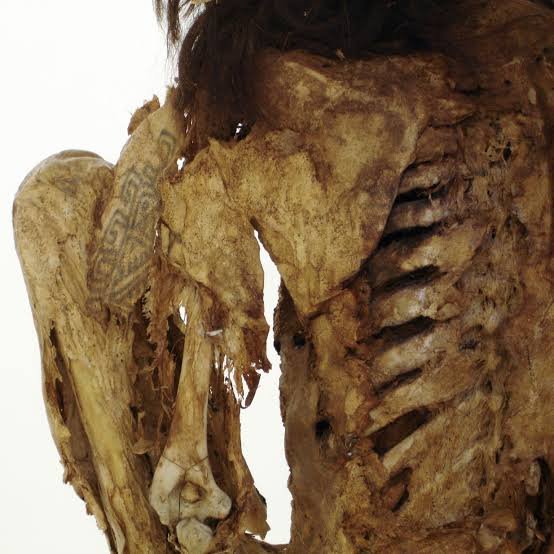
In exceptional circumstances, preserved skin can retain visible tattoo designs. These cases provide direct evidence, although interpreting the design's meaning remains a separate challenge.
When only skeletal remains survive, researchers generally need indirect evidence to investigate tattooing practices.
Skeletal Markers and Their Limitations
The phrase skeletal marker can refer to a feature of bone that provides information about an individual's life, health, activity, or physical history.
Examples include healed fractures, muscle attachment changes, dental modifications, and certain forms of bone remodeling.
None of these features is a generally accepted direct indicator of tattooing.
Tattooing usually affects the skin and superficial tissues, not the bone itself. Some tattooing practices may involve procedures that produce injury or scarring, but a skeletal change cannot be attributed to tattooing without a clear and specific connection.
Researchers must distinguish between evidence of bodily modification and evidence of a particular technique.
Direct Evidence from Preserved Bodies
The strongest evidence for ancient tattooing comes from preserved skin showing pigment arranged in deliberate patterns.
In some cold or otherwise favorable environments, human remains have retained skin and tattoos. Such discoveries can reveal the location, color, arrangement, and sometimes the technique used to create the designs.
Scientific imaging can help identify pigment beneath or within the skin. Microscopy and chemical analysis may reveal the materials used.
However, even direct evidence does not automatically explain the meaning of a tattoo. Its significance might have involved identity, healing, status, spirituality, protection, personal history, or several purposes at once.
Interpretation requires cultural and archaeological context.
Tools and Pigment Preparation
Tattooing tools may include sharp points, needles, or implements designed to puncture or abrade the skin. Pigments may be derived from carbon, minerals, or other materials.
Potential tattooing tools are difficult to identify because small pointed objects can serve many functions. Needles may have been used for sewing, leatherwork, ornament production, or medical procedures.
The identification becomes more convincing when tool morphology, microscopic wear, residue analysis, and archaeological context support tattooing.
Likewise, a black pigment found near a burial does not automatically indicate tattooing. It could have been used for painting, decoration, medicine, or other purposes.
Tattooing and Archaeological Context
Burial practices can provide clues about whether bodily decoration carried cultural significance.
Researchers may compare the treatment of bodies, associated objects, depictions of tattooed figures, and evidence from related communities.
Historical accounts can also describe tattooing customs, although such sources may be biased or may misunderstand the practices they record.
Iconographic evidence is especially useful when figures are depicted with recognizable patterns on the skin. Yet painted or carved body markings do not always represent tattoos; they might indicate clothing, body paint, scars, or artistic conventions.
Distinguishing Tattoos from Scars and Other Marks
Ancient bodily markings can result from several different processes.
Scarring may follow injury, surgery, ritual cutting, disease, or deliberate body modification. Body paint can produce visible patterns without permanently altering the skin. Tattooing introduces pigment into the skin and may remain visible long after healing.
These practices can overlap in cultural meaning while differing technically.
When skin is preserved, microscopic and chemical analysis may help distinguish pigment deposits from other changes. When only bones survive, the distinction may be impossible to establish.
Researchers should not label an unexplained skeletal feature as a tattoo-related marker simply because tattooing is known from the broader culture.
Chemical Analysis of Pigments
Pigment analysis can help identify the materials used in preserved tattoos.
Methods such as Raman spectroscopy, X-ray fluorescence, and microscopy may characterize certain mineral or carbon-based components.
The choice of method depends on the condition of the remains and the need to avoid damage.
Pigments can also be contaminated by burial soil, conservation treatments, or materials applied during earlier handling. Researchers must compare results with the surrounding environment and document sampling procedures.
A chemical identification may establish the presence of a pigment but not necessarily the technique by which it entered the skin.
Cultural Meaning and Social Identity
Tattooing can communicate information about identity, affiliation, personal experience, or social position.
Some societies have used tattoos in rites of passage, while others have associated them with protection, healing, status, or religious belief.
These meanings should not be treated as universal. The same pattern may carry different meanings across communities, and one individual may have had several reasons for receiving tattoos.
Archaeological interpretation should draw on reliable historical, ethnographic, and contextual evidence while recognizing that practices can change over time.
Ethical Considerations
Research involving human remains requires careful ethical consideration.
Researchers should follow applicable laws, consult descendant communities where relevant, and respect cultural expectations about the treatment and display of bodies.
High-resolution imaging and pigment sampling may provide valuable information, but these procedures should be justified and conducted with appropriate care.
Public communication should avoid treating tattooed individuals as curiosities or reducing their identities to their body markings.
Conclusion
Detecting ancient tattooing requires a clear distinction between direct evidence and indirect interpretation. Preserved skin containing deliberate pigment patterns can provide strong evidence, while tools, pigment residues, images, and historical accounts may support broader reconstructions of tattooing practices.
Skeletal markers alone generally cannot establish that an individual was tattooed. Bone can reveal aspects of a person's life, but tattooing primarily affects the skin.
A reliable study therefore combines careful preservation analysis, chemical investigation, contextual evidence, and cultural interpretation. This approach helps researchers investigate ancient body modification without assigning meanings or practices that the surviving evidence cannot demonstrate.