Introduction
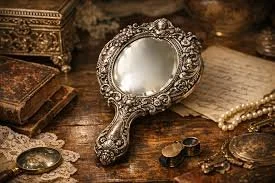
Hand-held mirrors have served practical and symbolic purposes throughout human history.
They allowed individuals to examine their appearance, arrange clothing, apply cosmetics, and participate in personal grooming practices. Yet mirrors could also communicate wealth, social identity, craftsmanship, and access to valuable materials.
Ancient mirrors were manufactured from polished metals, glass, and other reflective surfaces. Their archaeological distribution can reveal differences in consumption, trade, personal presentation, and burial customs.
Studying mirrors as status markers requires more than examining their material value. Their size, decoration, craftsmanship, ownership patterns, and archaeological context all contribute to interpretation.
Early Mirror Technology
Before modern glass mirrors became widespread, many ancient communities produced reflective surfaces by polishing metal.
Copper, bronze, and other metal alloys were commonly used in different regions.
A reflective surface required careful finishing to achieve sufficient smoothness.
Some mirrors had handles or decorated backs, while others were simple circular or oval plates.
The technical quality of the reflective surface could influence the object's usefulness and value.
Materials and Craftsmanship
The material used to manufacture a mirror could reveal access to particular resources and production techniques.
Bronze mirrors required knowledge of metal casting and surface finishing.
Silver examples could possess higher material value and often required more specialized craftsmanship.
Glass mirrors developed in different forms across ancient and historical periods.
Some objects were decorated with engraving, relief designs, inscriptions, or elaborate handles.
These features could increase the social and economic significance of an otherwise practical object.
Mirrors and Personal Appearance
Mirrors were associated with grooming and personal presentation.
They could be used when arranging hair, applying cosmetics, or checking clothing.
The ability to maintain a carefully presented appearance might be important in social settings where dress and bodily presentation communicated identity.
However, mirrors were not exclusively associated with women.
Their ownership and use varied according to period, region, and cultural practice.
Archaeologists should not assume the gender of a mirror's owner based on modern stereotypes.
Mirrors as Indicators of Wealth
Some mirrors were relatively simple objects that could be widely available.
Others required expensive materials, skilled production, or elaborate decoration.
A richly decorated mirror might indicate access to wealth or specialized markets.
Yet material value is only one aspect of status.
A modest object could possess considerable personal, religious, or symbolic importance.
The presence of a mirror in a wealthy burial does not automatically establish that it was a luxury possession during the owner's lifetime.
Mirrors in Burials
Mirrors are sometimes recovered from graves.
Their placement may provide information about funerary beliefs and personal identity.
A mirror might have been included as a personal possession, a symbolic object, or part of a larger set of burial offerings.
Researchers compare burial patterns across different social groups to investigate whether mirrors were associated with particular ages, genders, occupations, or status categories.
However, burial customs do not always reflect everyday ownership.
An object placed in a grave may have been selected specifically for the funerary ceremony.
Decoration and Symbolism
Mirror backs and handles could carry decorative images.
These might include geometric designs, plants, animals, mythological scenes, or religious symbols.
Such decoration could connect the owner with particular artistic traditions or cultural networks.
Motifs may also reveal influence from other regions.
However, a decorative style does not necessarily identify the ethnicity or social identity of the person who owned the mirror.
Objects could travel through trade, gifts, inheritance, and exchange.
Mirrors and Trade Networks
Mirrors could circulate through regional and long-distance markets.
Raw materials, finished objects, and manufacturing techniques moved between communities.
An imported mirror may indicate contact with a distant production center.
Chemical analysis can sometimes help identify the metal composition and compare it with known manufacturing traditions.
The distribution of mirror types may also reveal changing trade patterns and consumer preferences.
Identifying Mirrors Archaeologically
Ancient mirrors are not always immediately recognizable.
Corrosion can obscure their reflective surfaces.
Metal discs may be mistaken for lids, decorative fittings, or other household objects.
Researchers examine thickness, edge treatment, handle attachments, surface polishing, and traces of decoration.
Microscopic analysis may identify polishing marks and manufacturing techniques.
Conservation is essential because aggressive cleaning can remove surviving surface details.
The Limits of Status Interpretation
A mirror should not be classified as a status object solely because it is decorative or unusual.
Researchers must consider its archaeological context, material, quality, distribution, and relationship with other artifacts.
A common object may acquire special significance in a particular society, while an expensive object may have been accessible to a wider group through exchange or reuse.
Status is therefore a social interpretation rather than a property that can be read directly from an artifact.
Conclusion
Hand-held mirrors provide valuable evidence for personal presentation, craftsmanship, exchange, and social identity.
Their materials and decoration can reveal differences in wealth and access to specialized production, while their burial contexts may illuminate symbolic and funerary practices.
By studying mirrors alongside other personal objects and settlement evidence, archaeologists can better understand how appearance and material possessions contributed to social life in ancient communities.