Introduction
Color played an important role in medieval clothing, textiles, household goods, and decorative arts. Producing colored fabrics required knowledge of plants, insects, minerals, water, heat, and the chemical behavior of dyes. In many towns, dyeing was a specialized craft that connected farmers, collectors, merchants, textile producers, and consumers.
Small-scale dye workshops are particularly interesting because their remains may be less monumental than those of large industrial installations. They may leave traces in ordinary buildings, courtyards, drainage systems, storage areas, and waste deposits.
The archaeology of these workshops can help reconstruct craft production and urban economic life. However, identifying a dye workshop requires more than finding a colored residue or a container. Archaeologists must distinguish dyeing from other activities that used similar equipment or materials.
The Craft of Medieval Dyeing
Dyeing involves introducing color into a material, usually through a liquid preparation containing a colorant. Different dyes behave differently, and successful coloring may require careful control of temperature, concentration, timing, and the properties of the fabric.
Some colorants were obtained from plants, while others came from insects or mineral sources. Their availability varied by region, season, and trade network.
Dyers needed practical knowledge of how to prepare materials and achieve consistent results. Some techniques also required additional substances to help the dye bind to the fibers or change its final color.
The craft was therefore both technical and economic. A workshop had to manage raw materials, fuel, water, labor, and the quality of finished products.
Identifying a Workshop Archaeologically
A small dye workshop may not have a distinctive architectural form. It could occupy a room within a mixed-use building or share space with other crafts.
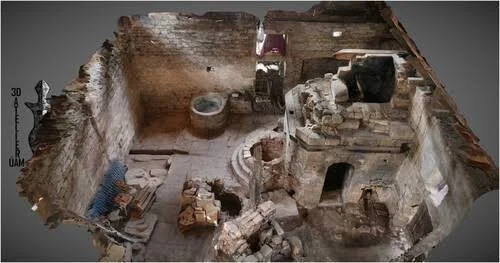
Potential evidence includes large containers, heating installations, drains, storage vessels, tools, chemical residues, and waste associated with dye preparation.
However, many of these features could also belong to cooking, brewing, metalworking, tanning, or other activities.
A strong identification requires a combination of evidence. Researchers must ask whether the arrangement of the space, the associated artifacts, and the residue chemistry fit a plausible dyeing process.
Containers, Heating, and Water
Dyeing often involves preparing liquids and immersing textiles or fibers. Containers may therefore be important parts of the workshop.
Heating installations could maintain the temperature required for particular processes, while water access and drainage would support repeated washing and preparation.
Yet a large vat is not automatically a dyeing vessel. Similar containers could be used for food production, fermentation, cleaning, or other crafts.
The interpretation depends on residue analysis, wear patterns, spatial organization, and comparisons with known workshop contexts.
Pigments, Dyes, and Residue Analysis
A dye is not the same as a pigment. Dyes generally color a material through chemical interaction or absorption, while pigments are usually particles that remain distributed on a surface or within a binding medium.
Archaeological workshops may contain evidence of both, depending on the crafts practiced there.
Chemical analysis can sometimes identify compounds associated with particular dye sources. However, residues may degrade, become contaminated, or lose diagnostic features over time.
A colored stain on a vessel could result from dye preparation, mineral deposits, corrosion, or another process. Researchers should not identify a specific dye source unless the analytical evidence supports it.
Raw Materials and Trade
Medieval dyeing depended on access to raw materials. Some colorants could be collected locally, while others required long-distance trade.
The cost and availability of a dye influenced the range of products a workshop could produce. A craftsperson might specialize in a particular color or use different materials according to customer demand.
Imported dye materials can reveal connections between urban workshops and wider commercial networks. Yet the presence of an imported substance does not necessarily mean the finished textiles were exported. The material may have been used for local production.
Researchers must distinguish the movement of raw materials from the movement of finished goods.
Water Quality and Workshop Location
Water is important in many textile processes. Its mineral composition can influence how dyes interact with fibers, while access to a reliable supply affects production capacity.
Workshops might be located near streams, wells, or drainage systems, although urban conditions and local regulations varied.
Wastewater disposal could create environmental problems if dye residues or other substances entered shared water sources. Medieval communities did not necessarily understand these effects in modern chemical terms, but practical experience may have influenced workshop placement and local rules.
Archaeological evidence can help investigate the relationship between craft production, water access, and waste management.
The Organization of Small Workshops
Not all dye production took place in large specialized facilities. Some work may have been carried out by individual craftspeople, households, or small groups within mixed-use urban buildings.
A small workshop could depend on relationships with weavers, merchants, and customers. The dyer might receive unfinished cloth, process it, and return it for further work.
This arrangement creates a network of interdependent crafts. Archaeological evidence from nearby weaving tools, textile fragments, storage areas, and commercial spaces may help reconstruct these relationships.
However, proximity alone does not prove that two workshops worked together. Documentary evidence, shared materials, or other connections may be needed to establish the relationship.
Craft Regulation and Urban Life
Medieval towns often developed rules governing trades, markets, property, and the use of shared resources. The degree of regulation varied by location and period.
Craft organizations could establish standards, control access to certain materials, or influence training and commercial practices. Yet not every dyer belonged to a formal guild, and the existence of specialized production does not automatically prove guild control.
Written records, where they survive, can complement archaeological evidence by identifying craftspeople, taxes, workshop locations, and disputes.
The combination of material and documentary evidence can provide a more detailed picture of how dyeing fitted into the town's economy.
Color, Clothing, and Social Distinction
Dyed textiles could communicate wealth, profession, group affiliation, or personal taste. Some colors and materials were more expensive or technically demanding than others.
However, color should not be treated as a universal indicator of social rank. The cost of a dyed garment depended on the fiber, dye source, labor, quality, and local market conditions.
Clothing could also be repaired, reused, and passed between individuals. The color of a surviving textile may have changed since its original use.
Archaeologists must therefore avoid assigning a fixed social meaning to a color without evidence from the specific historical context.
Waste and Environmental Evidence
Dye workshops could generate discarded plant matter, spent dye baths, broken containers, ash, and other waste. Such materials may accumulate in pits, drains, or nearby deposits.
Their distribution can help identify areas of repeated craft activity. Chemical traces in sediment may also indicate the handling of certain materials.
Yet waste can move after deposition, and urban deposits often contain materials from multiple activities. Researchers must determine whether the evidence is contemporary with the workshop and whether it originated there.
Reconstructing Workshop Production
A detailed reconstruction may combine artifact analysis, residue chemistry, spatial mapping, experimental work, and documentary research.
Experiments can test how particular dyes behave on different fibers and how their preparation might affect vessels or heating installations. These results can then be compared with archaeological traces.
However, modern experiments cannot reproduce every aspect of medieval production. Raw materials may differ, and ancient recipes may be incompletely understood.
The aim is not to invent a single definitive recipe for every workshop, but to identify the range of techniques consistent with the evidence.
Conclusion
The archaeology of small-scale dye workshops in medieval towns provides a valuable view of specialized craft production and urban economic relationships. Containers, heating features, drains, residues, and waste deposits may reveal how dyers prepared colorants and worked with textile producers.
Yet the identification of a workshop requires careful analysis because similar features occur in many crafts. Residue chemistry must be combined with spatial and archaeological context, while historical documents can help establish the social and commercial organization of production.
When these sources are considered together, small dye workshops can illuminate the connections between technical knowledge, raw-material supply, water management, trade, and clothing. They remind us that medieval towns were not simply centers of administration and commerce; they were also places where skilled craftspeople transformed natural resources into products that shaped everyday life and visual culture.