Introduction
Timber piers have helped people cross waterways, load boats, transport goods, and establish connections between land and water for thousands of years. In rivers, lakes, marshes, and coastal environments, wooden structures could provide access to boats and stabilize places where shorelines were soft or frequently flooded.
When these structures become submerged, they can preserve remarkable evidence of ancient engineering. Waterlogged wood sometimes survives for centuries or millennia because limited oxygen slows the activity of organisms that normally decompose timber. Yet underwater preservation also creates challenges: currents can move objects, sediments can bury structures, and changes in water chemistry can affect the condition of the wood.
Dating submerged timber piers is therefore more complicated than simply identifying old wood. Researchers must determine when the tree grew, when it was cut, when the timber was installed, and whether the structure was repaired or reused later.
Why Timber Piers Matter
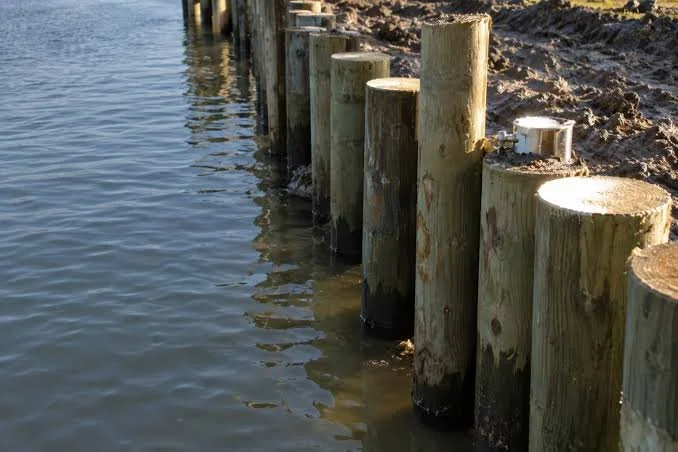
A pier creates a stable platform or landing point beside or above water. Depending on its design, it may consist of upright posts, horizontal beams, planks, stone supports, or a combination of materials.
Timber piers could serve fishing communities, agricultural settlements, trading centers, military installations, and towns with busy waterways. Their design depended on water depth, currents, seasonal flooding, the weight of expected loads, and the availability of suitable timber.
A simple structure may have been built for local access, while a larger installation could indicate sustained transportation or commercial activity. Nevertheless, size alone does not establish a pier's importance. A small landing could have served a strategically important crossing, while a large structure might have been temporary.
Why Waterlogged Wood Can Survive
Wood decomposes through the combined effects of microorganisms, oxygen, moisture, temperature, and physical disturbance. In waterlogged sediments with limited oxygen, some of these processes slow considerably.
This does not mean that submerged wood is automatically preserved. Certain bacteria and fungi can degrade timber even in wet environments, and wood may deteriorate rapidly when exposed to oxygen after excavation.
The surrounding sediment also matters. Fine-grained deposits can protect timber from currents and mechanical damage, while shifting sand may expose and erode a structure.
Understanding the preservation environment helps archaeologists decide how to sample, date, and conserve the wood.
Dendrochronology: Dating Through Tree Rings
One of the most valuable methods for dating timber is dendrochronology, the study of annual growth rings. Trees growing in seasonal climates often produce rings that reflect variations in temperature, rainfall, and growing conditions.
By comparing a timber sample's ring pattern with a regional reference chronology, researchers may establish when the tree grew. If the outermost ring and bark edge survive, the felling year may sometimes be determined with considerable precision.
However, not every timber can be dated this way. Some species produce unclear rings, and reference chronologies may not exist for every region or period. A sample with too few rings may also be difficult to match confidently.
The preservation of the outer rings is especially important. If the outer portion of the tree has been removed through shaping, decay, or later damage, the estimated felling date may be earlier than the actual date of construction.
Radiocarbon Dating
Radiocarbon dating measures the remaining radioactive carbon in once-living material. It can be useful when dendrochronology is not possible or when researchers need an independent chronological estimate.
The method generally produces a date range rather than a precise calendar year. Results must be calibrated against changes in atmospheric radiocarbon levels over time.
Timber introduces a particular complication known as the old-wood problem. A beam may have been cut from the inner part of a tree that had already grown for decades or centuries. The dated wood could therefore be much older than the pier itself.
For this reason, radiocarbon dating is strongest when researchers sample short-lived material or the youngest available wood from a securely understood context.
Dating the Construction Event
The age of a tree is not necessarily the age of a pier. Timber may have been stored, reused, or incorporated into a later structure.
Researchers must examine how individual pieces relate to one another. A row of posts may represent a single construction episode, or it may contain repairs made over many years.
Evidence such as overlapping joints, differences in tool marks, sediment layers, and the condition of the wood can help establish the sequence of construction.
Where several timbers can be dated independently, researchers can compare the results. A coherent set of felling dates may support a shared construction phase, while widely separated dates may indicate repair or reuse.
Sediment Stratigraphy and Associated Finds
Sediment surrounding a pier can help reconstruct when the structure was built, used, and abandoned. Researchers examine the order of deposits, the nature of the sediment, and the relationship between the timber and nearby artifacts.
Pottery, coins, tools, and other objects may provide chronological clues. However, objects can move through water or be redeposited, so an artifact found near a pier does not automatically date its construction.
A reliable interpretation depends on whether the object was deposited at the same time as the structure or entered the area later.
Sediment cores can also reveal changes in water depth, flooding, erosion, and shoreline position. These environmental changes may help explain why a pier became submerged.
Underwater Survey and Recording
Before excavation, researchers can use underwater photography, photogrammetry, sonar, and direct measurements to document the structure.
Photogrammetry creates a three-dimensional model from overlapping photographs. It can record the position of posts, beams, joints, and associated artifacts with considerable detail.
Survey data also help distinguish a coherent structure from scattered timber. Currents, storms, dredging, and boat traffic can move wooden objects away from their original positions.
Recording the structure before sampling is essential because excavation can disturb the very relationships needed to interpret its history.
Conservation After Recovery
Waterlogged timber can shrink, crack, and deform when it dries too quickly. During burial, water may occupy spaces within the wood that would otherwise contain air. Removing that water without appropriate treatment can cause the structure to collapse.
Conservation may involve controlled drying or other stabilization methods selected according to the condition and size of the timber.
Researchers should plan conservation before removing major wooden elements. Large structural timbers may be difficult to store or stabilize, and poorly planned excavation can result in the loss of information and material.
Conclusion
Submerged timber piers provide evidence of how communities adapted to waterways, built transportation infrastructure, and managed the challenges of working with wood in wet environments. Their dating requires more than a single scientific test.
Dendrochronology can sometimes identify a precise felling year, while radiocarbon dating, sediment analysis, associated finds, and construction relationships provide additional evidence. The key is distinguishing the age of the tree from the date when its timber entered the structure.
When these methods are combined, submerged piers can reveal not only when people built waterfront infrastructure but also how they maintained, repaired, and adapted it as waterways changed. These structures are valuable records of engineering and daily life, preserved in environments that can both protect and endanger archaeological evidence.