One of History’s Greatest Civilizational Crises
Around 1177 BCE, the ancient Mediterranean world experienced a dramatic collapse. Powerful civilizations that had dominated the region for centuries suddenly fell into decline or disappeared entirely.
This period marks the end of the Late Bronze Age and the beginning of a much darker and more fragmented era.
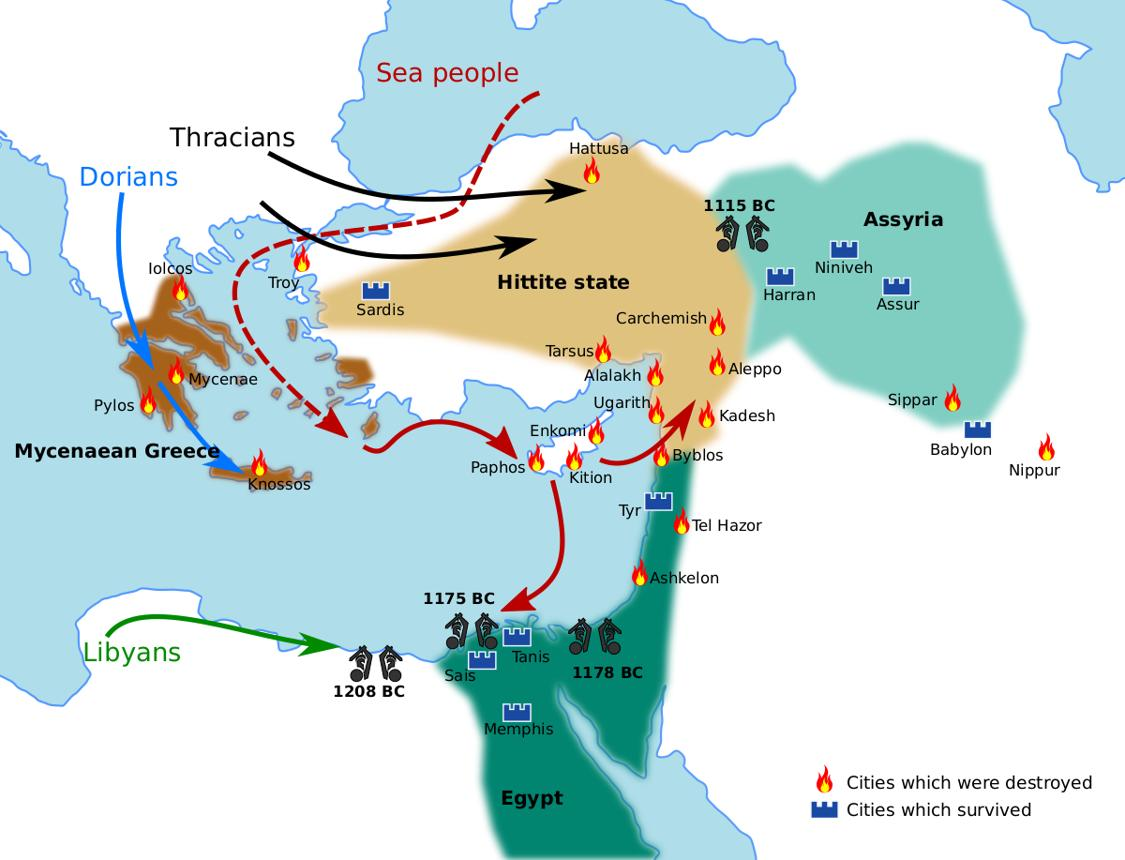
The Great Civilizations That Fell
The collapse affected several major powers, including:
The Mycenaean kingdoms of Greece
The Hittite Empire in Anatolia
The New Kingdom of Egypt (weakened but surviving)
Cities across the Levant
Many urban centers were destroyed, abandoned, or significantly reduced in population.
The Mystery of the Sea Peoples
Ancient Egyptian records describe mysterious invaders known as the “Sea Peoples.” These groups attacked coastal cities and disrupted trade networks.
Their exact identity remains uncertain, but they are believed to have been a combination of displaced populations, raiders, and migrating groups.
Climate, Collapse, and Crisis
Modern research suggests that the collapse was not caused by a single event, but by a combination of factors:
Climate change and prolonged drought
Earthquakes and natural disasters
Disruption of trade networks
Political instability
External invasions
Together, these pressures created a cascading system failure.
The Collapse of Trade Networks
The Bronze Age world was highly interconnected. Tin, copper, and luxury goods moved across vast distances.
When trade broke down:
Metal production declined
Armies weakened
Economies collapsed
Cities lost stability
Interdependence became vulnerability.
Written Records Go Silent
One of the most striking consequences of the collapse is the disappearance of written records in some regions. In Greece, for example, writing systems vanished for centuries, leading to what is sometimes called the “Greek Dark Ages.”
Survival and Adaptation
Not all societies collapsed completely. Some adapted, migrated, or reorganized into new political systems. The crisis reshaped the ancient world rather than simply ending it.
A Modern Warning
Historians often study the Bronze Age Collapse as a case study in systemic fragility. It shows how interconnected societies can be vulnerable to multiple simultaneous stresses.
Conclusion: Collapse as Transformation
The Bronze Age Collapse was not just an ending—it was a transformation. From its ruins eventually emerged the classical civilizations of Greece, Rome, and the wider Mediterranean world.
It remains one of history’s most powerful reminders that even great civilizations are not immune to change.