The Hopewell Culture: Ancient North American Geometric Earthworks
The Hopewell Culture is one of the most fascinating ancient societies in North America. Flourishing between 100 BCE and 500 CE, this culture is best known for its massive and precisely designed earthworks—geometric shapes built using soil, often on a monumental scale. These structures, found mainly in the Ohio River Valley, reveal advanced planning, social organization, and deep spiritual meaning.
1. Who Were the Hopewell People?
The Hopewell Culture was not a single tribe, but a network of communities.
Region: Centered in Ohio and surrounding areas.
Time Period: Around 100 BCE to 500 CE.
Shared Traditions: Connected by similar burial practices and artifacts.
Trade Network: Extended across much of North America.
Rather than a centralized empire, they were a cultural interaction sphere linking many groups.
2. The Geometric Earthworks
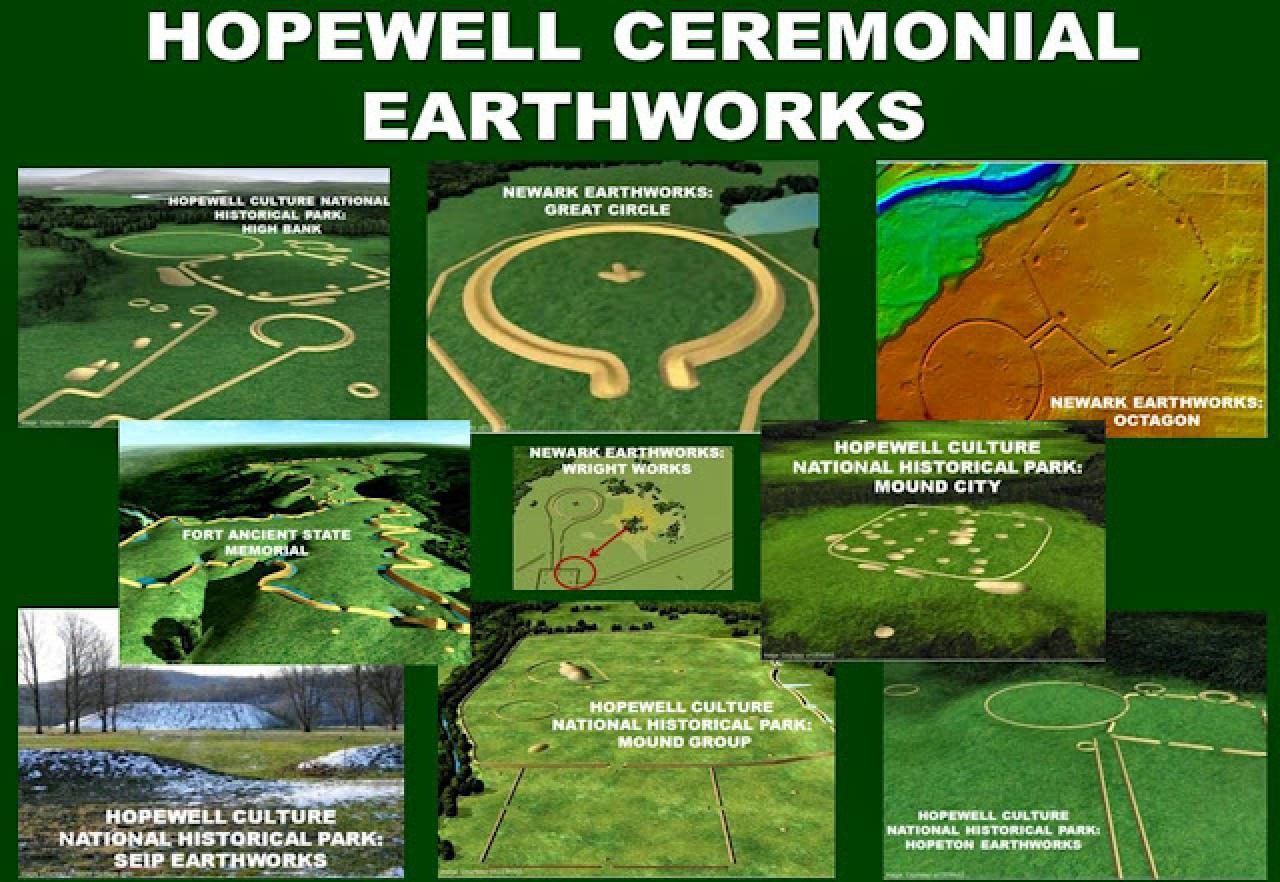
The most striking feature of Hopewell culture is their large earthworks.
Shapes: Circles, squares, octagons, and complex combinations.
Scale: Some cover hundreds of acres.
Precision: Alignments are remarkably accurate.
Famous Sites: The Newark Earthworks and Hopewell Culture National Historical Park.
These were built by moving tons of earth using simple tools—showing strong coordination and labor organization.
3. Purpose of the Earthworks
The exact purpose remains debated, but several theories exist.
Ceremonial Centers: Used for rituals and gatherings.
Astronomical Alignments: Some structures align with lunar and solar events.
Burial Sites: Certain mounds contain elaborate graves.
Social Spaces: Places for community interaction and trade.
Their design suggests both practical and symbolic functions.
4. Astronomical Knowledge
Some Hopewell earthworks show advanced understanding of the sky.
The octagon and circle at Newark are believed to align with the moon’s cycles:
Tlunar≈18.6 yearsT_{lunar} \approx 18.6 \text{ years}Tlunar≈18.6 years
This refers to the lunar standstill cycle.
Certain alignments match the moon’s extreme rising and setting points.
Suggests long-term observation and record-keeping.
This level of precision is comparable to other ancient astronomical sites worldwide.
5. Trade and Cultural Exchange
The Hopewell people were part of a vast trade network.
Obsidian: From the Rocky Mountains.
Copper: From the Great Lakes.
Shells: From the Gulf Coast.
Mica: From the Appalachian region.
These materials were used to create art, tools, and ceremonial objects, showing long-distance connections.
6. Art and Craftsmanship
Hopewell artisans created detailed and symbolic objects.
Intricate Carvings: Often depicting animals and human figures.
Ceremonial Items: Pipes, ornaments, and burial goods.
Symbolism: Reflects spiritual beliefs and social status.
Their craftsmanship highlights both artistic skill and cultural depth.
7. Decline of the Hopewell Culture
Around 500 CE, the Hopewell interaction network declined.
Possible Causes:
Environmental changes
Shifts in trade routes
Social transformation
No Clear Evidence of Conflict
Transition: Later cultures developed in the region
The reasons remain uncertain, adding to the mystery.
8. Historical Significance
The Hopewell Culture reshapes our understanding of ancient North America.
Complex Society: Demonstrates advanced planning and cooperation.
Scientific Knowledge: Evidence of astronomical observation.
Cultural Connectivity: Wide-reaching trade networks.
Indigenous Achievement: Built without modern technology.
Conclusion
The geometric earthworks of the Hopewell Culture are more than just mounds of earth—they are expressions of knowledge, belief, and community. They show that ancient North American societies were highly organized and intellectually sophisticated.