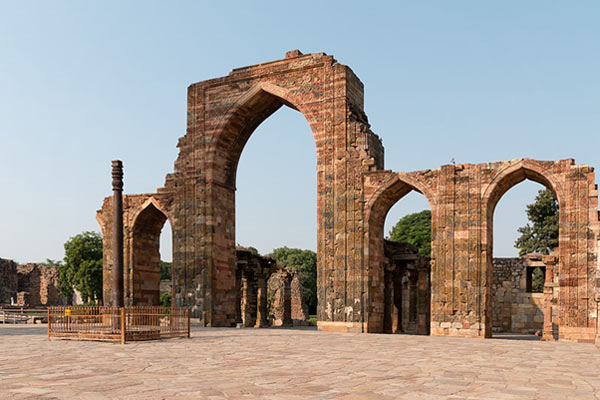
The Iron Pillar of Delhi, standing in the Qutb Complex, is a 7.2-meter tall testament to the advanced metallurgical skills of ancient India. Dating back to the Gupta Empire (c. 4th century CE), the pillar has fascinated scientists for decades because it has remained virtually rust-free for over 1,600 years, despite being exposed to the open air and monsoon rains of Delhi.
1. The Origin: A Monument to Victory
The pillar bears a Sanskrit inscription in Brahmi script, which attributes its construction to a king named Chandra (widely identified as Chandragupta II).
The Votive Monument: It was originally erected as a Vishnudhvaja (standard of Lord Vishnu) on a hill called Vishnupadagiri.
The Relocation: It wasn't originally in Delhi. Evidence suggests it was moved to its current location in the 11th century by the Tomar King Anangpal.
2. The Mystery of the "Non-Rusting" Iron
For years, people speculated that the pillar was made of a "lost" alien metal or a unique alloy. However, modern material science has revealed that the secret lies in the chemical composition and the specific manufacturing process used by ancient Indian smiths.
The Role of Phosphorus
Modern steelmaking typically removes phosphorus to prevent the metal from becoming brittle. However, the Delhi pillar contains a high concentration of phosphorus (up to 0.11%), which turned out to be its greatest defense.
The Protective Film: The phosphorus acts as a catalyst to form a thin, protective layer of misawite (an amorphous iron oxyhydroxide) on the surface of the pillar.
The "Passive" Layer: This layer, just a fraction of a millimeter thick, acts as a barrier that prevents oxygen and moisture from reaching the underlying iron, effectively "healing" itself if scratched.
3. Forge Welding: A Feat of Strength
The pillar was not cast in a single mold; it was constructed using a technique called forge welding.
Hammering It Out: Ancient smiths took smaller pieces of hot, pasty iron and hammered them together one by one.
Slag Inclusion: This manual process left tiny bits of "slag" (impurities) trapped inside the metal. While normally a flaw, these inclusions actually helped the phosphorus form the protective coating more evenly across the surface.
4. Environmental Factors
While the metallurgy is brilliant, the specific climate of Delhi has also played a supporting role.
High Humidity Cycles: The protective misawite layer requires cycles of wetting and drying to form properly. Delhi’s intense monsoons followed by extreme dry heat provide the perfect rhythm for this "protective skin" to strengthen over centuries.
Thermal Mass: Because the pillar is so massive, it does not cool down quickly at night, which prevents dew from forming on its surface—further reducing the risk of corrosion.
5. The "Human" Polish
There is a long-standing tradition of visitors attempting to wrap their arms around the pillar while standing with their backs to it (believed to bring good luck).
Natural Oils: For centuries, the lower portion of the pillar was inadvertently "maintained" by the oils and sweat from human hands, which added a supplementary layer of organic protection to the base. (The pillar is now protected by a fence to prevent erosion from this constant contact).
6. A Benchmark for Modern Science
The Iron Pillar of Delhi isn't just a historical curiosity; it is a case study in corrosion resistance. Modern engineers study its "passive film" to develop better ways to store nuclear waste and protect long-term infrastructure.
The pillar proves that the "Iron Age" in India reached a level of chemical sophistication that the West wouldn't match until the Industrial Revolution.