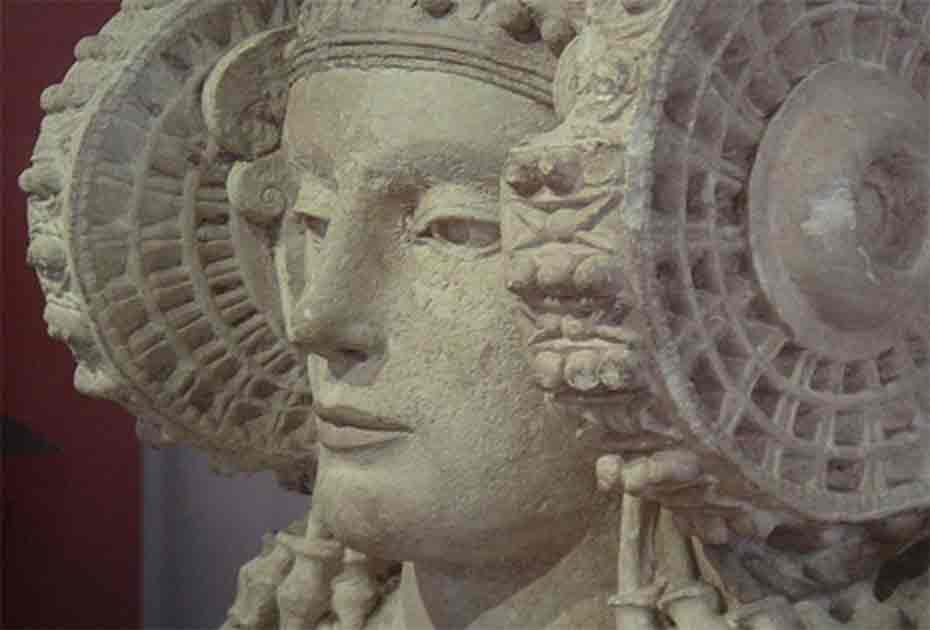
The Lady of Elche (La Dama de Elche) is one of the most famous and enigmatic archaeological finds in Spanish history. Discovered in 1897 at L’Alcúdia, near Elche, this polychrome stone bust represents the pinnacle of Iberian art from the 4th century BCE.
However, her journey from an archaeological discovery to a national icon has been fraught with debate, ranging from her true function to persistent (though largely debunked) theories that she is a modern forgery.
1. The Discovery and the "Exile"
The bust was found by a young farmworker, Manuel Campello Esclapez, while he was clearing land. Within weeks, it was purchased by a French archaeologist and taken to the Louvre in Paris, where it remained for over 40 years.
The Return: In 1941, during the Vichy regime in France, the bust was returned to Spain as part of a cultural exchange. She eventually found her permanent home in the National Archaeological Museum in Madrid, though residents of Elche have campaigned for her return to her place of discovery for decades.
2. Artistic Brilliance: The Iberian Esthetic
The bust is carved from porous limestone and originally featured vibrant colors—red on the lips and clothing, and blue and gold on the jewelry.
The "Rodetes": The most striking feature of the Lady is her massive, wheel-like headdresses (coiling hair or ornaments) on either side of her face. These "rodetes" were a distinct fashion among Iberian women of high status.
The Jewelry: She wears three necklaces with amphora-shaped pendants and a complex chest ornament. This "trousseau" of jewelry is highly detailed and matches archaeological finds of actual Iberian gold and silver work from that era.
3. The Function: Goddess, Priestess, or Urn?
For a long time, the Lady of Elche was viewed simply as a decorative bust. However, a closer look at her back changed the narrative.
The Cavity: There is a deep, circular hole in the back of the sculpture.
The Funerary Urn: Most archaeologists now believe the bust served as a funerary urn. It is likely that the cremated remains of an elite woman or perhaps a priestess were placed inside the cavity. This transforms the object from a portrait into a sacred vessel designed to bridge the gap between the living and the dead.
4. The "Fake" Controversy: The Case of John Moffitt
In 1995, art historian John Moffitt published a controversial theory arguing that the Lady of Elche was a 19th-century forgery.
The Arguments: Moffitt claimed the proportions were "too perfect," the carving was too crisp, and the "rodetes" were a romanticized 19th-century interpretation of ancient fashion. He suggested she was created by a local artist to capitalize on the archaeological craze of the late 1800s.
The Rebuttal: Scientific analysis has since effectively silenced these doubts. Pigment analysis and Scanning Electron Microscopy (SEM) of the stone’s surface revealed a natural "desert varnish" and ancient microscopic residues that would be impossible to replicate in a modern workshop. Furthermore, the discovery of the Lady of Guardamar in 1987—a similar but fragmented bust—confirmed the existence of this specific Iberian artistic tradition.
[Image comparing the Lady of Elche with the Lady of Guardamar]
5. The Cultural Impact: "La Dama" as an Icon
The Lady of Elche has become more than an artifact; she is a symbol of Iberian identity.
The Pre-Roman Past: For Spain, she represents a sophisticated, indigenous culture that thrived before the arrival of the Romans.
The Mystery of the Face: Her serene, stoic expression has led many to compare her to the "Mona Lisa of antiquity." The realism of her features—the slight asymmetry and the heavy eyelids—suggests she may have been a portrait of a real individual rather than a generic deity.
6. Current Research: Tracing the Pigments
Recent non-invasive studies using X-ray fluorescence (XRF) have allowed researchers to map the exact chemical composition of her original paint. This has revealed that the "Lady" was once a riot of color, wearing a bright red tunic and a blue mantle, which would have made her look remarkably lifelike in a candlelit tomb or temple.
The Lady of Elche remains a bridge to the "Silent Iberians." She represents a culture that didn't leave behind epic poems or vast histories, but instead communicated their status and beliefs through the sheer mastery of stone.