The Roman military’s success wasn't just built on the discipline of its legions, but on its status as a "technological superpower." Archaeology has revealed that Roman siege engines were marvels of precision engineering, utilizing principles of physics and mechanics that wouldn't be surpassed for over a millennium.
While the wooden frames of these machines have largely rotted away, archaeologists find the "fingerprints" of Roman warfare in the form of massive stone projectiles, iron bolt-heads, and the metal "washers" used in the torsion systems.
1. The Power of Torsion: The Onager
The most iconic Roman catapult was the Onager (named after the wild ass because of its "kick"). Unlike the medieval trebuchet which used a counterweight, the Onager relied on torsion.
The Torsion Springs: The heart of the machine was a massive bundle of twisted horsehair or animal sinew. An arm was inserted into this bundle and winched back; when released, the tension snapped the arm forward with immense force.
Archaeological Evidence: Excavations at Roman frontier forts often yield heavy iron plates and ratchet wheels used to hold these massive bundles under tension. We also find "ballista balls"—spherical stones carved to specific weights—at sites like Masada and Maiden Castle.
2. Precision Sniper Fire: The Ballista and Scorpio
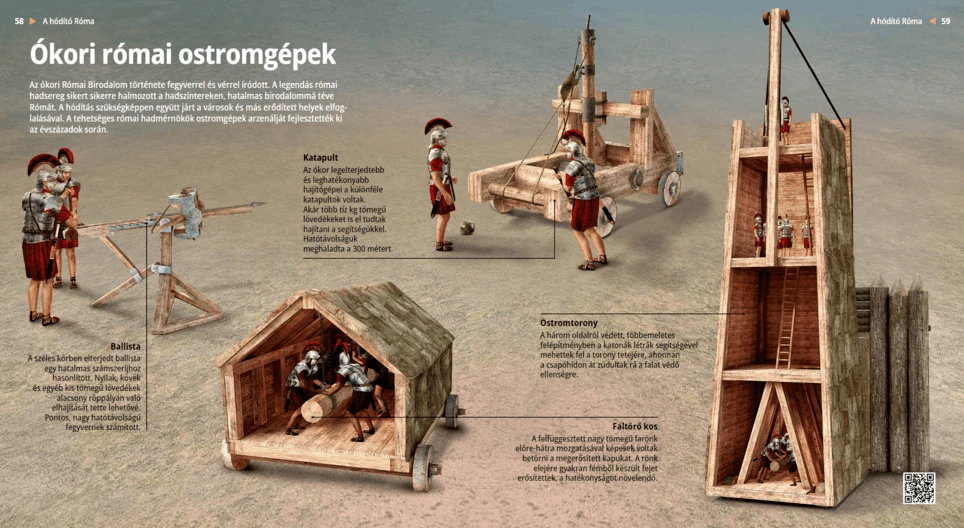
While the Onager was for smashing walls, the Ballista (and its smaller version, the Scorpio) was for anti-personnel precision. It functioned like a giant crossbow but powered by two vertical torsion springs.
The Scorpio’s Accuracy: Caesar noted that a Scorpio could hit a single soldier at incredible distances. In the siege of Avaricum, he described a Gallic defender being struck down by a bolt, only for another to take his place and be hit in the exact same spot.
The "Bolt" Finds: Thousands of pyramid-shaped iron bolt-heads have been recovered from battlefields. Metallurgical analysis shows they were hardened specifically to pierce the bronze or iron armor of the era.
3. The Helepolis: The Moving Fortress
When the Romans couldn't knock a wall down, they went over it. The Siege Tower (Helepolis) was a multi-story wooden skyscraper on wheels.
Engineering for Fire: Because they were made of wood, they were vulnerable to fire. Archaeology at sites like Masada shows evidence of raw hides being used to cover these structures, which were kept soaked in water to douse flaming arrows.
The Ramp of Masada: The most spectacular archaeological evidence of a Roman siege isn't a machine, but the Earthwork Ramp. In 73 CE, the Tenth Legion built a massive ramp of stone and earth to move a siege tower up the cliffs of the fortress. It is still visible today, a testament to Roman "brute force" engineering.
4. The Testudo and the Ram
To approach walls safely, Romans used the Testudo (Tortoise) formation, but they also built mechanical "tortoises"—sturdy, roofed sheds on wheels that protected soldiers as they operated a Battering Ram.
The Ram Head: Archaeologists have found massive bronze ram-heads shaped like rams or lions. These were designed not just to smash stone, but to "grip" the surface and prevent the ram from sliding off.
The "Bore": For thicker walls, they used a "Musculus" (Little Mouse), a specialized shed that protected soldiers while they used iron-tipped poles to pick away at the mortar between stones, literally hollowing out the wall from the bottom up.
5. The Logistics of War: Standardized Calibers
One of the most impressive "archaeological" insights into the Roman military is their standardization.
The Vitruvian Formula: The architect Vitruvius recorded the mathematical formulas used by Roman engineers. The size of every part of a catapult was determined by a single constant: the diameter of the hole in the torsion frame, which was calculated based on the weight of the projectile.
Universal Ammo: Because of this, a legion in Syria and a legion in Britain used the same caliber of stones and bolts. This allowed for a global supply chain of weaponry that was unprecedented in the ancient world.
6. The Durability of Iron and Stone
While the wood is gone, the impact is permanent. At the site of the Siege of Jerusalem (70 CE), archaeologists discovered over 400 ballista stones. Forensic analysis of the damage on the remaining wall sections shows the terrifying kinetic energy these machines possessed—some stones were fired with enough force to shatter the limestone blocks they struck.
The archaeology of Roman siege engines tells a story of a military that treated war as a mathematical problem to be solved with iron, stone, and tension.