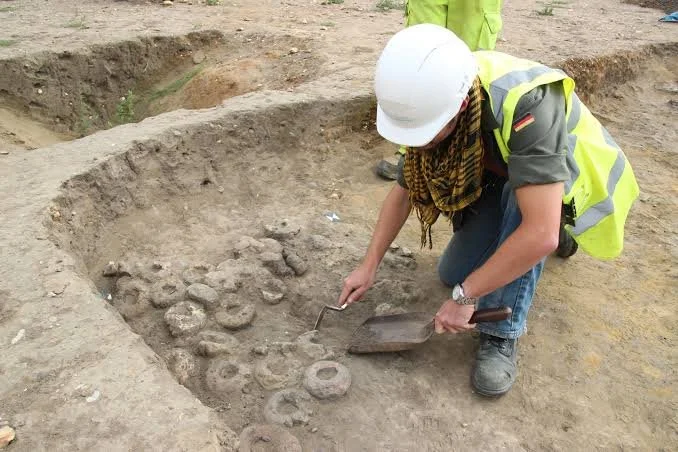
Textile production was an important part of everyday life in many ancient communities. Woven fabrics provided clothing, blankets, coverings, bags, and materials used in trade and domestic activities. Although textiles frequently decay in archaeological deposits, the tools and spaces associated with their production can survive. Loom weights, compacted floors, microscopic plant remains, and other traces may help researchers reconstruct where weaving took place and how craftspeople organized their work. The microarchaeology of weaving floors examines these small-scale remains to understand textile production beyond the finished objects themselves.
Microarchaeology focuses on evidence that may be too small to recognize through ordinary excavation. This includes microscopic fibers, plant fragments, mineral particles, residues, and subtle changes in the structure of soil. By examining these traces in their original context, researchers can investigate activities that took place within a room or working area. A floor that appears relatively ordinary during excavation may preserve evidence of repeated movement, equipment placement, cleaning, and the accumulation of production debris.
Loom weights are among the most recognizable artifacts associated with certain ancient weaving technologies. In a warp-weighted loom, vertical threads are held under tension by weights attached near their lower ends. These weights help maintain the alignment of the threads as the weaver passes horizontal threads through them. Loom weights were commonly made from clay or stone, although their form and material varied across cultures and periods. Their size, shape, mass, and arrangement can provide clues about the loom's construction and possible operating requirements.
The discovery of loom weights within a building does not automatically identify the exact location where weaving occurred. The weights may have been stored, discarded, reused, or moved after the loom was dismantled. In some cases, they may have entered a deposit during the collapse or rebuilding of a structure. Researchers therefore examine whether the weights form a coherent arrangement, whether their chronology matches the floor beneath them, and whether other evidence supports textile production in the same area.
A group of weights found in a line or concentrated near a wall may indicate the position of a loom, particularly if the pattern is consistent with the tensioning system of the relevant loom type. However, the original arrangement may be difficult to reconstruct if the building collapsed or the floor was disturbed. Archaeologists may use experimental reconstruction to compare different weight arrangements and determine which configurations are consistent with the surviving evidence.
Floors can also preserve traces of repeated activity. Walking, sitting, moving equipment, and placing heavy objects can compress soil in different ways. Microscopic examination may reveal compacted layers, fine particles, and localized deposits that differ from the surrounding surface. Yet these traces are not uniquely associated with weaving. Similar patterns can result from cooking, food processing, storage, or other household activities, so interpretation depends on the wider archaeological context.
Footprints are especially intriguing but require careful treatment. In favorable conditions, impressions left in soft clay, mud, or other materials may survive after the surface hardens or becomes buried. Such impressions can indicate where people stood or moved during a particular activity. If footprints occur near a suspected weaving installation, they may help researchers understand how the working area was arranged. However, footprints are rarely preserved on ordinary domestic floors, and their absence does not mean that people did not work in the space.
Microscopic botanical evidence can contribute to the reconstruction. Fibers from flax, wool, and other textile materials may leave residues, although the identification of specific fibers is often difficult after long burial. Plant fragments may indicate the preparation of raw materials, while animal hair or other organic traces may be consistent with textile work. These findings must be distinguished from materials introduced through bedding, clothing, food preparation, or natural environmental processes.
The organization of a weaving area may also be inferred from the relationship between tools and other household features. A space with loom weights, spindle whorls, fiber-processing tools, and suitable working room may have supported several stages of textile production. If the building also contains domestic installations, weaving may have occurred as part of household work rather than in a separate workshop. This arrangement would have allowed people to combine textile production with other responsibilities.
The scale of production is another important question. A small number of weaving tools may indicate occasional or household production, while repeated concentrations of equipment and production debris could suggest more intensive activity. Nevertheless, the number of surviving tools does not directly measure the amount of cloth produced. Looms could be dismantled and reused, and many components were made from wood or other materials that rarely survive.
Textile production also involved specialized knowledge. Weavers needed to understand thread tension, pattern formation, material properties, and the relationship between yarn thickness and fabric structure. These skills could be transmitted through observation and practice within households or communities. Archaeological evidence may reveal the tools and working spaces involved, while comparisons with surviving textiles and historical records can help reconstruct the technical traditions.
The microarchaeology of weaving floors demonstrates how small traces can reveal activities that are otherwise difficult to observe in the archaeological record. Loom weights, floor sediments, microscopic residues, and occasional impressions can help reconstruct the layout and use of textile-working spaces. When these findings are combined with architectural evidence and experimental studies, researchers can develop a clearer understanding of how ancient communities organized weaving and integrated textile production into daily life.