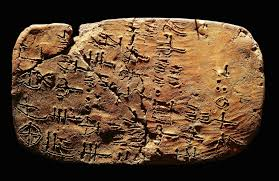
The Minoan Linear A script is the ultimate "holy grail" of historical linguistics. Used by the Bronze Age civilization of Crete (c. 1800–1450 BCE), it is a sophisticated system of writing that predates the earliest Greek scripts.
Despite over a century of research, it remains undeciphered. Unlike its successor, Linear B (which was revealed to be an early form of Greek), Linear A refuses to speak, hiding the secrets of a culture that built the palace of Knossos.
1. The Structure of the Script
Linear A is a syllabic script, meaning each sign represents a syllable (like "ma," "to," or "se"), supplemented by ideograms (symbols representing entire concepts like "wine," "wheat," or "olive oil").
The Numbers: We actually understand the Minoan mathematical system quite well. They used a decimal system and had symbols for fractions, showing a highly advanced bureaucratic culture.
The Direction: It was written from left to right, usually on clay tablets, stone libation tables, or jewelry.
2. Why Can’t We Read It?
Cracking an ancient code usually requires three things: a large body of text, a known "target" language, and a bilingual key (like the Rosetta Stone). Linear A lacks all three.
The Language Gap: This is the biggest hurdle. The language behind Linear A is known as "Minoan." It does not appear to be Indo-European or Semitic. It is a "language isolate," meaning it has no known relatives. Even if we could sound out the words, we wouldn't know what they mean.
The Corpus Problem: We have very little to work with. There are only about 1,500 known inscriptions of Linear A. For comparison, we have thousands of tablets in Linear B. This is simply not enough data for modern statistical or AI models to find meaningful patterns.
The Lack of a "Rosetta": We have never found a bilingual text where the same message is written in both Linear A and a known language like Egyptian Hieroglyphs or Akkadian.
3. The "Ghost" of Linear B
In the 1950s, Michael Ventris famously cracked Linear B, which was used by the Mycenaean Greeks who eventually took over Crete.
The Connection: Linear B borrowed many signs from Linear A. This allows us to "read" the sounds of some Linear A signs (a process called phonetic transfer).
The Dead End: When we apply the sounds of Linear B to Linear A, the words produced are gibberish. For example, the word for "total" in Linear B is to-so; in Linear A, the equivalent word is ku-ro. This confirms that while the alphabet is related, the language is entirely different.
[Image comparing Linear A and Linear B characters and structures]
4. What Do the Tablets Say?
Even without "reading" the sentences, the ideograms tell us about Minoan life.
Bureaucracy: Most Linear A tablets are economic accounts. They list quantities of agricultural products, livestock, and personnel. They show a "Palatial Economy" where the central palace collected and redistributed goods.
The "Libation Formula": Outside of the palaces, Linear A is found on stone vessels used for religious rituals. A specific sequence of signs (often starting with a-sa-sa-ra-me) appears repeatedly. This is believed to be a prayer or a name of a Minoan deity.
5. Failed Theories and Modern Hopes
Dozens of scholars have claimed to "crack" Linear A. Some tried to link it to Luvian (an Anatolian language), others to Sanskrit or Hebrew. None of these theories have stood up to rigorous linguistic testing.
AI and Machine Learning: Currently, researchers are using AI to compare Linear A's structure to every known language family. While AI is great at spotting patterns, it still struggles with the "small data" problem of the limited Minoan corpus.
6. The Historical Context: The Fall of the Minoans
Linear A disappeared around 1450 BCE, coinciding with the volcanic eruption of Thera (Santorini) or the subsequent Mycenaean invasion. The victors (the Mycenaeans) took the Minoan script, tweaked it to fit the Greek language, and created Linear B. In doing so, the original Minoan language was pushed into the shadows of history.
The silence of Linear A is a reminder that without a living connection to the past, even the most advanced civilizations can become "lost" to us, leaving behind only the voiceless scratches of their pens.