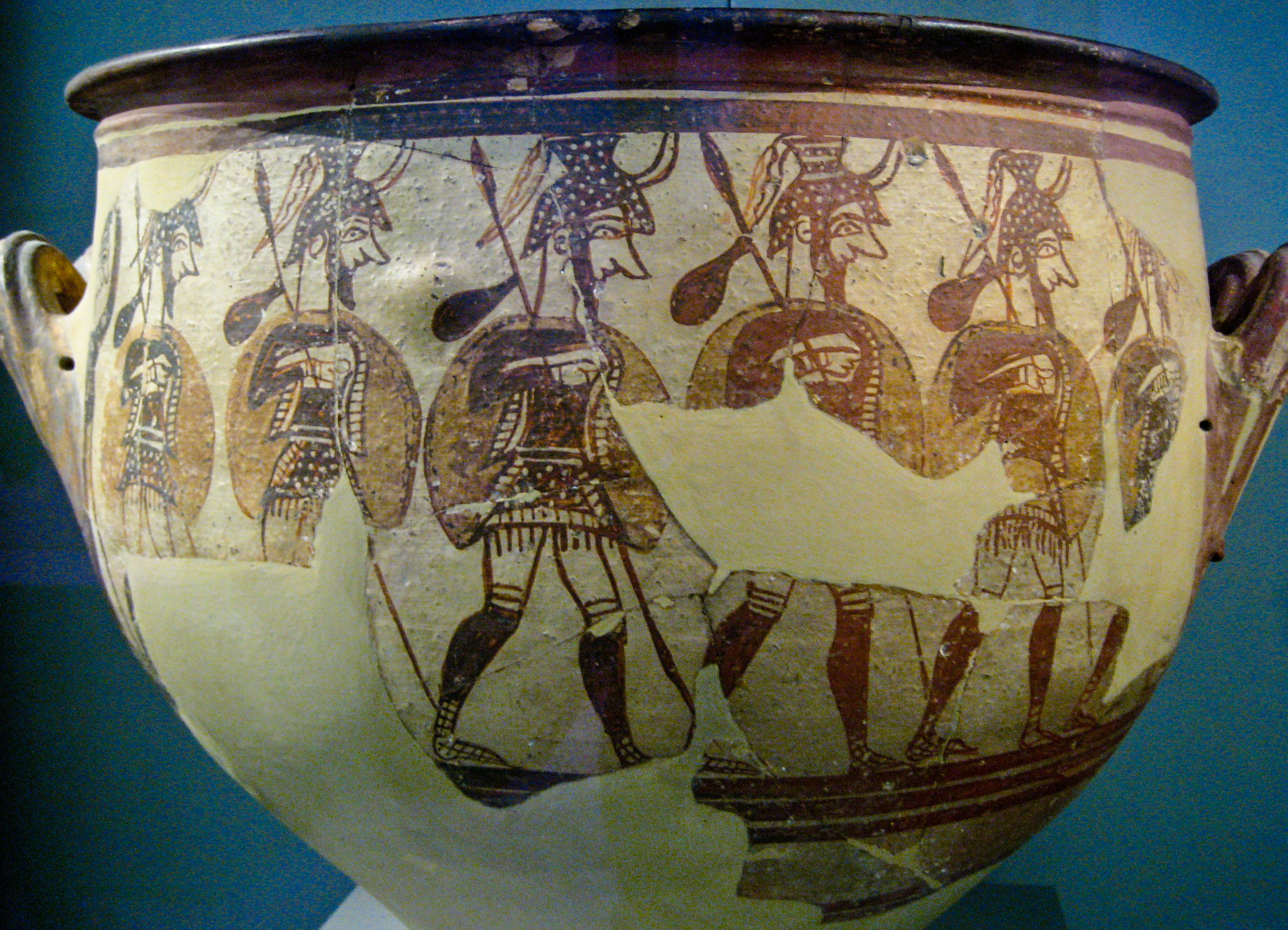
The Warrior Vase (or Warrior Krater) is arguably the most famous piece of Mycenaean pottery ever recovered, functioning not merely as a decorative vessel for mixing wine and water, but as a primary historical document. Discovered within the house of the "Warrior Grave" on the Acropolis of Mycenae in 1870, this vessel—dating to the transition between the LH IIIB and LH IIIC periods (roughly 1200 BCE)—offers an unparalleled visual inventory of the military state during the final, tumultuous decades of the Bronze Age.
I. The Aesthetics of a Shifting Era
The vessel represents a radical departure from the sophisticated, flowing, and naturalistic style that defined earlier Mycenaean pottery. During the height of the Mycenaean palaces, artwork was often ethereal, focusing on marine life or abstract, fluid patterns. The Warrior Vase, by contrast, is characterized by a "Pictorial Style" that is rigid, repetitive, and deeply schematic.
The figures are arranged in a solemn, rhythmic procession. The artist was not interested in perspective or anatomical realism; instead, they sought to communicate functional efficiency. Every soldier is identical in stature, gait, and equipment, underscoring the shift toward mass, disciplined infantry as the primary pillar of late Mycenaean power. This is the visual language of a society that was increasingly defined by the exigencies of defense and conflict.
II. The Infantry Panoply: An Archaeological Inventory
The vase serves as a "battle guide" for the Late Bronze Age, detailing the specific kit required of a professional soldier. Because of its clarity, it has been used by experimental archaeologists to reconstruct the realities of Mycenaean combat:
The Headgear (Helmets): The soldiers wear distinct, high-crested helmets adorned with what appear to be horns or cheek pieces. Some scholars interpret these as hedgehog-style headgear, likely reinforced with layers of leather or perhaps even rows of small, trimmed boar's tusks—an evolution of the iconic boar's tusk helmet seen in earlier, more heroic-age depictions.
The Defensive Layer (Body Armor): Each figure wears a short, fringed tunic. Beneath this, there is strong evidence for a breastplate—likely constructed of hardened leather or layered linen—to provide protection against the thrusting spears that were the primary weapons of the time. The addition of greaves (shin guards) suggests that these soldiers were trained to move on foot through rough, mountainous terrain, rather than relying exclusively on the chariot as a platform for battle.
The "Crescent" Shield: This is perhaps the most significant tactical detail. Earlier Mycenaean iconography favored the massive, unwieldy "tower shield" or the "figure-of-eight" shield. The soldiers on the vase carry smaller, circular, or "crescent" shields. This smaller footprint indicates a strategic shift toward a mobile infantry capable of intricate maneuvering, likely necessitated by the need to combat agile raiders or to operate in close-quarters skirmishing.
The Logistics of the Spear: The long, leaf-shaped spears are depicted with small, rounded bundles dangling from the shafts. These have been interpreted by historians as ration sacks or field-packs containing essential supplies. This detail humanizes the army, signaling a transition from the "heroic" combat of singular champions to a professionalized force that could sustain itself on long-distance marches across the Peloponnese.
III. The Cultural Narrative: Farewell and Resolve
The presence of a female figure on the far left of the procession, shown with her hand raised toward her forehead in a gesture of mourning or farewell, introduces a poignant human dimension. It suggests that this was not merely a stylized glorification of war, but a reflection of the profound societal anxiety that characterized the end of the 13th century BCE.
This was a time of "The Great Migration" and the collapse of neighboring civilizations (the Sea Peoples, the decline of the Hittite Empire). The Warrior Vase reflects this climate; it is a depiction of a society girding itself for an existential threat. The woman represents the home front, watching the men depart for a war from which they might not return, reinforcing the connection between the palace, the household, and the defense of the state.
IV. Legacy and Tactical Evolution
The Warrior Vase marks the beginning of the "Dark Ages" artistic tradition, where the focus shifted from the elite, palace-based culture to the community of the village and the warrior class. The transition from the massive chariot-based warfare—where a few aristocratic heroes decided the fate of cities—to a standardized infantry force represents a democratization of violence.
The vase confirms that by 1200 BCE, the Mycenaeans had abandoned the outdated, heavy gear of the earlier age in favor of a nimble, well-equipped, and highly disciplined infantry. It is the visual record of a military system in its final, frantic attempt to survive the crumbling of the Bronze Age world.