The Fishbourne Roman Palace, located near Chichester, West Sussex, represents perhaps the most significant window into the Romanization of Britain. Far from a mere provincial villa, this site is widely considered the largest residential structure of its kind north of the Alps, and its mosaic collection is a testament to the staggering wealth and political integration of the British client-kings within the broader Roman Empire.
I. Historical Context and Architectural Grandeur
Constructed around 75 CE, only a few decades after the initial Roman invasion of 43 CE, the palace serves as the ultimate symbol of the cultural shift in Britain. Most historians believe the palace was built for Tiberius Claudius Togidubnus, a local ruler who served as a loyal Roman ally. The sheer scale—covering roughly 10 acres—was designed to impress visitors and assert Roman authority, functioning as an administrative headquarters and a lavish royal residence that rivaled the architecture found in the heart of Rome itself.
The palace was structured in a sprawling, symmetrical "H" or quadrangle design centered around a massive formal garden. This garden, which has been meticulously reconstructed based on the original 1st-century planting trenches, is itself a marvel of Roman landscape architecture, incorporating sophisticated drainage and irrigation systems that allowed for imported Mediterranean plants to flourish in the British climate.
II. The Mosaics: A Masterclass in Opus Tessellatum
The mosaics at Fishbourne are globally renowned not only for their beauty but for their temporal sequence, allowing archaeologists to track the evolution of Roman decorative arts over several generations.
1st-Century Geometric Sophistication: The earliest floors, dating to the initial construction period, utilize a more restrained, monochromatic palette. These feature complex geometric patterns such as "guilloche" (braided bands), "swastika-meanders," and "labyrinthine" designs. These patterns required immense mathematical precision to ensure that the small, hand-cut stone cubes—known as tesserae—aligned perfectly across vast areas of flooring.
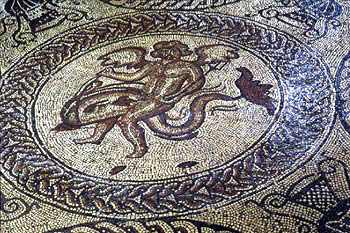
The Cupid on a Dolphin: This is the most famous example of the palace’s figurative art. Located in the north wing, this polychromatic masterpiece depicts Cupid, the god of love, riding a dolphin through a sea of patterned waves. It is a classic "Mediterranean" motif, suggesting that the owner of the villa was well-versed in the cultural currents of the wider Empire and wished to broadcast his status as a sophisticated, Romanized elite.
Technical Artistry: The mosaics are prime examples of opus tessellatum. To create these floors, craftsmen first laid a foundation of rubble, concrete, and lime plaster. As the plaster began to harden, they pressed thousands of tiny colored stones into the surface. The variety of colors—deep reds, ochres, vibrant blues, and chalky whites—was achieved by sourcing limestone, marble, and terracotta from across the British Isles and, in some cases, importing materials from the Continent.
III. The Architecture of Luxury: Hypocausts and Preservation
The mosaics were not just aesthetic choices; they were part of a high-tech domestic environment. Beneath many of the floors lies an extensive hypocaust system. This underfloor heating technology involved supporting the floors on stacks of ceramic tiles (pilae) and circulating hot air from external furnaces through the space below.
Why they survived: The palace was abandoned in the 3rd century, likely due to a fire. Unlike other Roman sites that were stripped of their valuable materials (like roof tiles and marble columns) for use in medieval construction, Fishbourne was left to fall into ruin and was gradually buried by silt and earth. This deep burial protected the mosaics from the elements and human scavengers for nearly 1,700 years until their accidental discovery by a construction crew in 1960.
Modern Preservation: Today, the mosaics are protected by a permanent conservation building that maintains a constant humidity and temperature. This is essential, as the ancient mortar—which has been exposed to the air for only a few decades—is incredibly fragile compared to the surrounding stone.
IV. Cultural Significance: "Power Dressing" in Architecture
The Fishbourne mosaics represent a deliberate act of "Power Dressing" on a monumental scale. By commissioning such expensive, complex, and quintessentially Roman floors, the residents were making a political statement. They were signaling that Britain was no longer a distant, "barbarian" periphery of the Empire, but a fully integrated province where Roman identity, luxury, and artistic mastery were the new standard.
The palace remains an unparalleled archaeological resource because it captures a moment of total cultural transformation. Every pattern and tile tells a story of an elite class desperate to prove their loyalty to Rome by mimicking the domestic life of the Roman aristocracy in Italy.