Introduction
Flint was an important raw material for many prehistoric communities because it can fracture in predictable ways and produce sharp cutting edges. People used flint to manufacture knives, scrapers, projectile points, and many other tools.
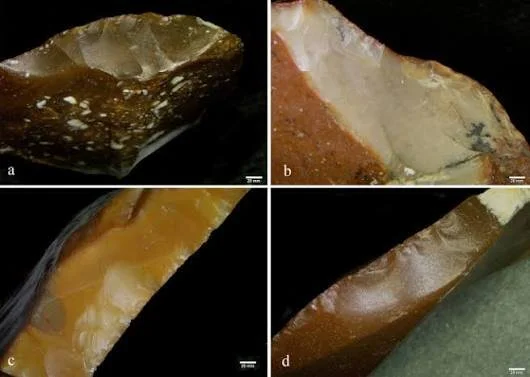
The title's reference to "healed stone tools" requires clarification. Stone does not heal in the biological sense. Instead, flint tools can develop wear, edge damage, repairs, and resharpening scars that alter their appearance through repeated use.
These changes create a life history for each tool. A flint artifact may have been manufactured, used, repaired, reshaped, transported, and eventually discarded. Archaeologists can study these stages to understand how people maintained tools and made decisions about valuable materials.
Why Flint Is Suitable for Toolmaking
Flint is a fine-grained form of silica-rich rock that can fracture conchoidally, producing curved surfaces and sharp edges. Skilled toolmakers can control the removal of flakes by striking the stone with a hammerstone or using other techniques.
The quality of flint varies. Some varieties fracture cleanly, while others contain inclusions or irregularities that make controlled shaping more difficult.
Access to good raw material could influence where people settled, traveled, and exchanged goods. In some regions, flint was obtained locally; elsewhere, communities transported it over considerable distances.
The Manufacturing Process
Stone tool production often begins with the selection of a suitable nodule. The toolmaker removes flakes to create a desired shape, then refines the edge through additional flaking.
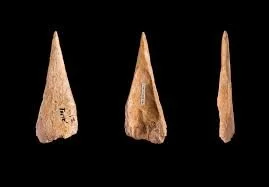
Different tools require different approaches. A projectile point may need a symmetrical shape and carefully prepared edges, while a scraper may be designed for repeated contact with hide or another material.
The production sequence leaves recognizable scars on the stone. Researchers can examine these scars to reconstruct how flakes were removed and whether the tool was modified after its initial manufacture.
Resharpening and Tool Maintenance
A sharp edge becomes dull through use. It may also develop chips or fractures.
Rather than discarding a tool immediately, its owner could remove small flakes to restore the edge. Repeated resharpening changes the tool's size and shape.
A tool that begins as a large flake may eventually become much smaller. Its final form may therefore look very different from the original design.
This process is important because archaeologists often classify tools by their final appearance. Without considering resharpening, they may mistakenly treat a modified tool as a separate type rather than a later stage in the life of the same object.
What Could "Healed" Mean?
The term "healed" can be used metaphorically to describe repaired or modified stone tools, but it should not be confused with biological healing.
A stone tool cannot regenerate missing material. Its owner can, however, reshape damaged edges, remove fractured sections, or alter its form to make it useful again.
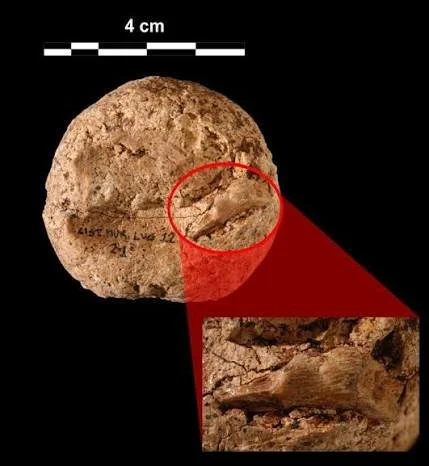
A tool may also acquire surface deposits after burial that partly obscure earlier damage. Such deposits do not indicate repair; they are part of the object's post-depositional history.
Researchers must distinguish manufacturing scars, use-wear, resharpening, and burial-related changes.
Reading a Tool's Life History
Archaeologists can investigate tool biographies through several methods.
Technological analysis: Studies how the tool was made and modified.
Use-wear analysis: Examines microscopic damage associated with contact with materials.
Residue analysis: Investigates surviving substances that may be associated with use.
Refitting: Attempts to reconnect flakes removed during manufacturing or resharpening.
Raw-material sourcing: Investigates where the flint may have originated.
Each method answers different questions. For example, a tool may show repeated edge modification, but its precise function may remain uncertain if wear patterns are poorly preserved.
The strongest interpretations combine several lines of evidence.
Flint and the Value of Raw Materials
The effort invested in a tool can depend on the availability of raw material, the skill required to manufacture it, and the importance of the task it performed.
When high-quality flint is scarce, people may be more likely to maintain and resharpen tools. Where suitable material is abundant, replacing a damaged tool may be easier.
However, tool maintenance is not determined by scarcity alone. A familiar tool may be retained because it is comfortable to use, has a specialized shape, or carries personal or social significance.
Archaeologists should therefore avoid assuming that every resharpened tool reflects poverty or a shortage of raw material.
Mobility and Portable Technology
Tools can travel with their owners. A flint artifact found far from its geological source may indicate movement, exchange, or the transport of raw material before manufacture.
A portable tool may be maintained across several journeys. Resharpening can reduce its size while extending its useful life.
The relationship between tool size, wear, and archaeological location may therefore help researchers investigate mobility.
However, the presence of imported flint does not prove that its user traveled to the source. The material may have passed through exchange networks.
Use-Wear and Functional Interpretation
Microscopic marks on a tool's edge can sometimes reveal how it contacted another material. Cutting plant fibers, scraping hide, working wood, and processing animal tissue can produce different wear patterns.
Yet these differences are not always clear. Tool edges can be damaged during manufacture, use, burial, or excavation.
Researchers must compare archaeological specimens with experimental tools used under controlled conditions. Even then, an exact function may remain uncertain.
A tool may also have served several purposes during its lifetime.
Discard, Recycling, and Archaeological Survival
Tools were discarded for many reasons. They might become too small to use, break beyond repair, or lose their usefulness as activities changed.
Some fragments could be recycled into new tools. Others might be used as cores from which additional flakes were removed.
The final deposit represents only the last known stage of the object's history. Earlier activities may be reconstructed from scars and residues, but they are not always preserved completely.
Post-depositional processes can further alter the artifact. Soil movement, trampling, water transport, and later human activity may change its location or surface condition.
Experimental Archaeology
Experimental archaeology can help researchers understand resharpening. Researchers manufacture tools using traditional techniques, use them for controlled tasks, and record how their edges change.
Comparing experimental specimens with archaeological artifacts can help identify plausible sequences of use and maintenance.
However, experiments cannot reproduce every aspect of prehistoric life. Modern users may have different skills, habits, and physical conditions from ancient toolmakers.
Experimental results are therefore most useful when combined with archaeological evidence rather than treated as exact replicas of past behavior.
Conclusion
The plasticity of flint tools lies in their ability to be reshaped, maintained, and reused. Their forms are not always fixed at the moment of manufacture. Repeated use and resharpening can transform an artifact, leaving evidence of changing needs, technical choices, and material management.
Although stone does not heal biologically, the idea of a tool's "healing" can serve as a metaphor for repair and continued use. Archaeologists can reconstruct parts of this process through technological analysis, use-wear, refitting, and raw-material studies.
By studying the full life history of flint tools rather than only their final shapes, researchers gain a richer understanding of prehistoric technology. A small stone artifact can reveal not just what a tool looked like, but how people maintained useful objects, responded to damage, and extended the value of materials across repeated activities.