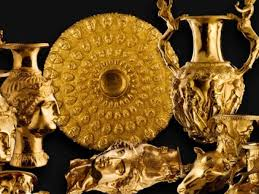
The Thracian gold treasures represent some of the most sophisticated metalwork of the ancient world. The Thracians, a group of Indo-European tribes who inhabited large parts of Southeast Europe (modern-day Bulgaria, Romania, and Northern Greece), were described by Herodotus as the most numerous people in the world after the Indians.
Though they lacked a written language, their "written history" exists in the spectacular gold and silver hoards buried in the tombs of their warrior-kings. These treasures were not mere ornaments; they were political instruments and ritual objects designed to project the semi-divine status of the Thracian elite.
1. The Panagyurishte Treasure: A Masterpiece of Hellenistic Art
Discovered in 1949 by three brothers digging for clay, this is perhaps the most famous Thracian hoard. Dating to the late 4th or early 3rd century BCE, it consists of nine solid gold vessels weighing over 6 kilograms.
The Rhytons: These are drinking vessels shaped like animal heads (stags, rams, and goats) or the foreparts of animals. They feature intricate relief scenes from Greek mythology, such as the Judgment of Paris.
The Amphora-Rhyton: The centerpiece is a large amphora with handles shaped like centaurs. The base has two holes for drinking, allowing two people to drink simultaneously—likely a symbol of a formal alliance or "blood brotherhood."
2. The Varna Necropolis: The Oldest Gold in the World
While the "classic" Thracian treasures date to the Iron Age, the roots of their gold-working tradition go back much further. In 1972, archaeologists in Varna, Bulgaria, discovered a cemetery dating to 4500–4200 BCE.
The Birth of Hierarchy: Grave 43 contained more gold than has been found in the rest of the world from that entire period combined. It belonged to a high-ranking male buried with a golden phallus, golden axes, and hundreds of gold beads.
Technical Sophistication: This find proved that a complex, stratified society with professional goldsmiths existed in the Balkans long before the rise of Mesopotamia or Egypt.
3. The Rogozen Hoard: A Royal Library in Silver
Discovered in a garden in 1985, this is the largest Thracian treasure ever found, consisting of 165 silver vessels, many of them heavily gilded.
Diplomatic Gifts: Many of the bowls bear inscriptions of the names of Thracian kings (like Kotys I) and the names of the craftsmen. These vessels were often gifted between tribes to cement peace treaties or celebrate marriages.
The Great Mother Goddess: The imagery frequently depicts the "Thracian Horseman" or the Great Mother Goddess riding a lion, emphasizing the unique local religious beliefs that blended with Greek influences.
4. The Gold Mask of Shipka
In 2004, a massive gold mask was discovered in the "Svetitsata" mound near Shipka. Unlike the thin foil masks found in Mycenae, this mask is made of solid gold and weighs 673 grams.
The Face of a King: The mask depicts a man with a thick beard and closed eyes. It is believed to be the funerary mask of King Teres I, the founder of the Odrysian Kingdom.
Ritual Decapitation: Interestingly, the mask was found alongside a body that had been "dismembered" according to Orphic ritual practices, suggesting the Thracian belief in the king's journey toward immortality.
5. The Art of the Goldsmith: Filigree and Granulation
Thracian jewelry displays a mastery of complex techniques that modern jewelers still find challenging.
Filigree: The use of delicate gold wires twisted into intricate patterns.
Granulation: A technique where tiny spheres of gold are soldered onto a surface to create texture and detail.
Chasing and Repoussé: Hammering the metal from the back (repoussé) or the front (chasing) to create three-dimensional scenes.
6. The Treasure of Valchitran
Dating to the late Bronze Age (1300 BCE), this hoard consists of 13 vessels, including a unique "triple vessel" connected by tubes.
The Ritual Use: Archaeologists believe these vessels were used in complex cult ceremonies. The triple vessel allowed three different liquids (perhaps milk, wine, and honey) to mix as they were poured, symbolizing the union of different divine or natural forces.
The Thracian gold treasures tell the story of a culture that sat at the crossroads of the East and the West. They were a people who loved horses, war, and wine, and who used the most precious material on earth to ensure their names would be remembered by the gods.